Archbishop Theophilos of Alexandria was the enemy of Archbishop John Chrysostom of Constantinople. Bishop Epiphanios of Salamis, an enemy of Origenism, was told by Archbishop Theophilos that Archbishop John was harboring Origenist fugitives. Epiphanios traveled to Constantinople and conspired to discredit John and cast doubts on his leadership, while John did his best to accommodate his elderly colleague from Cyprus, not knowing he had been duped by Theophilos. Their differences, however, were irreconcilable. In the end, each bishop wished a dubious fate for the other, both of which came true: Epiphanios died on his journey home, and John was deposed twice and died in exile.
The historians Sozomen and Socrates record this encounter and the mutual prophecies of doom, yet both reserve their judgments as to whether or not it was true. Nonetheless, rumor or not, the story stuck, and still the Church considers both to be preeminent Fathers of the Church. This being the case, the Church has always sought to reconcile them in various ways, besides adding both to the calendar of the Church for commemoration. It was considered the best way to do this was to depict them in icons next to each other, particularly in the sanctuary. Indeed, we find this in many old churches throughout Greece.
If the story is true, the fact of the matter is that Saint Epiphanios was clearly given false information about Saint John Chrysostom, and in his zeal to eradicate the heresy of Origenism from the Church, Epiphanios went after Chrysostom based on false pretenses fed to him.
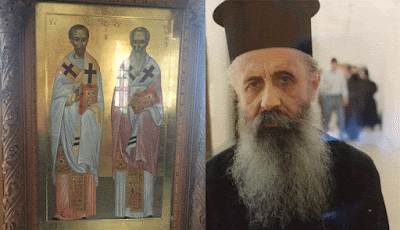
Elder Epiphanios Theodoropoulos (+ 1989), whose patron saint was Saint Epiphanios of Salamis, yet who also loved Saint John Chrysostom very much, lamented their dispute, and wanted to do something to reconcile them once and for all. This is why he commissioned an icon of the two Saints to be depicted together, and he went further to have them depicted next to each other in the sanctuary of the Church of the Zoodochos Pege among the holy hierarchs, lifting their hands in prayer to God unified.
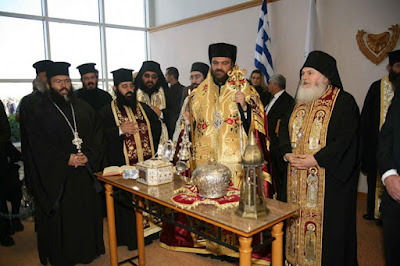
Another moment of reconciliation took place in 2007. That year Elder Ephraim, the abbot of Vatopaidi Monastery, brought the sacred head of Saint John Chrysostom to Cyprus to be venerated by the faithful. When he arrived at the airport in Larnaka, he was welcomed by Metropolitan Isaiah of Tamasos and Oreinis, who was holding the sacred head of Saint Epiphanios of Salamis. By this gesture, Saint Epiphanios received Saint John Chrysostom, a symbolic action which reveals the true character of the Saints.
Another moment of reconciliation took place in 2007. That year Elder Ephraim, the abbot of Vatopaidi Monastery, brought the sacred head of Saint John Chrysostom to Cyprus to be venerated by the faithful. When he arrived at the airport in Larnaka, he was welcomed by Metropolitan Isaiah of Tamasos and Oreinis, who was holding the sacred head of Saint Epiphanios of Salamis. By this gesture, Saint Epiphanios received Saint John Chrysostom, a symbolic action which reveals the true character of the Saints.