

 |
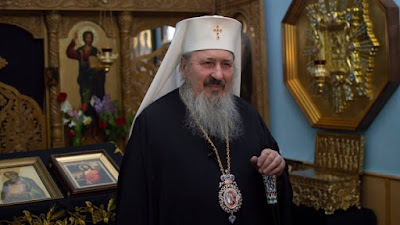
| Archbishop Petru of Bessarabia |
...continued from part nine.
* Let us proceed to some of their other movements, which show a purely political and secular sense of the mystery of the Church. They recently awarded Irinej of Bačka of the Serbian Patriarchate the title of Honorary Doctor at the Theological Academy of St. Petersburg. They have published numerous photographs on the internet, insisting in every way to influence the public opinion in Greece that they also have theological academies, which are accepted by the other Churches, and that they have something that measures a mature scientific theological education in their country.
* The bearers of the Muscovite ecclesiastical policy (from 1948 onwards, as the Metropolitan of Nafpaktos writes) do not hesitate to cooperate even with Catholic priests. Initially, the Minister of Foreign Affairs presented a distinguished Catholic theologian clergyman at the Theological Academy of Moscow as a distinguished scientist (until this point, I present no blame), and the next day at the Divine Liturgy he was received as a protopriest who co-liturgized with Orthodox clerics. In other words, they promote advanced practices in inter-Christian relations without fundamental barriers.
* In Moldova there is an Autonomous Church as proclaimed by the Russians, which is under the jurisdiction claimed by the Romanian Patriarchate. Bessarabia is a relative of the Romanians and not of the Russians. In response to the Russian expansionist stance, the Patriarch of Romania received a Russian bishop, a priest who had been deposed by the Russians, and sent him there as a liaison between Romania and Moldova (this is Petru of Bessarabia, a Russian in origin from where he began ecclesiastically, and after he was deposed by the Russians, he was taken in by the Romanians). There is a peculiar silence from Moscow about Bessarabia. This shows the motives of the hypothetical ecclesiastical reactions of Moscow (they are motives for political manipulations and claims, they are not motives for the truth of the canons of the ecclesiastical order).
Moreover, the whole attitude of the Romanian Church towards the Ukrainian Church is prohibited by the problem of the claim for Moldova. The Romanians are experienced in regards to Russian expansion, but now the compulsion of Communism no longer exists as a motive for communication, and they freely claim what belongs to them, while the Russian Church is under the control of the Kremlin. The Russians want it as their own as a political space and as an ecclesiastical region, while Romania considers it its own as a patriotic space and as an ecclesiastical territory.
This further shows that the Russian Church is spreading out globally, but to the extent permitted by other local Churches. And the whole attitude of several local Churches is prohibited primarily by motives of national deontology.
PART ELEVEN
* Let us proceed to some of their other movements, which show a purely political and secular sense of the mystery of the Church. They recently awarded Irinej of Bačka of the Serbian Patriarchate the title of Honorary Doctor at the Theological Academy of St. Petersburg. They have published numerous photographs on the internet, insisting in every way to influence the public opinion in Greece that they also have theological academies, which are accepted by the other Churches, and that they have something that measures a mature scientific theological education in their country.
* The bearers of the Muscovite ecclesiastical policy (from 1948 onwards, as the Metropolitan of Nafpaktos writes) do not hesitate to cooperate even with Catholic priests. Initially, the Minister of Foreign Affairs presented a distinguished Catholic theologian clergyman at the Theological Academy of Moscow as a distinguished scientist (until this point, I present no blame), and the next day at the Divine Liturgy he was received as a protopriest who co-liturgized with Orthodox clerics. In other words, they promote advanced practices in inter-Christian relations without fundamental barriers.
* In Moldova there is an Autonomous Church as proclaimed by the Russians, which is under the jurisdiction claimed by the Romanian Patriarchate. Bessarabia is a relative of the Romanians and not of the Russians. In response to the Russian expansionist stance, the Patriarch of Romania received a Russian bishop, a priest who had been deposed by the Russians, and sent him there as a liaison between Romania and Moldova (this is Petru of Bessarabia, a Russian in origin from where he began ecclesiastically, and after he was deposed by the Russians, he was taken in by the Romanians). There is a peculiar silence from Moscow about Bessarabia. This shows the motives of the hypothetical ecclesiastical reactions of Moscow (they are motives for political manipulations and claims, they are not motives for the truth of the canons of the ecclesiastical order).
Moreover, the whole attitude of the Romanian Church towards the Ukrainian Church is prohibited by the problem of the claim for Moldova. The Romanians are experienced in regards to Russian expansion, but now the compulsion of Communism no longer exists as a motive for communication, and they freely claim what belongs to them, while the Russian Church is under the control of the Kremlin. The Russians want it as their own as a political space and as an ecclesiastical region, while Romania considers it its own as a patriotic space and as an ecclesiastical territory.
This further shows that the Russian Church is spreading out globally, but to the extent permitted by other local Churches. And the whole attitude of several local Churches is prohibited primarily by motives of national deontology.
PART ELEVEN
