October 31, 2021
Discourse Two on the Parable of the Rich Man and Lazarus (St. John Chrysostom)
Reflection on the Fifth Sunday of Luke (St. Theophan the Recluse)
October 30, 2021
The Russian Churches on Blood
1. Church of Saint Demetrios on Blood in Uglich (17th century) - commemorates the murder of Tsarevich Demetrius
2. Church of the Saviour on Blood in St. Petersburg (19th century) - commemorates the murder of Alexander II of Russia
3. Church of All Saints, Yekaterinburg (21st century) - commemorates the murder of Nicholas II of Russia and his family
4. Church of the New Martyrs and Confessors of the Russian Orthodox Church a.k.a. Lubyanka Church on Blood (21st century) - commemorates the Gulag victims. It stands next to the infamous Lubyanka Building on the grounds of the Sretensky Monastery.
October 28, 2021
Homily One on the Holy Protection of the Most Holy Theotokos (St. Luke of Simferopol)
Homily on the Protection of the Most Holy Mother of God (St. Dimitri of Rostov)
October 27, 2021
Saint Nestor of Thessaloniki Resource Page
| St. Nestor the Martyr (Feast Day - October 27) |
Saint Nestor the Martyr
The Victorious Martyr of Christ Nestor is known to us from the life of Saint Demetrios. Thessaloniki is the place of origin of Saint Nestor.
The age at which he appears is young, in fact according to Saint Nikodemos the Hagiorite it was "when the hairs of the beard begin to grow", while Saint Damaskinos the Studite mentions he was "around twenty years old". Dionysios from Fourna says he was "young and without a beard" and Photios Kontoglou says he was "young without a mustache and just beginning to grow a beard". The teacher of the Gospel, Michael Galanos, identifies his form as beautiful: "He therefore bent his blonde and beautiful head and gave his last breathe with the striking of the sword, in order that he may ascend even more beautiful, to be with the ruler of life, the source of immortal beauty." Scholars of his life therefore determine his age and form as directly related to his story, since the hagiography and the iconography around his person coincide.
When Bulgarian Soldiers Tried to Steal the Relics of Saint Demetrius the New of Basarabov from the Cathedral of Bucharest During World War I
During World War I, on 17 February 1918, when Bucharest was occupied by the Germans, about 20 Bulgarian soldiers, allies of the Germans, broke down the entrance to the Cathedral of Saints Constantine and Helen and snatched the relic of the patron saint of Bucharest, Saint Demetrius the New of Basarabov, to transport it to their country. They hid it in a car and at night set off for the Danube River. But the Saint, not wanting to leave Romania, caused such confusion in the streets that the thieves could not find a way out, so they found themselves outside the Cathedral again. As soon as it dawned, they managed to find the public exit road, but on their way the car broke down several times and they were arrested by the German occupying forces. Thus the holy relic was returned to its place in the midst of a glorious reception by the Metropolitan himself and thousands of people.
October 26, 2021
Fr. Ioannis Aleiferis, a Holy Monk of Mount Sinai Known as a Fool for Christ, Has Reposed
Fr. Ioannis Aleiferis (+ 10/19/2021), who after a brief illness departed for the heavenly dwelling place, was a Sinaite monk of the God-trodden Monastery of Saint Katherine.
Hailing from the region of Neapolis (Vatika) in Lakonia, Fr. Ioannis joined the monastic brotherhood of Mount Sinai and served as an ecclesiarch for many years.
He was found worthy of the rare gift of foolishness for Christ, which he preserved as the apple of his eye, appearing to people as a supposedly real fool in the world and not for Christ.
Translation of the Relics of the Holy New Martyr George of Ioannina
"A deep emotion continues in my heart and fills my soul with awe and sacred fear, because the Most High has reserved for me this great honor, that I should at least search for him and that His unworthy servant should deposit the Sacred Relics from the grave to his household position."
"You have supported me, my children in the Lord, my dear ones, and you have strengthened me in the great dare, which I attempt, of the exhumation of our Patron Saint, through your fervent prayers."
Saint Demetrios and the Bitter Woman
Her son, Demetrios, however, soon fell ill and flew off to heaven. The blow to the mother was heavy. In such a short time she lost her husband and child.
The second may have been heavier and she could not overcome it. It was God's fault!
She had placed her last hopes and supplications in Him but what she asked of Him did not come true.
Testimony of a Man Who Spoke With Saint Demetrios and Was Healed By Him
The house was on the edge of the village.
I go in and the hostess tells me she was going to find witnesses.
In the meantime I ask the old woman if she wants to confess and she asks me:
"My child, are you of Christ?"
Saint Demetrios of Thessaloniki: Epistle and Gospel Reading
October 26
October 25, 2021
Testimony of a Miracle of the Panagia Prousiotissa During the Spanish Flu Pandemic of 1918
"In 1918 my wife Spyridoula had contracted a severe form of the flu. My friends who are doctors, Selimas and Sakkas, had assured me that my wife was in the last moments of her life. My wife's brother Nikos Panouklias, from Messolonghi, had arrived at my house that morning to see his sister for the last time. Everyone in my house was discussing the funeral. After a few hours, the sacred procession of the Holy Icon of Panagia Prousiotissa passed outside my house. My nearly-departed wife begged us to take her to the window, which we did. As soon as the sick woman saw the Icon and prayed, she fell asleep, but after an hour we noticed in amazement that the wreck of a human began to move, to come to life and after a few days to become completely well. My wife is still alive and in excellent health, thanks to the miracle of Panagia Prousiotissa."
Saint Tabitha the Merciful as a Model for our Lives
October 24, 2021
Reflection on the Sixth Sunday of Luke (St. Theophan the Recluse)
Myrrh Flows from the Icon of Saint George Karslides in Karpathos
@ekklisiaonline Μυρο αναβλύζει εικονα του Αγιου Γεωργιου στην Κάρπαθο#εκκλησια #γεωργιος ♬ πρωτότυπος ήχος - Εκκλησία Online
October 23, 2021
Homilies on Holiness and the Saints - The Holy Martyrs (Metr. Hierotheos of Nafpaktos)
By Metropolitan Hierotheos of Nafpaktos and Agiou Vlasiou
The word "martyr" refers to those people who testify, especially in the courts, because they heard and saw certain events that they are called upon to confirm.
This notion of the martyr is also transferred to ecclesiastical terminology and thus characterizes those who have been in their lives audible-witnesses and eyewitnesses of God, they saw and heard God and then were called to confess to this reality.
Is There A Liturgy of Saint James?
The Apostles performed the Mystery on the basis of what they had seen from Christ (Saint Sophronios of Jerusalem, P.G. 87:3982).
They "framed" it with their own personal eucharistic prayers. Peter had his, Andrew his, John his, James his, etc.
October 22, 2021
Explanations and Clarifications of Ecclesiastical History and the Deontology of the Ukrainian Issue (Part 9)
* Russianism is slowly "gnawing" at the historical course of Orthodoxy, by any means of communication. This is how the obsession with maintaining the "Minister of External Affairs" of the Russian Patriarchate is explained, something that began in the Stalinist period and today is entrenched.
* This is how the propaganda is explained in the Western world and in America, with publications in English that advertise the strange Pan-Slavic idea that Greek-speaking Orthodoxy has long since been extinguished as a language, and that Orthodox spirituality is expressed today by the Slavic language and especially in the Russian world. It is at least one wretched action (which fights against the mystery of the Incarnation and Pentecost and makes useless the last lines of the Creed). In these English-spoken publications of the foreign policy of the Russian side, Alexandros Papaderos gave a reply in English.
Homilies on Holiness and the Saints - The Fathers of the Church (Metr. Hierotheos of Nafpaktos)
By Metropolitan Hierotheos of Nafpaktos and Agiou Vlasiou
The word "fathers" is also known in everyday life, since it means those who give birth to children and are the head of every family. This word, conveyed in ecclesiastical life, signifies those Clergy who give birth to spiritual children in the life according to Christ and guide them to grow spiritually. The Apostle Paul, writing to the Corinthians, told them that even if they have many teachers according to Christ, they do not have many fathers, because their father was the one who gave birth to them with his teaching, which was the teaching of Christ: "For though you might have ten thousand teachers in Christ, yet you do not have many fathers; for in Christ Jesus I have begotten you through the gospel”(1 Cor. 4:15).
October 21, 2021
Saints Barnabas and Hilarion the Wonderworkers
The Life of Saint Hilarion the Great (St. Dimitri of Rostov)
The Life of Our Venerable Father
Hilarion the Great
By St. Dimitri of Rostov
October 20, 2021
Explanations and Clarifications of Ecclesiastical History and the Deontology of the Ukrainian Issue (Part 8)
* Regarding the deposing and excommunication of Filaret, these double convictions were imposed in excess of all canonical sensitivity. He did not violate matters of faith, but matters of order. Why then did they impose an excommunication? For the same canonical offense that they imposed his deposing, and (because Filaret insisted) they also imposed the excommunication. However, an excommunication is imposed on matters of faith, not on matters of canonical and moral deviance. How then did they impose double penalties for the differentiation of Filaret?
This is somehow aimed at the ecclesiastical fullness of 15,000,000 people who followed Filaret - bishops, clergy, monks and laity. It was done in order to force either him or his ecclesiastical faction to bow their necks, for reasons of pastorally fencing off the rest of the people of Ukraine, and for the exaltation of the splendor of Moscow. We have everywhere an authoritative rationale and practice, as I emphasize again and again. A rationale and practice of new Regulations in the ecclesiastical space, outside and above the Holy Synods of Orthodoxy. And they rest on the compulsorily granted autocephaly and patriarchal value of the 16th century, which they expand at their pleasure in extent and depth. We have something like a new Orthodoxy, as if the inter-patriarchal ancient Apostolic Orthodoxy had disappeared, and they are rebuilding a new structure and rational Orthodoxy. It is similar to a secular political change.
Saint Matrona of Chios Resource Page
The Veneration of Saint Matrona of Chios in the Islands of the Aegean
| Icon of St. Matrona with scenes from her life dating to 1933 and located in the church bearing her name in Ano Vathi, Samos. |
Thus, in Samos and Ikaria, the wonderworking Saint is especially honored and praised, since both Aegean islands neighbor Chios and are adorned with a total of ten sacred churches in her honor. The honor and veneration of Saint Matrona of Chios in Samos and Ikaria has a special interest and important historical extensions. After the fall of Constantinople in 1453, the people of Samos, following the Genoese, who had occupied the island, were forced to flee to Chios due to pirate raids. Thus in 1475 Samos submitted to the Turks and was abandoned for about a hundred years. The re-colonization of Samos took place in 1572 after the privileges granted to the island by Sultan Suleiman, and only a Christian population settled there. At this time the so-called Chiosamians, ie the people who had their origins in Samos but were living in Chios, returned to Samos and brought with them icons of Saint Matrona. In this way, her veneration and honor was established on the island and sacred churches were erected in her name in Ano Vathi, where an old miraculous icon of the Saint is kept, in Neo Karlovasi, where the churches was erected in 1845 and is decorated with a magnificent wooden iconostasis, in Mytilenious, where the reverence of the inhabitants towards the Saint is memorable, in Palaiochori Kampos Vourlioton, where the church is mentioned in a sigil of Patriarch Cyril from the year 1745 and is decorated with remarkable frescoes in folk style, and in Koumeika. Saint Matrona is also honored in Samos with an aisle named after her in the holy churches of Prophet Elias in Marathokampos, Saint Demetrios in Ydrousas and Saint Anna in Chora, while in several churches of the island there are portable icons of her (Saint Nicholas of Ormou Karlovakou, Saint Spyridon in Vatheos, Dormition of the Theotokos in Chora, Dormition of the Theotokos in Mytilenious, Transfiguration of Savior in Pythagoras). But also in Ikaria after the fall of Constantinople in 1453, the Giustiniani of Genoa and more specifically the family of the Aragians maintained the sovereignty of the island until 1481, paying the Turks a tribute. However, seeing the power of the Turks increasing threateningly, they left Ikaria and took with them the inhabitants of the island, taking refuge in Chios. Returning later to their island, the Ikarians established the veneration of Saint Matrona and built churches in her name in the villages of Perdiki (1887), Oxe, Maratho, Dafni and Vrakades.
The Church of Saint Matrona in Lythri of Asia Minor
October 18, 2021
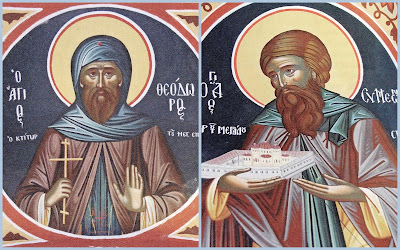
Saints Symeon and Theodore, Founders of the Monastery of Mega Spelaion
Withdrawing from Mount Athos they went to venerate in the Holy Land and at God-trodden Mount Sinai. They returned to Mount Athos but left again for Thessaloniki and Thessaly, preaching against the heresy of the iconoclasts. They settled on the mountain near Thermopylae, continuing their inner struggles and after a vision they went to the Great Cave (Mega Spelaion) near Kalavryta in the Peloponnese. There they met with the shepherdess Saint Euphrosyne and after finding the miraculous icon of the Theotokos, they built a monastery.
Why You Should Never Trust A Quote Unless You Can Authenticate It
This morning I came across such an example. I read a lovely quote in Greek about a kneeling camel as an image of a person in prayer, and the source for that quote was an Elder Gabriel of Mount Athos. I said to myself that I would like to translate this quote and share it, but I knew I needed to find the source. There are many Elder Gabriels from Mount Athos, so which is it and from where did this quote come from? Now if I didn't ask this question, I wouldn't have discovered the truth.
October 17, 2021
Homily One on the Fourth Sunday of Luke (St. John of Kronstadt)
Fourth Sunday of Luke
By St. John of Kronstadt
Pitiful man! Poor man! How many obstacles he has in this most important matter, that of saving his soul! In that he himself treads upon the saving seed of the word of God, which can make him wise unto salvation, treading upon it either intentionally, consciously, and sneeringly, or out of frivolity, neglect, and ignorance; in that the universal malefactor and blighter of the human race, the devil, snatches away the saving word; in that his hardened and obdurate heart does not permit him to be saved; in that thorns – or the various cares, passions, and pleasures of life, along with riches – set before him insurmountable barriers to salvation. Only a few, who with honest and goods hearts and true reason value their salvation as they should, patiently making use of the means for salvation that have been given us, are saved. Many are called, but few are chosen. Astonishing! What is ultimately happening here? Who is to blame for this absurdity, for this voluntary perdition of men? Man himself is to blame, for treading upon – and often learning to tread upon daily – the wondrous, great, and countless gifts of God. The Lord God, Who created him in His image and likeness, in righteousness and holiness, granted him every opportunity, every means and strength, for life and piety. Man, in his laziness and ignorance, his negligence and obstinancy, his unreasonable predilection for the here and now, is like a shadow passing through life, rushing headlong towards perdition while pushing aside the saving hand of God. Who is to blame for this perdition, if not man himself? You will say: it is impossible, or at least difficult, to be saved! But, in fact, countless multitudes of men like you have been saved; they are even now being saved, though not many. “Being saved is difficult!” But do you really want to obtain eternal life – in blessed union with God, the Mother of God, the Angels, and all the Saints – without labor? Without the labor of self-purification, assisted by grace, without the labor of prayer and vigilance, without almsgiving, without meekness, without humility, without abstinence? In the acquisition of earthly goods we do not judge labor to be superfluous, and we often work at this with all our strength; but when it comes to obtaining eternal blessedness, we throw up our hands. It is not as though the matter of salvation were extremely difficult: “For My yoke is easy, and My burden is light,” says the Saviour (Matthew 11:30). Yes, with God’s help it gradually becomes easy, though at first it is hampered by the persistent warfare with sin. But is not sin itself a matter of extreme difficulty, since it is unnatural and alien to our divine nature? Is sin not torturous? If we labor in sin, how then can we not labor in righteousness, in saving our soul from sin? There, the end is death; but here, eternal life. “For the wages of sin is death; but the gift of God is eternal life” (Romans 6:23).
Reflection on the Fourth Sunday of Luke (St. Theophan the Recluse)
Gospel Reading - Luke 8:5-15
By St. Theophan the Recluse
October 14, 2021
Homilies on Holiness and the Saints - The Evangelists (Metr. Hierotheos of Nafpaktos)
The word Gospel in Greek is Evangelio and consists of two words "ev" and "angelia" and signifies "good news", "good information". The Evangelists, therefore, transmitted in writing the news that the Son and Word of God incarnated, taught, died, was crucified, resurrected, ascended, and will come again to judge people.
Explanations and Clarifications of Ecclesiastical History and the Deontology of the Ukrainian Issue (Part 7)
* As is confessed by the Bishops of the Patriarchate of Alexandria (Nikephoros of Kinshasa), the Russians in various African countries are seeking the right of Russian priests to liturgize in the Russian Embassies of Africa. This is a stark demonstration of unbridled hegemonism and expansionism. They achieved the authorization of the Patriarch of Alexandria for a few countries of Africa, something like exarchies, and now they want to expand more, something like a Super-Patriarchate!
It seems that they succeeded in Cyprus, with the authorization of the Church of Cyprus, they spread even into occupied Cyprus, even though they solemnly lie and deny any connection with some Russian missions of clergy to the land of occupied Cyprus. However, they also have a relationship and they promote the action of such groups on Cypriot soil.
October 13, 2021
Homilies on Holiness and the Saints - The Apostles (Metr. Hierotheos of Nafpaktos)
The word apostle comes from the verb "send" and denotes one who is sent by someone to fulfill a mission.
October 12, 2021
Words of Complete Immortality: Saint Symeon the New Theologian (Photios Kontoglou)
I would have written today on another subject, which is not religious. But I received many letters and phone calls from readers of "Eleutheria" expressing their strong desire to read more about the Orthodox Fathers and their books, because they find no such spiritual food anywhere. Well, I changed my purpose and I will write about Saint Symeon the New Theologian.
Truly, unaware are those who have not tasted from this immortal fountain, I mean the words of the Holy Fathers, which many consider to be priestly chatter.
The discourses of Saint Symeon the New Theologian are read in Europe today more than any other patristic book, from what has been translated into foreign languages, as I wrote a few days ago. This saint has a certain grace to touch the most elusive and deepest mysteries of religion. It is as if he is pointing it out to you, the blessed one, with his finger, because he was found worthy to live in the inexpressible Light of Christ, being still in the body.
"O My Sanctified Athens" (Elder Eumenios Saridakis)
"How beautiful Athens is!
Blessed Athens!
O my sanctified Athens!
O very noisy wilderness of Athens!
Saint Epiktetos the Wonderworker
October 11, 2021
Homilies on Holiness and the Saints - The Prophets (Metr. Hierotheos of Nafpaktos)
Among the saints are the Prophets, who lived in the Old Testament and led the people according the command of God. Such Prophets were Isaiah, Jeremiah, Daniel, Elijah, Samuel, Moses, etc.
The word Prophet comes from two words "pro" and "fanai", and denotes the one who predicts and reveals the future, but also teaches at the same time. God reveals His will to the specific Prophet, who said: "Speak Lord, for your servant hears" and then this man conveyed God's will and command to the people, saying: "Thus saith the Lord". "Thus saith the Lord" and "Speak Lord" are what denotes the work of the Prophet. Because the Prophets saw God, the pre-incarnate Word, that is why the people called them, as it appears in the life of the Prophet Samuel, "seers" and "visionaries".
Explanations and Clarifications of Ecclesiastical History and the Deontology of the Ukrainian Issue (Part 6)
I will now dwell on some other historical facts, in order to give rest, or rather strain, to your frustration.
* The Ukrainian titular patriarch Filaret (who co-ordained Kirill), who was a fellow candidate for Patriarch with the late Patriarch Alexy, was punished two or three times by the religious policies of the Russian Patriarchate, which serves the Russian Federation policies. Regardless of the much-publicized Russian "other", primarily and mainly the dynastic political-religious criteria prevailed.
On the other hand, if such a prominent executive hierarch proved - always against the Russians - to be so prone to an obsession with power, surely this is taken into account in the origin/quality of his ordination, in the origin/quality of his theology, the origin/quality of the beginning of his ecclesiastical rise, the origin/quality of his piety: by the Russian Patriarchate, the Patriarchate that "dominates the clergy" from within and is attempting to fearlessly export its merchandise of religious authoritarian goods in Ukraine and in so many arbitrary autocephalies and autonomies and finally in all of Orthodoxy.
Synaxis of the Venerable Fathers of Optina Monastery
The monastery, well-known since the sixteenth century, had fallen into ruin as a result of the anti-monastic laws of Catherine II. Towards the end of the eighteenth century, Metropolitan Platon of Moscow, impressed by the beauty of its location, gave Abbot Abraham of Pechnocha the task of restoring the monastic buildings and of reviving cenobitic life at Optina in the spiritual tradition promoted by Saint Paisius.
October 10, 2021
Sermon on the Healing of the Son of the Widow from Nain (St. Cyril of Alexandria)
"And it came to pass the day after, He was going to a city called Nain, and His disciples were going with Him" (Luke 7:11).
Homily on the Third Sunday of Luke (Archpriest Rodion Putyatin)
"As he approached the town gate, a dead person was being carried out — the only son of his mother, and she was a widow" (Luke 7:12).
October 9, 2021
Reflection on the Third Sunday of Luke (St. Theophan the Recluse)
Third Sunday of Luke
(Luke 7:11-16)
Explanations and Clarifications of Ecclesiastical History and the Deontology of the Ukrainian Issue (Part 5)
[Examples of Some Newer Errors]
* In the vast Russian Federation, in Ukraine, in Moldova, in Belarus, in the Russian parishes of the Diaspora, in every place where an "altar of Russian worship" to God (sic!) is erected, it is mandatory for the name of the Russian Patriarch to be commemorated first and then the local Hierarch! We thus have a demise of Eucharistic theology, of Orthodox liturgical theology, of the unity of the ecclesiological and the Synodical-Hierarchical sacredness of the Church. Even in the mystery of the eucharist of God, the Patriarch of Moscow is projected as a national and world ruler, something like an absolute Pope. With such practices, which are recorded in a customary way in their subconscious, how can our diplomatic friends not be taken by Russian ecclesiology?
Homilies on Holiness and the Saints - The Holy Trinitarian God (Metr. Hierotheos of Nafpaktos)
According to Photios the Great, the Greek word for Holy or Saint, Agios, comes from the negation "A" and the word "gi" which means "earth", therefore Agios means "one who is beyond the earth", that is, "one who is above the earth". And of course this primarily refers to God. Others claim that the word Agios comes from the negation "A" and the word "agos" (with smoothe breathing), but because the two "A's" are contracted and made one they create the word Agios which means "one who is free from defilement". However, Saint Nikodemos with the above interpretations also gives us his own opinion, according to which the word Agios comes from the word "agos" (with rough breathing) and signifies "the worthy and the revered and the pure".
October 8, 2021
Explanations and Clarifications of Ecclesiastical History and the Deontology of the Ukrainian Issue (Part 4)
[5th Great Historical Error]
Within the Russian hegemony (politically justified, but ecclesiastically problematic and theologically ill) stands the ecclesiastical question of Ukraine. The Ukrainian issue has many roots, but it is treated by Russia as their own field of action.
The Russians, who have caused so many autocephalies, have for many decades refused to take such a step in Ukraine (albeit anti-canonically). This is because they want besides vast Ukraine also neighboring Moldova and beyond this Abkhazia and Ossetia as an ecclesiastical space of power, because they ultimately serve political plans, the Russian policy of expansion, the Great Russian Idea.
For more than fifteen years, the Mystagogy Resource Center has been a labor of love dedicated to making the riches of the Orthodox Christian tradition freely available to people throughout the world.
Thousands of articles, translations, lives of saints, theological reflections, historical resources, and daily materials have been published across this ministry’s websites, all offered free of charge for anyone seeking a deeper understanding of the Orthodox faith.
This is a one-man ministry that requires countless hours of research, translation, writing, editing, and maintenance each day.
If this work has spiritually benefited, educated, encouraged, or inspired you in any way, I humbly ask you to consider supporting this ministry financially.
Generous annual and monthly benefactors make possible the continuation and expansion of this work for the future, for without such support this ministry cannot exist.
Every contribution, whether large or small, truly makes a difference and is deeply appreciated. May God bless you abundantly for your generosity and prayers.