Showing posts with label Monk Moses the Athonite. Show all posts

Saint Nikanor of Hilandar (+ 1990)

St. Nikanor of Hilandar (Feast Day - March 4)

By Monk Moses the Athonite

The late Elder Nikanor was born in Divci, near Valjevo of Serbia, on August 13, 1903 to pious and simple parents. From a young age he had the zeal of the early Christians. In the world he was known as Nikola Savic.

He came to the Sacred Monastery of Hilandar, which was founded by his compatriots and in which many live until today, on August 17, 1927. There he was tonsured a monk on September 15, 1929. He was elected abbot of the monastery of his repentance, which he fervently loved and tirelessly served, on December 31, 1941. In 1963 he was the First Administrator of the Holy Mountain, and for several years a commissioner and representative of his monastery in the Sacred Community. He also worked in the vineyards and the chestnut groves of the monastery.

Saint George Karslides and his Wondrous Meeting With the Three Hierarchs

 By Monk Moses the Athonite

When Saint George Karslides was a young child, he met in a wondrous vision the Three Hierarchs - Basil the Great, Gregory the Theologian and John Chrysostom. This is how he described it to his spiritual children many years later:

I was home alone, in my brother's house, after my parents died.

A beggar came that day, I took a plate, I went to the barn, I took some flour and I gave it to him.

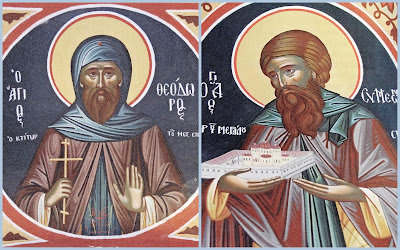
Saints Symeon and Theodore, Founders of the Monastery of Mega Spelaion

 
By Monk Moses the Athonite
 
They were born in Thessaloniki, and were brothers. When they came to Mount Athos, they were discipled under Venerable Euthymios the New. After being ordained priests they were seen as wise teachers of Mount Athos, distinguished for their asceticism.

Withdrawing from Mount Athos they went to venerate in the Holy Land and at God-trodden Mount Sinai. They returned to Mount Athos but left again for Thessaloniki and Thessaly, preaching against the heresy of the iconoclasts. They settled on the mountain near Thermopylae, continuing their inner struggles and after a vision they went to the Great Cave (Mega Spelaion) near Kalavryta in the Peloponnese. There they met with the shepherdess Saint Euphrosyne and after finding the miraculous icon of the Theotokos, they built a monastery.

Great Lent Is An Extraordinary Time To Learn To Truly Pray


By Monk Moses the Athonite

The main elements of Great Lent are prayer and fasting. Prayer presupposes faith. A person who does not pray is helpless, insecure, blind and alone.

They are attached to the earth, to matter, they do not know how to fly high, to sail in the heavens, to have necessary celestial assistance. They are magnetized, bound, clinging to the perishable earth. They do not detach easily. They try to treasure the earth. They are constantly looking for pleasures, to make them happy, but rather they give them pain. It is sad and worthy of lamentation to see them seeking joy in the mud. The ascent to heaven begins with repentance, sincere repentance, compunctionate remorse. It is worth feeling that you were not created for the dirt. Empathy does not really make you happy. Adherence to the hereafter is a serious mistake and has costs with bitter consequences. It is not impossible to climb higher than the peaks. It is possible for everyone. As long as they want it, they love it. At first we are hesitant, cowardly, scared, we do not want to risk it.

Hieromonk Kosmas of Gregoriou, Missionary to Congo (+ 1989)


 By Monk Moses the Athonite

He was born in the village of Theodosia in Kilkis in 1942. At a young age he went with his parents to Thessaloniki, where they lived very poor. His second home was the church and his second father was the pastor of his parish. He enjoyed studying Holy Scripture and going to catechism. From a young age he entered the daily struggle while studying. He became spiritually connected with the late Augoustinos Kantiotis (+ 2010) and began correspondence with Fr. Chrysostomos Papasarantopoulos (+ 1972), who was in Africa. The desire for missionary work was constantly burning inside him. He also had contacts with Elder Philotheos Zervakos (+ 1980) of the Longovarda Monastery of Paros. He knew technical, mechanical, electrical, electronic, nursing, lifeguard and construction things. He attended the Frontistirion for Catechists and took foreign mission courses at Apostoliki Diakonia, as well as nursing at Red Cross. He even got a degree for swimming. Later he would rescue a child from drowning in a lake in Kolwezi. He also wanted to study medicine, but he did not succeed. However, he went to the Higher Frontistirion of Rizareio School.

Monk Onouphrios Agiannanitis (1845 - 18 September 1935)

Skete of Saint Anna on the Holy Mountain
 

 By Monk Moses the Athonite

He came from the hierarchical province of Metron in Eastern Thrace and was the son of a rich shepherd of many sheep. While grazing the sheep, he did not fail to pray. When he was young he decided on his monastic dedication. He left with only one cape, without money and things with him, for Mount Athos. After many adventures he arrived at the Athonite port of salvation in 1888.

He went to the Monastery of Iveron to venerate the Panagia Portaitissa. Someone approached him, and when Onouphrios informed him that he had come to become a monk, he was told to go to Papa-Menas in Mavrovounio at the Skete of Saint Anna. He went, knocked on the door, Papa-Menas came out and welcomed him with joy, telling him that the Panagia had brought him from the City. The young man admired how the Elder knew about him, without having told him anything. Entering the temple to worship he saw the icon of the Virgin "sweaty". He realized that the Elder was praying to the Panagia and she enlightened the man in the Monastery of Iveron to direct him here. As a novice he did extreme obedience. Papa-Menas (+ 1916) soon tonsured him a monk in 1890 and gave him the name of his Elder Onouphrios of Cyprus, who once for his obedience angels carried him by boat from Daphne to the beach of Saint Anna.

He Visited Saint Hieronymos of Simonopetra Needing a Cane to Walk and then Left Without Needing It


By Monk Moses the Athonite

Haralambos Bogakos, who lived at Penteli, suffered much with his legs, and as swollen as he was he was unable to walk at all.

He said to his wife:

"I will take a car and go to Athens, to the Elder, so he can read a prayer for me."

She had objections, for how would he go, since he couldn't even move.

Like Thomas Let Us Ask To See Christ (Monk Moses the Athonite)


By Monk Moses the Athonite

Last Sunday we celebrated the glorious Resurrection of the Lord. The echo of the great celebration remains.

It's bright light bathes us. The resurrected Christ visits the unbelieving Thomas and us. He lowers Himself to our weakness. He allows Himself to visit us in order to dispel our disbelief, doubt and fear.

At midnight on Pascha was born joyful hope, the fearlessness of death, the death of death, the death of despair. The terrible and tedious darkness recedes. A powerful light comes, that illumines all things. Nothing can be hidden. Everything is now clear. The people are no longer indecent. With the Resurrection of Christ there was inspired another wind, transformative, that came to regenerate people, to the beginning of a new life, another way of life. Our nature has shifted.

The First Miracle of Saint George Karslides


By Monk Moses the Athonite

In the village of Sipsa at that time there was someone who was seriously sick, who for eight months his soul would not depart from him. One day the Saint said:

"You have a sick person here and you never brought me to see him?"

Then they raised up the Saint [he was disabled at the time] to take him to the sick man's home.

Elder Daniel of Katounakia (1846-1929)


By Monk Moses the Athonite

Elder Daniel of Smyrna was a sacred offshoot and fragrant flower from the martyric land of Ionia. His fragrance brought delight to many, when he was transplanted to the Garden of the Panagia, and the fruits of his virtues as well.

The son of most-devout parents, he studied Holy Scripture and the Philokalia, and graduated with excellence from the Evangelical School of Smyrna. After venerating monasteries and churches in the Peloponnese and the islands of the Aegean, and at the urging of Venerable Arsenios (1800-1877) in Paros, he entered the Athonite Monastery of Saint Panteleimon.

An Exemplary Priest, Hieromonk Gerasimos Koutloumousianosketiotes (+ 1991)


By Monk Moses the Athonite

Known as George Stogias in the world, he was born on 26 May 1892 in the village of Plikati on Mount Gramos, at an altitude of 1200 meters, with towering aromatic fir trees and pine trees, many water springs and beautiful forests. In 1908 he went to the Hermitage of Saint Gerasimos the New at the Sacred Skete of Saint Panteleimon-Koutloumousiou [Mount Athos] to learn iconography. His elder was the first subordinate to Elder Hadji-Georgis (+ 1886) and the virtuous Abramios (+ 1915) with his revered brotherhood, who were all from Northern Epirus. There he was tonsured a monk on 9 February 1912, which was the Sunday of Orthodoxy.

A New Year, A New Beginning (Monk Moses the Athonite)


By Monk Moses the Athonite

Every new beginning is a joy. It is a new start. A bright sun that rises with meaning and hope. Every new start is an enjoyable contest. The new year creates assessment, thoughts, plans, programs, emotional enthusiasm. A responsible struggle is essential for these things. Every beginning renews us significantly. We forget the old and extend towards the new.

Saint John Chrysostom beautifully teaches how the year will pass pleasantly if you happily do the divine will. If you work righteousness, your day will be good. If you sin, your day will be wicked, disturbing and dark. If you believe in virtue and practice it, your entire year will go well. But if you neglect virtue and depend on the number of days, you will remain desolate and poor of all good things.

Saint Nikodemos the Hagiorite (1749-1809)


By Monk Moses the Athonite

Saint Nikodemos the Hagiorite is one of the greatest theological and instructive figures of the Turkish occupation. His works elevated the morals of monastics and all the faithful by making known the wisdom of the holy fathers, the fragrance of hagiography and the grace of hymnography. Rightly is he the boast of the Holy Mountain and the glory of the Orthodox Church.

Saint Nicholas, a Bright Example for our Times

St. Nicholas icon from Gregoriou Monastery

By Monk Moses the Athonite

Saint Nicholas the Storm-Tossed, the Saint of the Sea, the beloved of the people and protector of seafarers, is particularly honored in Mount Athos.

Celebrating him are Stavronikita Monastery, Gregoriou Monastery and many Cells. This Saint was the Archbishop of Myra in Lycia of Asia Minor, where his tomb and the remains of his old church are today. He was benevolent and charitable, a defender of truth and justice.

What Orthodox Christianity Is and Isn't


By Monk Moses the Athonite

I will not repeat passages from books, but speak from my heart. Orthodoxy is the only truth. It is an invitation to a moving and amazing adventure. It requires daring and there is risk. It does not rest on its past laurels. I agree with what Dostoevsky says: "I believe there is nothing more beautiful, more profound, more enticing, more reasonable, more courageous, more perfect than Christ."

Orthodoxy wants us strictly pure and innocent. It has great expectations from us. Without God we would certainly be worse scoundrels. It is true that we are not saints. The worst thing is to make ourselves out to be saints. God does not like this at all. Orthodoxy wants us unhypocritical, unalloyed, genuinely humble and lenient with others. As well as unsuspicious, non-envious, resigned.

The Christ of Orthodoxy is approachable, friendly, kind, forgiving and sympathetic. He never spoke harshly to sinners nor ever disdained them. He understands our weaknesses. He does not get infuriated, does not berate, does not punish, does not avenge. He forgives, loves and sacrifices for us.

Elder Sophrony (Sakharov) of Essex (+ 1993)


By Monk Moses the Athonite

He was born in Moscow in 1896 and his lay name was Sergei Symeonovich Sakharov. As he himself recalls, his first experience of the vision of the uncreated light occurred in his childhood. He studied at the School of Fine Arts in Moscow. At one stage, his religious pursuits took him into non-Christian mysticism. His artistic ambitions led him to Italy, Germany and France. He found, however, that art neither fulfilled nor enlightened him.

His return to the love of Christ resulted in a new, very powerful experience of the uncreated light at Easter of 1924, in Paris. While there he was influenced by his acquaintance with Fr. Sergei Bulgakov (†1944). As he himself says, "In Paris, I had everything, but there was no real joy." He attended the Institute of Saint Sergius to find and learn. He would later say, "At Saint Sergius everyone spoke about God but I didn’t see Him. When I went to the Holy Mountain, though, nobody spoke about God but everything pointed to Him."

Athonite Neo-Hesychast Fathers (3 of 3)


Elder Daniel the Katounakiotis from Smyrna (+ 1929) had as beloved saints John Climacus and Isaac the Ascetic, as well as the Kollyvades. After living as a monastic in the Monasteries of Saint Panteleimon and Vatopaidi, he went to the very pleasant Katounakia, where he gave himself over to asceticism, study and the prayer. Poverty became his wealth and quietness his friend and the occasion for spiritual gladness. The external silence became internal and he cultivated the garden of a good heart with the prayer of Jesus, which filled him with joy. His correspondence with holy figures and writers indisputably reveal his divine illumination and grace, his discernment and wisdom, such as his letter to a monk about noetic prayer, where he demonstrates his patristic knowledge, the acquisition of the prayer, discernment and insight.

Athonite Neo-Hesychast Fathers (2 of 3)


Hieromonk Eustratios of Trebizond became a monk at eight years of age in Soumela Monastery in Pontus. After twenty years there he was ordained a priest, and after visiting Jerusalem he came to the Holy Mountain to the Skete of Kavsokalyva. His typikon was as follows: three thousand prostrations every night and the prayer unceasingly. This typikon he followed throughout his life. The cave in which he lived looked like a tomb, dark and closed, in order to lengthen the night which fosters prayer. He would sleep one hour a day, practically standing. Daily he would liturgize. Continuously he would fast. To one of his disciples, who lived beside him, but in another place, he said prior to his death, how God had given him such prayer, that even while sleeping his heart would pray. The Elder would pray either while sitting or standing, leaning his head slightly towards his chest, and would softly utter with contrition and attention the prayer, fixing his mind on the words of the prayer while holding his breath, in order to harmonize it with the movement of his mind. He was adorned with the gift of insight. While praying he would hold a large handkerchief, for his many heartfelt tears, and he would be found in a state of spiritual ascent.

Athonite Neo-Hesychast Fathers (1 of 3)


By Monk Moses the Athonite

After the 18th century revival, with the actions of the neo-hesychast movement of the so-called Kollyvades, and its venerable pioneers, such as Paisius Velichkovsky (+ 1794), another Gregory of Sinai (+ 1346) that occupied himself with translations and missionary work throughout the Balkans; Nikodemos the Hagiorite (+ 1809), the wise teacher and new Gregory Palamas (+ 1359); Makarios Notaras and former Metropolitan of Corinth (+ 1805), another Holy Photios (+ 899); and Athanasios Parios (+ 1813), the irresistible defender of correct doctrine who was like another Mark the Evgenikos (+ 1445), we have a chorus of virtuous friends of noetic prayer.

The Sunday of All Saints and the Purpose of Life (Monk Moses the Athonite)


By Monk Moses the Athonite

Today is the Sunday of All Saints, and who thinks about how the main purpose of our life on this earth is to acquire holiness? Yes, we exist to become saints.

The failure of this achievement is the greatest tragedy of human existence. But how is holiness considered today? What is our stance before it? How do we view it? How do we live it? How can we find it and not lose it? How do we use it, perhaps even exploit it?

Holiness does not eliminate the human personality. It does not violate human freedom and will, uniqueness and the sacredness of the human person. Holiness is not unmanned and the manufacturing of an identical statue. Many have a false perception of holiness. The most fragrant books of the lives of saints give us numerous and beautiful examples from the West to the East, among women and men, young and old, educated and illiterate, married and unmarried, clergy and laity, closed and open types of personalities.