Showing posts with label Pascha and the Pentecostarion. Show all posts

July 26, 2022

Homily on Galatians 3:27 - "As Many of You as Were Baptized Into Christ Have Put on Christ" (Metr. Hierotheos of Nafpaktos)


Homily on Galatians 3:27 - "As Many of You as Were Baptized Into Christ Have Put on Christ"

By Metropolitan Hierotheos of Nafpaktos and Agiou Vlasiou

In the sermon of each Sunday of the two summer months this year, we will interpret some phrases of the apostolic readings that are read in the Divine Liturgy. These are readings from the Apostle Paul's Letters to the Christians of the various Churches he had founded, and they aimed at solving problems and guiding them to a life in Christ.

Today we will interpret the passage from his Epistle to the Galatians, which refers to the Baptism of Christians and declares its great value: "As many of you as were baptized into Christ have put on Christ". That is, those who were baptized in the name of Christ have clothed themselves with Christ. This passage is chanted every time the Mystery of Baptism takes place and it is also chanted on the great Despotic Feasts, Christmas and Easter, because then the group baptisms of the catechumens and the illuminated took place. It is a very important passage.

June 20, 2022

Homily Four for the Sunday of All Saints (St. Luke of Simferopol)

 
By St. Luke, Archbishop of Simferopol and All Crimea

(Delivered in 1958)

The Sunday of All Saints gives us occasion to reflect on the many different ways that the holy people of God walked along the thorny road to the Kingdom of God.

Their conditions of life, their aspirations and inclinations, and their characters were very different; their lives were very different, and, accordingly, their minds and hearts were inclined most of all towards the fulfillment of one of the commandments of God.

Among them were people who were not at all interested in issues of state and public life, in secular, worldly affairs and wholly embraced only one desire - to be in constant communion with God.

June 19, 2022

Homily for the Sunday of all Saints - The Confession of the Saints (Metr. Hierotheos of Nafpaktos)


 Homily for the Sunday of all Saints

The Confession of the Saints

By Metropolitan Hierotheos of Nafpaktos and Agiou Vlasiou

"Whosoever therefore shall confess Me before men, him will I confess also before My Father which is in heaven" (Matt. 10:32).

Beloved brethren,

The Feast of All Saints is today and our Church with the Gospel reading reminds us of the confession of the saints, which must take place in the whole perspective of the Orthodox life. That is, we must confess Christ, but within Orthodox ecclesiastical contexts.

June 18, 2022

Divine Grace Drove the Apostles Crazy, in a Good Way, and Excited Them (St. Porphyrios of Kavsokalyva)


Saint Porphyrios of Kavsokalyva, speaking about Pentecost and the outpouring of the Holy Spirit on the Apostles, said:
 
On Pentecost, the grace of God was poured out not only on the apostles, but on all the people around them. It affected the believers and the unbelievers. What does Acts say? While the Apostle Peter was speaking his own language, his language was being processed in the minds of the listeners at that time.

In a secret way the Holy Spirit made them understand his words in their language, secretly, without being noticed. These miracles are done by the influence of the Holy Spirit.

June 13, 2022

Homily for Pentecost Sunday: Christ and the Holy Spirit (Metr. Hierotheos of Nafpaktos)


 By Metropolitan Hierotheos of Nafpaktos and Agiou Vlasiou

"If anyone thirsts, let him come to Me and drink" (John 7:37).

Beloved brethren, this is the word of Christ that He spoke during the Jewish Feast of Tabernacles. On this feast the Jews glorified God for their miraculous salvation. Every morning in the Temple there was a procession in remembrance of the miraculous gushing of water from the stone through the staff of Moses. Also, every afternoon, two lamps were lit in the portico in memory of the cloud of light that illuminated their fathers during the night journey. On the last day of this feast, Christ, standing in Jerusalem and referring to these two miraculous events that these two worshipful acts reminded us of, cried out: "If anyone thirsts, let him come to Me and drink ... I am the light of the world. He who follows Me shall not walk in darkness, but have the light of life" (John 7:37; 8:12). Then we will be preoccupied with the first proclamation of Christ: "If anyone thirsts, let him come to Me and drink" (John 7:37).

Second Homily for the Monday of the Holy Spirit (St. Luke of Simferopol)


By St. Luke, Archbishop of Simferopol and All Crimea

(Delivered in 1957)

We recognize the powers of material nature by their manifestations with greater or lesser power.

A light breeze caressing our cheeks, and a terrible hurricane destroying entire cities - this is only the movement of air with the weakest and strongest power. The barely noticeable twinkling of the smallest star and the dazzling light of the midday sun are only manifestations of the same light energy in the weakest and strongest degree.

On this great feast of the descent of the Holy Spirit upon the Apostles, we see that the spiritual energy, which reveals to us the power of God, can manifest itself not only quietly and hardly noticeably, but also with tremendous power and glory.

Monday of the Holy Spirit: Epistle and Gospel Reading


Monday of the Holy Spirit
 
Monday After Pentecost

 Epistle Reading

Prokeimenon. Mode Plagal 2.
Psalm 27:9,1
O Lord, save your people and bless your inheritance.
Verse: To you, O Lord, I have cried, O my God.

The reading is from St. Paul's Letter to the Ephesians 5:8-19

English

Brethren, walk as children of light (for the fruit of light is found in all that is good and right and true), and try to learn what is pleasing to the Lord. Take no part in the unfruitful works of darkness, but instead expose them. For it is a shame even to speak of the things that they do in secret; but when anything is exposed by the light it becomes visible, for anything that becomes visible is light. Therefore it is said, "Awake, O sleeper, and arise from the dead, and Christ shall give you light." Look carefully then how you walk, not as unwise men but as wise, making the most of the time, because the days are evil. Therefore do not be foolish, but understand what the will of the Lord is. And do not get drunk with wine, for that is debauchery; but be filled with the Spirit, addressing one another in psalms and hymns and spiritual songs, singing and making melody to the Lord with all your heart.

Reflection for the Monday of the Holy Spirit (St. Theophan the Recluse)


 By St. Theophan the Recluse

Comforting His disciples, the Lord said that it will be better for them if He rises to heaven, for upon rising, in place of Himself He will send the Comforter — the Spirit. The Holy Spirit has descended and abides in the Church, accomplishing in each believer the work of Christ. Each Christian is a communicant of the Spirit. This is something so necessary, that in fact whoever does not have the Spirit is not of Christ. Look closely at yourself — is the Spirit of grace within you? For it does not remain in everyone; it can depart. Here are the signs of His presence: first He finds a spirit of repentance and teaches a Christian to turn to God and correct his life; the spirit of repentance, accomplishing its work, passes the Christian on to a spirit of holiness and purity, which is succeeded, at last, by a spirit of adoption. The characteristic of the first is a work-loving zeal; the characteristic of the second is warmth and a sweet burning of the heart; the characteristic of the third is a feeling of adoption whereby the heart sighs to God: "Abba, Father!" (Mk. 14:36). Examine which of these levels you are on. If you are not on any of them, take care for yourself. 


June 12, 2022

Homily Three for the Feast of Pentecost (St. Luke of Simferopol)

 
By St. Luke, Archbishop of Simferopol and All Crimea

(Delivered in 1958)

The deeply important and mysterious dogma of the Trinity in the Persons of the One God distinguishes our Christian religion from all other religions.

For thousands of years the God-chosen Jewish people lived by faith in the One God, who revealed His omnipotence and incomprehensible wisdom in the creation of the universe; His truth in the global flood, His mercy and love for His people in the miraculous liberation of the Jewish people from the long Egyptian captivity, in the passage through the Red Sea, in conversations on Mount Sinai with the great prophet Moses and in the giving of His ten commandments through Him, and in many, many other great events, about which the Apostle Paul speaks with great power in his epistle to the Romans: “... because what may be known of God is manifest in them, for God has shown it to them. For since the creation of the world His invisible attributes are clearly seen, being understood by the things that are made, even His eternal power and Godhead, so that they are without excuse ...” (Rom. 1:19-20).

June 6, 2022

What Does It Mean That Christ Ascended and Sat at the Right Hand of the Father? (Metropolitan Athanasios of Limassol)

 
By Metropolitan Athanasios of Limassol
 
On the Fortieth day after the Resurrection the Lord physically left the world and went up to and ascended to heaven and sat at the right hand of the Father. Of course, this is not a place. That is, He does not have a chair next to the Father and sat down, nor is heaven a geographical space.
 
It is a place where God is located and these things are said so that we can understand that Christ left and took human nature with Him and was taken up as the God-man, not as God. As God He was always with His Father and was not separated for a moment. And when He was on earth and when He was in Hades He was with God His Father. That He took with Him human nature is exactly the result of all the previous events - the Cross, the Tomb, the Passion and the Resurrection. The human nature of Christ was ascended and with it the whole deified human nature was ascended.
 
Therefore this event of the Ascension, of our deification, is an event that now concerns all mankind. It is the glory of the human body. It is what reveals how much God has honored humanity.

The theory that in the Church and in her teaching the human body is despised and only constantly speaks of spiritual life and virtues, is not correct.
 
On the contrary, the Church and Orthodoxy are the ones who speak first and foremost about the deification of the human body. Nowhere else do we even theoretically have a deification of the human body, such as we have the deification of the human body in Orthodox theology.
 
This is what the Ascension of Christ means. None of what Christ did was for Himself. The Ascension of Christ does not mean that Christ simply returned "to His house" after His presence on earth.

This is not the reason for the Ascension.
 
The reason for it is precisely to show us what is our path and where do we end up, where Christ has raised us.
 
Remember how before He suffered that night in Gethsemane, when He prayed to His Father, He prayed for us. Then He said: "Father, I desire that they also whom You gave Me may be with Me where I am, that they may behold My glory which You have given Me." That is, Christ asked His Father, that in all ages, in His endless kingdom, where He is, there we may be.

And where is Christ? In the glory of God the Father, He is equal to His Father. And to Him belongs this nature, while it is given to us by grace. Thus we know that since Christ is at the right hand of the Father, therefore we too are at the right hand of God the Father, seeing and participating in this glory and deification of our human nature.
 
Source: Περιοδικό Παράκληση, Αρ. Τεύχους 89, Έκδοσις Ιεράς Μητροπόλεως Λεμεσού. Translated by John Sanidopoulos.


June 2, 2022

How Mount Athos Monks Greet Each Other on the Feast of the Ascension


"During this period we are celebrating the Divine Ascension. The Holy Fathers called it the foremost of the Despotic Feasts. For this reason we greet each other along the road with this beautiful phrase: 'Christ has ascended!' (Αναλήφθηκε ο Χριστός) and the Christian replies: 'I also have ascended!' (Αναλήφθηκα κι εγώ)."

- Archimandrite Gregorios Archipelagites,
Abbot of the Monastery of Docheiariou


Homily on the Day of Christ's Ascension (St. Luke of Simferopol)


By St. Luke, Archbishop of Simferopol and All Crimea

(Delivered on May 14, 1953)

I will not preach to you for a long time today because of my weakness, I will only try to explain to you the significant kontakion of this feast.

Listen, listen with deep attention to this kontakion (the choir sings): "O Christ our God, upon fulfilling Your dispensation for our sake, You ascended in Glory, uniting the earthly with the heavenly. You were never separate but remained inseparable, and cried out to those who love You, I am with you and no one is against you."

What does it mean: “fulfilling Your dispensation for our sake"?

June 1, 2022

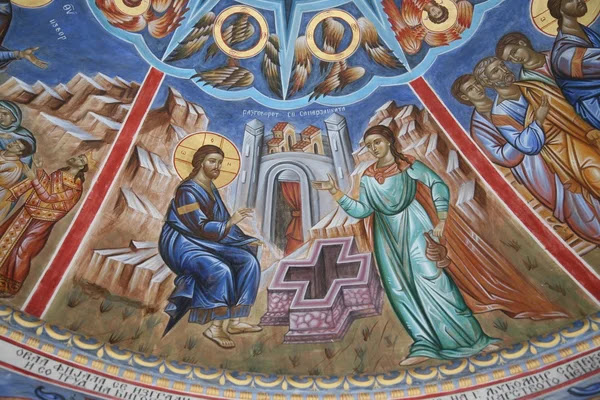
Third Homily for the First Day of Pascha (St. Luke of Simferopol)


Explanation of the Words of the Savior to Mary Magdalene: 
“Do Not Touch Me”
 
By St. Luke, Archbishop of Simferopol and All Crimea

(Homily Delivered on May 25, 1952)

Holy Scripture, and above all the New Testament, is our greatest treasure, it is the most precious thing on earth for us.

For only from the words of God, embodied in Holy Scripture, which is written by the Holy Spirit, do we learn the most important and most necessary for us - we learn first of all about the meaning and tasks of our life, for those who do not know the word of God, and even more reject it, human life is often presented as devoid of meaning, or even full of evil meaning.

In their ignorance, they do not have a firm support for determining their attitude to the world, as we have this support, for the Lord Jesus Christ and His holy apostles showed us the path of life, indicated everything that we should do, indicated everything that God hates, and what we should avoid.

And if so, if Holy Scripture is the most precious guide to our life, to our moral behavior, then shouldn't we treat everything that we read in the word of God with the greatest reverence and fullest attention?

But even those of you who constantly read the Holy Scriptures often find places in it that are inaccessible to their understanding.

There is something mysterious in Holy Scripture, and above all in the words of the Lord Jesus Christ Himself, for the Lord Jesus Christ could not speak completely openly, clearly and simply about the greatest mysteries of God.

He could only speak about these great mysteries in secret, and therefore it is necessary for us to delve into every word of Christ, and especially into those words of the Lord Jesus that seem obscure and not entirely understandable, with all the power of our understanding.

But you yourself will not be able to clarify for yourself, to understand everything that is unclear, that is hidden. God has appointed for you shepherds, and teachers, and archpastors, whose duty is to explain the Holy Scriptures to you, to help you comprehend all that is not easy to comprehend.

To do this, your teachers and pastors must themselves have a deep theological erudition, a complete knowledge of the Holy Scriptures and the works of the Holy Fathers.

So it is my duty to explain to you one passage from the Gospel of the Apostle John the Theologian, which you heard yesterday at Vespers.

You have heard the story of how Mary Magdalene on the first day of the week, i.e. on the day of the resurrection of the Lord, she went to the tomb and did not find the Lord Jesus there, but saw only two angels sitting on a stone.

Being in deep sorrow, in confusion, she turned back and suddenly saw the Lord Jesus standing in front of her, but she did not recognize Him, just as the holy apostles did not recognize Him when He appeared to them, just as the apostles Luke and Cleopas did not recognize Him when they went to Emmaus, and He went up to them and accompanied them.

Without recogning the Lord Jesus, Saint Mary mistook Him for a gardener and asked: “Sir! if you carried Him away, tell me where you put Him, and I will get Him” (John 20:15).

The Lord addressed Mary Magdalene with only one word: “Mary!” But this word was spoken in such a way that it immediately penetrated into her heart, and she suddenly recognized the One Whom she took to be the gardener, the Lord Jesus Himself.

She exclaimed, "Rabbi," and rushed to Him to kiss His feet.

But the Lord suddenly suddenly pushed her aside and said to her: “Do not touch Me, for I have not yet ascended to My Father; but go to my brothers and say to them: I ascend to my Father and your Father, and to my God and your God” (John 20:17) .

So I want to explain to you why the Lord Jesus Christ forbade Mary Magdalene to touch Him, why He sent her to His disciples to announce what He commanded her?

After all, we know from the narration of other evangelists that the Lord appeared to other myrrhbearing women, and to the apostles themselves, and He did not forbid them to touch Him. So, we read from the Evangelist Matthew, how it was no longer Mary Magdalene, but other myrrhbearing women who learned from the angel that the Lord had risen - “When they went to announce to His disciples, behold, Jesus met them and said: 'Rejoice.' And they approached, took hold of His feet, and worshiped Him” (Matt. 28:9).

You see, the Lord did not forbid them to grasp His feet and kiss them, but Mary Magdalene was forbidden.

We read from the Evangelist Luke that when the apostles Luke and Cleopas recognized Jesus Himself in the breaking of bread and believed in His resurrection, they immediately returned to Jerusalem to the apostles and told about it.

And suddenly, when they were speaking, He Himself, “Jesus Himself stood in the midst of them and said to them: Peace be with you, ... Look at My hands and at My feet; it is I myself; touch Me and see; for the spirit has no flesh and bones, as you see with me” (Luke 24:36-39).

He himself suggested: touch - feel with your hands, lest you think that this is not I, the living Jesus, but only a ghost.

You also know that the holy apostle Thomas was not present with the other disciples at that time: the Lord Jesus appeared to him together with the other apostles only eight days later and said to Thomas: “Put your finger here, and see my hands; give me your hand and put it in my side; and do not be unbelieving, but believing” (John 20:27).

He offered to put his finger into His wounds, and forbade Mary Magdalene to touch Him.

What does this mean, why did He forbid Mary to touch Him? We find the answer to this in the words of the Lord Jesus Himself, immediately after that was said to Mary: Do not touch Me, because "I have not yet ascended to My Father; but go to My brothers, i.e. to the apostles, and say to them, I ascend to my Father and your Father, and to my God and your God.”

This is how the Lord Himself explained the prohibition to touch Him.

Therefore, it was impossible to touch, because He had not yet ascended to His Father and His God.

How to understand it? Nowhere in Scripture is it said, no one anywhere taught that the Lord Jesus Christ immediately after His resurrection ascended into heaven to His Father and only after having fellowship of love with His Father did He allow people to touch Him.

And I think that Mary Magdalene came directly after the resurrection of the Lord Jesus.

He had just risen, He had not yet ascended to the Father and His God.

He says: Go to the apostles, to my brothers and say: "I ascend to my Father and your Father, and to my God and your God."

And so, from these words of the Lord Jesus Himself, we learn that before His final ascension to heaven, when He left the earth forever, He ascended to the Father directly after His resurrection.

This, so to speak, was His first ascent.

This is not my arbitrary thought, these are the words of the Lord Jesus Himself: "I ascend to my Father and your Father, and to my God and your God."

How can we understand this ascent? Why was it necessary, and where did our Lord Jesus ascend?

We know that God is omnipresent. Yes, He is omnipresent, and by His omnipresence He, by His omniscience and reason, by His Divine will, guides everywhere the life of the world and mankind.

Where, then, did the Lord Jesus have to ascend, if God is omnipresent by His omniscience, His mind, His will, His love?

From the words of the holy Apostle Paul, addressed to his disciple, Bishop Timothy, we know that "God lives in unapproachable light." By His nature, His spiritual essence, His hypostasis, He is not everywhere, but somewhere in the impregnable light.

We do not know where this unapproachable light is, but Jesus Christ, of course, knew, for He is one with the Father, and if He was temporarily separated from the Father, when He took on human flesh, when He accomplished His feat of saving the human race, which was immeasurable in the power of love, then He was separated from the Father not by hypostasis, but because He, as the Second Person of the Holy Trinity, is characterized by His separate personal existence along with the common existence of the Holy Trinity.

We know that the Holy Spirit proceeds from the Father. We also know that the Lord sent the Holy Spirit to His disciples after His Ascension, which means that the Holy Spirit was temporarily separated from the Father, just as the Lord Jesus Christ was absent for the sake of earthly life and the redemption of the human race.

So, into the impregnable light unknown to us, in which God lives eternally, the Lord Jesus Christ entered immediately after His resurrection.

Before appearing to people, didn’t He need to enter into the communion of love with His Eternal Father, didn’t He, together with the Father, need to share the joy of that great feat that He had just accomplished - the feat of saving mankind from the power of the devil.

Just as we, people, as children in particular, yearn for our parents, father and mother, in order to share our joy with them, in order to inform about the most important events of our life, so the Second Person of the Holy Trinity needed the communion of love and joy about the accomplished feat. For the sake of this fellowship of love and joy, the Lord Jesus Christ ascended immediately after His Resurrection to where the light is unapproachable, where is the eternal abode of the Triune God.

Here is my explanation of why the Lord Jesus Christ forbade only Mary Magdalene to touch Him: He had not yet ascended to His Father. It is too early to enter into fellowship with people, too early to allow Him to be touched.

Later you will see My new appearances, you will see how the disciples will touch My Body, and Saint Thomas put his fingers in the nail wounds, puts his hand in my ribs - wait.

So, therefore, I believe that before the final Ascension of the Lord from the earth, He, as He Himself said, ascended to His Father and His God.

And for us, who know this, who know that first of all the Lord Jesus Christ Himself, the Son of God, aspired to where the light is impregnable, should we not build life so that it would be an unceasing striving for this impregnable light, for the throne of God!

Let's go, let's go where the Lord Jesus Christ is. But remember that only those who have loved God with all their hearts and believed in Christ Jesus will go to Him after death – only those will go into the unapproachable light.

And their eternal life will be in joy and gladness, in communion with God in the unapproachable light.

Source: Translated by John Sanidopoulos.


May 29, 2022

Second Homily for the Sunday of the Blind Man (St. Luke of Simferopol)


 By St. Luke, Archbishop of Simferopol and All Crimea

(Delivered on May 10, 1953)

You heard today the Gospel story about one of the greatest miracles of Christ - the healing of a man born blind. Much could be said about this, and I've been talking about it for years. Today I want to talk about what I did not speak about, about those words of Christ, full of great significance for us, which He spoke after the healing of the blind man. He said:

“I am the light of the world” (John 8:12).

“I came into this world for judgment, so that those who do not see may see, and those who see will become blind” (John 9:39).

May 23, 2022

Third Homily for the Sunday of the Samaritan Woman (St. Luke of Simferopol)


 By St. Luke, Archbishop of Simferopol and All Crimea

(Delivered in 1958)

In the book of the Prophet Isaiah we read words of great importance inspired by the Holy Spirit: “I revealed myself to those who did not ask about me; those who did not seek Me found me” (Isaiah 65:1).

The conversation of our Lord Jesus Christ with the Samaritan woman, set forth in the fourth chapter of the Gospel of John, serves as the most striking confirmation of the truth of these Divine words.

The Lord Jesus Christ rested at the well of Jacob, near the Samaritan city of Shechem, on the long journey from Jerusalem to Galilee. A Samaritan woman came to the well with a water carrier to draw water. The Lord asked her to give Him a drink.

May 22, 2022

Second Homily for the Sunday of the Samaritan Woman (St. Luke of Simferopol)


St. Luke, Archbishop of Simferopol and All Crimea

(Delivered on May 8, 1953)

Very much could be said to you about the conversation of the Lord Jesus Christ with the Samaritan woman. I have already spoken a lot about this in past years in the cathedral, but I did not speak about one very important thing that you have heard in the current Gospel reading.

When our Lord Jesus Christ unusually deepened His conversation with the Samaritan woman, when He taught that it was not in Jerusalem, not on Mount Gerizim that God should be worshiped, for God is a Spirit, and that He should be worshiped in spirit and in truth, worshiped in more than one place, but anywhere and everywhere all the days of her life, - the Samaritan woman listened to the deepest discourse of the Lord Jesus Christ and this is what she said: “I know that the Messiah, that is, Christ, will come; when He comes, He will announce everything to us." Jesus said to her: "It is I who speak to you” (John 4:25-26).

Here on these words of the Lord Jesus Christ I want to draw your attention. For the first time in His entire earthly life, He directly told a person that He is the Messiah, that He is the Christ. It is I - I am the Messiah, I am the Christ - I, who speaks to you.

He said this for the first time, for He never directly told His apostles, His friends, that He was the Messiah, and even the apostles then considered Him only the greatest prophet, but did not know that He was the Son of God, that He was Christ the Messiah.

Once the Lord Jesus Christ asked His disciples: “Who do people say that I, the Son of Man, am?" They said: "Some John the Baptist, others Elijah, and others Jeremiah or one of the prophets."

He said to them, “And who do you say that I am?” And Holy Apostle Peter answered for all: "You are the Christ, the Son of the living God."

What answer did Christ then give him to this confession? “Blessed are you, Simon, son of Jonas, for it was not flesh and blood that revealed this to you, but My Father who is in heaven.”

God the Father revealed through the Apostle Peter to all the other apostles that the Lord Jesus Christ is the Son of God, the Messiah, the Christ.

So, you see, not Christ Himself, but His Heavenly Father mysteriously revealed to the Apostle Peter, and through him to the other apostles, that He is the Messiah, the Christ, the Son of God. And He strictly forbade them to talk about it.

As you can see, He never told the chosen people, the people of Israel, that He was the Messiah, the Son of God, the Christ; but here, in a conversation with a Samaritan woman, He said this for the first time.

How will we understand this? How can we explain this? After all, the Jews did not have fellowship with the Samaritans, considering them an outcast people. Not only did they not have spiritual communion with them, they also did not have everyday communion: they never spoke, never ate with them.

So the Samaritans were outcasts in the eyes and hearts of the Jews. And the Samaritan woman herself, at the beginning of her conversation with the Lord, said: “How can You, being a Jew, ask me, a Samaritan woman, to drink?”

Therefore to this Samaritan woman, who did not belong to God's chosen people, she was a stranger to them, and they were to her, the outcast, with whom the Jews did not want to have fellowship, that Jesus Christ said what He had never said to the Jews, that the Messiah is He: "It is I who speak to you."

The Samaritan woman, struck by these words, left her waterpot and ran into the city and said to all the people: “Go, go to Jacob’s well, see at the man who told me everything that I have done in my life, behold, is this not Christ?”

And many, many Samaritans, at her word, went to Jacob's well. At that time, the disciples of Christ also returned, who had gone to the city to buy food. Jesus talked with them about His calling, about what He and them should do. And the Samaritan woman stood and listened to these amazing words. “And many of the Samaritans of that city believed in Him at the word of the woman, who testified that He had told her all that she had done. And therefore, when the Samaritans came to Him, they asked Him to stay with them; and He stayed there two days, and an even greater number believed according to His word” (John 4:39-41).

You see what happened: the Lord converted to faith in Him, to the Christian faith, those Samaritans whom the Jews despised, Jews who themselves did not want to believe, but whom Christ called first - the first to call to faith. Now He called to faith in Himself those who were considered outcasts.

This means that the Lord was the Knower of Hearts: the Lord knew that in His chosen people Israel there would be many, many who would not believe, despite His amazing endless miracles, which the Samaritans did not see, despite the Divine teaching, which the Samaritans did not hear.

Well, if Israel for the most part did not believe in Him, should the work for which the Son of God was incarnated from the Blessed Virgin Mary, descended to earth, ascended the terrible cross of Golgotha and gave His life for the salvation of the human race, really have to remain unfulfilled? Could it remain unfulfilled? No, the Lord knew that there would be many outside the people of Israel, many of those whom Israel considered unclean pagans and outcasts, but who would believe in Him and enter Christ’s flock: "And I have other sheep, which are not of this fold; I must bring them also, and they shall hear My voice; and they shall become one flock with one shepherd.”

You see, out of all nations, our Lord and God Jesus Christ will find the sheep of His flock. Who will be the sheep of His flock? Only the humble, only the brokenhearted, trembling at His word, as the Holy Prophet Isaiah foretold.

And we know that today the flock of Christ no longer consists of the people of Israel, the majority of whom rejected Him, but of that part of them that believed, and of those countless meek and lowly in heart, whom Christ found in all ages and still finds in all peoples. There is one Church of Christ in the eyes of God; it is divided only in our sinful eyes.

So, remember that the present little flock of Christ consists and henceforth will consist only of the meek and humble, contrite in spirit, trembling at the word of God.

Know that only those of you who tremble at the words of Christ, who loved Him with all their heart, believed unconditionally, and every word of Him is considered a Divine revelation - only they will be worthy to be friends of Christ, brothers and sisters of Christ. They alone will be deemed worthy to enter His eternal Kingdom.

Does this apply only to individuals, to each of us? Isn’t it necessary to say that Christ’s demand applies to entire nations, among which there are proud peoples, completely far from humility, proud peoples, even exalting themselves above other peoples, thirsting for power over the whole world, thirsting for the treasures of the whole world and for this, committing horrific atrocities in the unfortunate Korean country and in many other countries where the weak and defenseless are oppressed and brutally exploited by strong peoples.

These are the French who oppress the peoples of Tunisia, Morocco and the unfortunate Negroes in their colonies; these are the British who oppress the peoples of Central Africa.

The words of Christ apply to all of them, that they, proud and exalted, will be far, far from the Kingdom of God. They, who imprison peace fighters, speak falsely about their desire for peace.

And we, Christians, shall we really be like them, shall we not love peace with our hearts, peace with the whole world! Shall we not be heralds of peace among peoples, shall we not be opponents of a terrible world war, which is being prepared by proud peoples, thirsting for power over the whole world? Let it not! Let it not! May the word "peace" be sacred to us. Amen.

Source: Translated by John Sanidopoulos.


May 18, 2022

Homily on the Wednesday of Mid-Pentecost (St. Luke of Simferopol)

 
 By St. Luke, Archbishop of Simferopol and All Crimea

(Delivered on May 3, 1950)

"Whoever is thirsty among you, let them come to Me and drink" (John 7:37). These wondrous words were spoken by our Lord Jesus Christ on the day of Mid-Pentecost in the Temple of Jerusalem. Roughly the same words were given in the Holy Spirit by the Prophet Isaiah, who lived seven centuries before the incarnation of our Lord Jesus Christ. It was as if the Prophet heard what 700 years later would be spoken by the Lord Jesus Christ. He said the following: "Everyone who thirsts, come to the waters; and you who have no money, come, buy and eat. Yes, come, buy wine and milk without money and without price" (Is. 55:1). "Therefore with joy you will draw water from the wells of salvation" (Is. 12:3).

May 17, 2022

Fourth Homily for the Sunday of the Paralytic (St. Luke of Simferopol)


 By St. Luke, Archbishop of Simferopol and All Crimea

(Delivered in 1958)

Our Lord Jesus Christ came to Jerusalem for the feast. At the Sheep Gate of this city stood a pool, called in Hebrew Bethesda, which means "the House of Mercy". This pool was surrounded by five covered passages, in which lay a huge number of sick, blind, lame, withered, waiting for the movement of water, which from time to time was made by an angel descending into the pool. And then every sick person, who was first to descend into the water, was miraculously healed of their illness, whatever it was. Who, if not the Eternal Son of the God of mercy and the Father of bounties, should enter the House of Mercy?

May 16, 2022

Third Homily for the Sunday of the Paralytic (St. Luke of Simferopol)


 By St. Luke, Archbishop of Simferopol and All Crimea

(Delivered on May 20, 1951)

One evening, the Holy Prophet David was on the roof of his house, and from the height of the roof in the neighboring courtyard he saw an extremely beautiful woman bathing. He was inflamed with passion for her, and sent his servants to bring her to his house. The king questioned her and learned that she was the wife of Uriah, a brave warrior who fought against the Ammonites and the Syrians. He took her for himself. He called for the commander under whose authority Uriah was, and ordered to put Uriah in the most dangerous place and move away so that he would be killed. A messenger came from the field and reported what was done according to his word - and Uriah died.

Synaxis of All the Holy Venerable Fathers of Meteora


On the Sunday of the Paralytic, it has been established in Meteora and Kalambaka to commemorate the Synaxis of All the Holy Venerable Fathers of Meteora, whose asceticism for the love of God shine as a bright example for our own sanctification.
 
Support the Mystagogy Resource Center

For more than fifteen years, the Mystagogy Resource Center has been a labor of love dedicated to making the riches of the Orthodox Christian tradition freely available to people throughout the world.

Thousands of articles, translations, lives of saints, theological reflections, historical resources, and daily materials have been published across this ministry’s websites, all offered free of charge for anyone seeking a deeper understanding of the Orthodox faith.

This is a one-man ministry that requires countless hours of research, translation, writing, editing, and maintenance each day.

If this work has spiritually benefited, educated, encouraged, or inspired you in any way, I humbly ask you to consider supporting this ministry financially.

Generous annual and monthly benefactors make possible the continuation and expansion of this work for the future, for without such support this ministry cannot exist.

Every contribution, whether large or small, truly makes a difference and is deeply appreciated. May God bless you abundantly for your generosity and prayers.

❖ ❖ ❖
PayPal • Credit Card • Debit Card • Venmo
Become a Patron on Patreon