Showing posts with label Parables of Christ. Show all posts

November 20, 2022

Homily for the Ninth Sunday of Luke (St. Luke of Simferopol)


 By St. Luke, Archbishop of Simferopol and All Crimea

(Delivered on December 11, 1949)

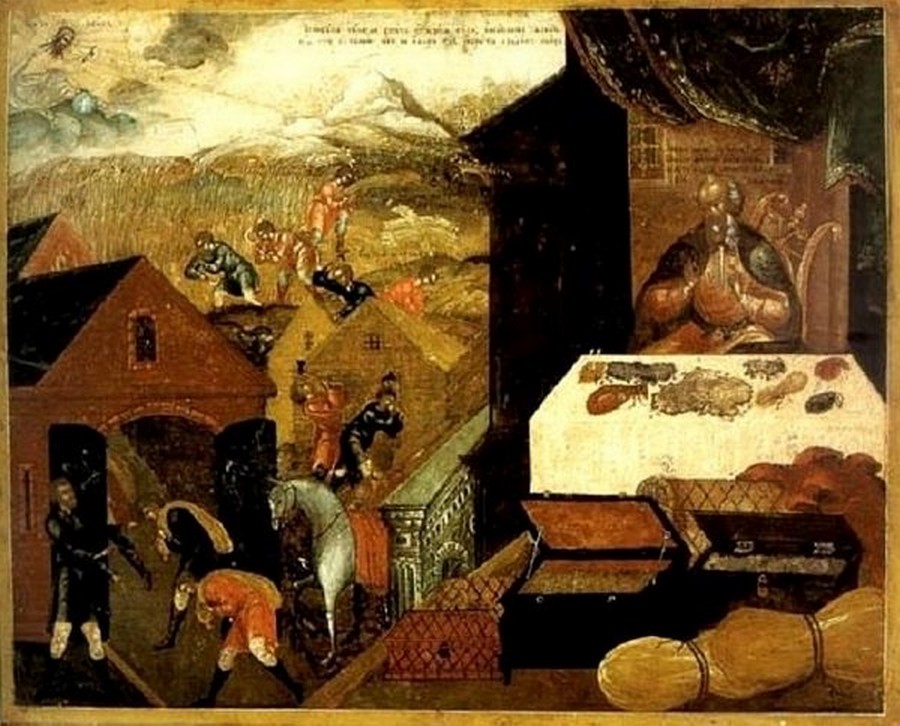
Then He spoke a parable to them, saying: “The ground of a certain rich man yielded plentifully. And he thought within himself, saying, ‘What shall I do, since I have no room to store my crops?’ So he said, ‘I will do this: I will pull down my barns and build greater, and there I will store all my crops and my goods. And I will say to my soul, “Soul, you have many goods laid up for many years; take your ease; eat, drink, and be merry.” ’ But God said to him, ‘Fool! This night your soul will be required of you; then whose will those things be which you have provided?’ (Luke 12:16–20).


Reflection on the Ninth Sunday of Luke (St. Theophan the Recluse)


 Reflection on the Ninth Sunday of Luke

Luke 12:16-21
 
By St. Theophan the Recluse

Having spoken the parable about the man who became rich and planned to just eat, drink and be merry, and for this was struck with death, not remaining alive for the supposed pleasures, the Lord concluded: "So is he that layeth up treasure for himself, and is not rich toward God." 
 
“So”—that is, such occurs, or such a lot befalls both these and others. Those who become rich and forget about God only think about pleasures of the flesh. Let those who desire to avoid this bitter lot “lay up” not “unto themselves, but be rich only toward God.” Since riches come from God, then devote them to God when they flow, and holy riches will come of it. 
 
Divide all surplus with the needy: this will be the same as returning to God what was given by God. He who gives to a poor person gives to God. Seemingly exhausting his riches, such a person becomes truly rich—rich through good deeds, rich for God. In pleasing Him he becomes rich in God, and by attracting His good will, he becomes rich from God, Who makes one who is faithful over a few things, ruler over many things. He becomes rich toward God, and not toward himself, for he does not consider himself to be master of the house, but only a steward and accountant, whose entire concern consists of satisfying all who come to him in need. But he fears spending anything in particular on himself, considering it to be an improper usage of property entrusted to him. 


November 13, 2022

Homily Two for the Eighth Sunday of Luke (St. Luke of Simferopol)


 By St. Luke, Archbishop of Simferopol and All Crimea

(Delivered on December 9, 1951)

The parable of Christ about the merciful Samaritan, which you have now heard, is infinitely deep and important for us, and therefore I want you to remember it well.

You heard it in the Slavic reading, now listen to it in Russian translation. (The Gospel of Luke chapter 10, 25-37 is read.)

Why do I consider this parable of Christ one of the most important and profound of His parables? Because in this parable the Lord gave us a genuine revelation, a revelation about who we should consider as our neighbors.

October 30, 2022

Sermon for the 5th Sunday of Luke - The Rich Man and Lazarus (Monk Agapios Landos)


Sermon for the 5th Sunday of Luke

The Rich Man and Lazarus

By Monk Agapios Landos of Crete (1585-1657)

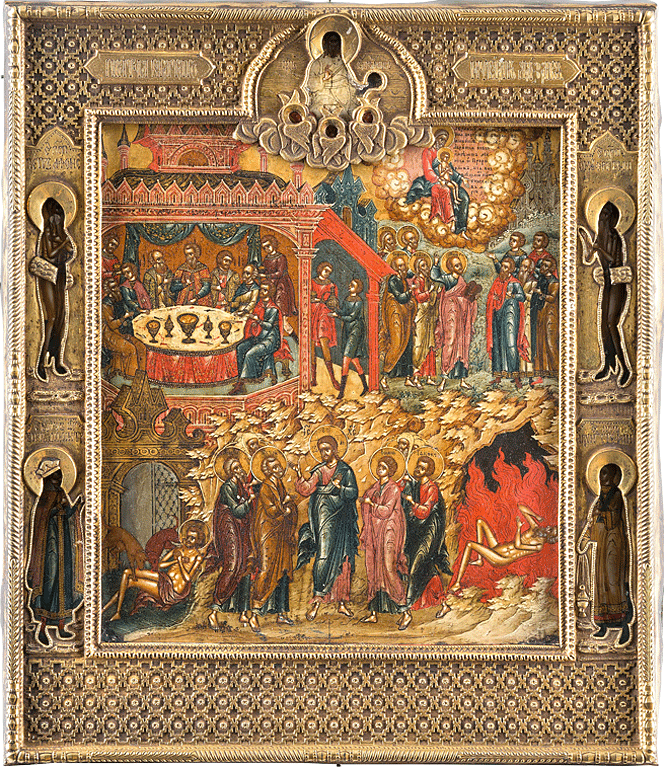
The Lord said, ‘There was a rich man, who was clothed in purple and fine linen and who feasted sumptuously every day. And at his gate lay a poor man named Lazarus, covered in sores, who desired to be fed with what fell from the rich man’s table’.

Wanting to make us generous and charitable, to love one another and to instruct the mean and hard-hearted what perils await them and also to teach those who have sorrows and who suffer here what joy and elation they will inherit, the Lord wisely described for us the rich man as being very harsh and inhuman beyond measure and the poor man as possessing wonderful fortitude and patience. He leaves the rich man anonymous, as being unworthy of a name, as the prophet says: ‘I shall not mention their name on my lips’ [Ps. 16:4] and ‘his memorial has perished with a noise’ [Ps. 9:6]. The name of the poor man is given because the names of the righteous are recorded in the book of life. And the Jews have a tradition that, at the time of Christ, there was, indeed, a certain Lazarus in Jerusalem who endured great poverty with fortitude pleasing to God. The Lord mentions him as being virtuous and holy, since Scripture says ‘Blessed are they who fear the Lord’ and ‘their memorial remains unto the ages’ and ‘you shall be unto eternal memory’.

Discourse Three on the Parable of the Rich Man and Lazarus (St. John Chrysostom)

 
 Discourse Three

On the Parable of the Rich Man and Lazarus

By St. John Chrysostom

1. The parable about Lazarus has benefited us not a little, both rich and poor, teaching the latter to bear poverty well, and not allowing the former to think highly of their riches; but showing, by the circumstances of the case, that he is of all men to be most pitied who lives in luxury without sharing his wealth with others. Allow me again to take up the same subject; since, also, those who work in mines, wherever they see many grains of gold, there they dig again, and do not cease until they have gathered out all that can be found. Let us, therefore, proceed, and, at the place where we left off yesterday, there again recommence the discourse. It might be possible, indeed, to unfold to you the whole parable in a single day; but we do not strive to be able to depart with the feeling that we have said a great deal, but that you, having received and retained the things spoken, may be able, through this carefulness, to gain a sense of real spiritual benefit. A tender mother about to change the food of her child from milk to more solid diet, if she were at once to give it unmixed wine would injure it, for the child would at once reject the new diet. She feeds it little by little, and thus the new nourishment is received without trouble. In order that you may not feel distaste for the offered food, we do not without preparation pour out to you from the cup of instruction; but distributing the portion over several days, we give an interval of repose from the toil of hearing, that both that which has been said may be firmly fixed in your understanding and in your heart, and that you may receive that which is about to be said with constant and increasing zeal.

February 22, 2022

Meditation on the Parable of the Prodigal Son (St. Nikodemos the Hagiorite)


 Spiritual Exercises

Meditation 15

On the Parable of the Prodigal Son
 
By St. Nikodemos the Hagiorite

A. He Departed From the House of His Father.

B. What Life He Lived After His Departure.

C. What His Return Consisted Of

A. Think, brother, of the departure of that prodigal son from his father's house, as narrated by sacred Luke (15:11), with which the departure really seemed like a young man without a mind and intellect, because what was he missing when he was at his paternal home and under the protection of his sweetest father? He was in his paternal arms every day, he had everything he needed, he was served by all the slaves, he had the caresses and honors as the heir of the paternal property and he was almost recognized as the master and ruler of everything, so he could have every reason to say that psalm: "We shall be filled with the good things of thy house" (Psalm 64:5). But the desire for delusional freedom, from being a child and an heir, made him desire to become a slave and a servant. So he began to be disturbed by the royal and free life he had under his father's obedience; and desire to live according to his own will and utilize his disposition, as it is utilized by others, and this disturbance and desire urged him to seek the consent of his father, to leave the paternal house, and they advised him to ask for the share of that inheritance which belonged entirely to him: "Father, give me the share of property that falls to me" (Luke 15:12). The father did not want to stop him from this move, but let him go, to find out through trial and deprivation, what goods he enjoyed when he was in his father's house and despised them, as sacred Chrysostom explains: "That is why the father left him and did not prevent him from going to a foreign country, in order to learn with experience, how many benefits he had by staying in his paternal home" (Discourse 1 On Repentance). And because his father could not persuade him with words to stay in his house, he let him be persuaded by these things and sufferings: "Many times God, when words cannot persuade, allows experience of situations to be a teacher", says he who had golden speech (ibid.), as it is written: "Thine own wickedness shall correct thee, and thy backslidings shall reprove thee" (Jer. 2:19), because even Adam, when he was in paradise, did not know the blessedness he had, but from the time he was exiled by Him, then he knew it. ”So he divided to them his livelihood. And not many days after, the younger son gathered all together, journeyed to a far country, and there wasted his possessions with prodigal living" (Luke 15:12-13).

February 21, 2022

Homily Two for the Sunday of the Prodigal Son (St. Luke of Simferopol)

 
Sunday of the Prodigal Son
 
Flesh and Spirit
 
By St. Luke, Archbishop of Simferopol and All Crimea

(Delivered on February 25, 1951)

You heard in the Gospel reading the parable of Christ about the prodigal son. This is one of the most precious, most important parables of Christ for us, and I must explain it to you.

Why did I call this parable precious and extremely important? Because in it our Lord and God Jesus Christ teaches us the most important thing: how we should build our life, He teaches us what we should consider necessary in our life.

Why did the prodigal son leave home?

February 20, 2022

Homily Three for the Sunday of the Prodigal Son (St. Luke of Simferopol)


 Sunday of the Prodigal Son

On Shame
 
By St. Luke, Archbishop of Simferopol and All Crimea

(Delivered in 1958)

The devil has laid many nets on the paths of our life, and with many passions and lusts he traps us under his power. But our Lord Jesus Christ delivers us by many grace-filled means from these devilish snares.

A very prominent place among these saving means of God's help to us, who are weak, belongs to the grace-filled and blessed parable of our Savior about the prodigal son.

You have already heard it many times shortly before the start of the fast. But everything precious and blessed must be preserved with great care and remembered more often. So, let us once again recall the precious Parable of the Prodigal Son and delve deeper into it.

December 12, 2021

Reflection on the Eleventh Sunday of Luke (St. Theophan the Recluse)


 Eleventh Sunday of Luke

Luke 14:16-24

By St. Theophan the Recluse

"Many are called, but few are chosen" (Matt. 22:14). All Christians are called; chosen are those Christians who believe and live in a Christian manner. In the early Christian times preaching called to faith; we are called by our birth from Christians and upbringing among Christians. And glory be to God! We pass half the road, that is, entrance into Christianity and the taking root of its principles in our heart from our very childhood, without any labor. It would seem that our faith should be all the stronger, and our life all the more correct throughout all the time that follows. It was this way; but from a certain point in time it has started to be different. Unchristian principles are permitted in our schools which ruin young people, and unchristian customs have entered into society, which corrupt them after leaving school. If according to the word of God there always have been only a few chosen, it is no surprise that in our time there are even fewer of them; such is the spirit of the age — anti-Christian! What will be next? If our manner of education and social customs are not changed, true Christianity will weaken more and more, and at last will entirely end; only the name of Christian will remain, but the spirit of Christianity will not be there. The spirit of the world will fill everything. What is one to do? Pray…
 

November 14, 2021

Discourse on Love (Archimandrite George Kapsanis)


By Archimandrite George Kapsanis,
Former Abbot of the Holy Monastery of Gregoriou

Our Lord and Savior Jesus Christ handed down to us the perfect teaching on salvation. And he himself was the first to implement what he taught. It is he who ‘practices and teaches’ (Matt. 5, 19). He also gave us the parable of the Good Samaritan as an example of real love. But the most outstanding Good Samaritan is Christ himself, who took upon himself our nature tortured by robbers, that is the demons, the passions, and human wickedness, then raised it and gave it life through his death on the Cross and his resurrection.

Homily on the Parable of the Good Samaritan (Metropolitan Dionysios of Servia)

 
By Metropolitan Dionysios of Servia and Kozani

(Delivered on September 14, 1965)

‘Just then a lawyer stood up to test Jesus’. This ‘lawyer’ [i.e. a student of the Law of the Old Testament, rather than an advocate in a court] approached Jesus Christ, supposedly to ask what he should do to inherit eternal life, but in fact out of a desire to provoke Him. The lawyer was an educated man of his time who studied and interpreted the Law and it was his aim to trap Jesus into a discussion. Instead he received a much-needed lesson. Jesus got him to understand that it’s one thing to be well-educated and play at being clever and quite another to be a good and useful human being. Wisdom isn’t a matter of knowing who your neighbor is, but knowing what you should do for that person. Everybody knows and says lots of things, but very few do what they should. This is why we see in this parable the lawyer asking one thing and Christ answering another. The lawyer asks: ‘Who is my neighbor?’, and Christ answers: ‘Go and do likewise’. The lawyer asks who’s supposed to be his neighbor and Christ sends him off to demonstrate his love to every person. Because each and every person is our neighbor. Christ doesn’t tell him that every person’s his neighbor, but what he should do for every person, who is his neighbor. And this is what we Christians need to do on every occasion: not to know a lot and be wise, but to have love and to do what we should.

Reflection on the Eighth Sunday of Luke (St. Theophan the Recluse)


 Eighth Sunday of Luke

Luke 10:25-37

By St. Theophan the Recluse

To the man who asked how to be saved, the Lord on his part offered a question: "What is written in the law? how readest thou?" By this He showed that to resolve all perplexity one must turn to the word of God. And so that there will not be such perplexity at all it is best to always read Divine Scripture attentively, with discernment and sympathy, applying it to your own life, and fulfilling in your own thoughts what relates to thoughts, in your own feelings and dispositions what relates to the senses, and in your deeds what relates to deeds. One who hearkens to the word of God gathers bright understanding of all that is in him, what is near to him, and what is above him; he clarifies his obligations in all aspects of life, and holy rules, like valuable pearls, are strung onto the thread of his conscience, which then precisely and definitely indicate how and when to act so that he please the Lord. He tames the passions—something reading the word of God always acts to assuage. No matter what passion troubles you, begin to read the word of God and the passion will become quieter and quieter, and at last it will be entirely calmed. He who enriches himself through knowledge of the word of God is overshadowed by the pillar of cloud which guided the Israelites in the desert.


October 31, 2021

Discourse Two on the Parable of the Rich Man and Lazarus (St. John Chrysostom)


Discourse Two on the Parable of the Rich Man and Lazarus
 
(Delivered in Antioch in the year 389 or 390 on the second day of the month.)
 
By St. John Chrysostom
 
1. I was pleased yesterday to see your right feeling when I entered upon the subject of Lazarus, inasmuch as you approved of the patience of the poor man, and shrank from the cruelty and inhumanity of the rich man. These are no small tokens of a noble mind. For if, though not possessing virtue, we yet praise it, then we may be at all events more able to attain it. In like manner if, though we do not flee from sin, we still blame sin, then we may at all events be able to escape from it. Since, therefore, you received that address with great favor, let me deliver to you those things which still remain.

October 17, 2021

Homily One on the Fourth Sunday of Luke (St. John of Kronstadt)

 
Homily on the Parable of the Sower

Fourth Sunday of Luke

By St. John of Kronstadt

Today, beloved, the Gospel parable was read about the sower and the seed, about the unequal quality of the land upon which the seed fell, and about the varying fates of the seed. At the end of the Gospel reading the Lord Himself, at the request of His disciples, explained the parable (Luke 8:5-15).

Pitiful man! Poor man! How many obstacles he has in this most important matter, that of saving his soul! In that he himself treads upon the saving seed of the word of God, which can make him wise unto salvation, treading upon it either intentionally, consciously, and sneeringly, or out of frivolity, neglect, and ignorance; in that the universal malefactor and blighter of the human race, the devil, snatches away the saving word; in that his hardened and obdurate heart does not permit him to be saved; in that thorns – or the various cares, passions, and pleasures of life, along with riches – set before him insurmountable barriers to salvation. Only a few, who with honest and goods hearts and true reason value their salvation as they should, patiently making use of the means for salvation that have been given us, are saved. Many are called, but few are chosen. Astonishing! What is ultimately happening here? Who is to blame for this absurdity, for this voluntary perdition of men? Man himself is to blame, for treading upon – and often learning to tread upon daily – the wondrous, great, and countless gifts of God. The Lord God, Who created him in His image and likeness, in righteousness and holiness, granted him every opportunity, every means and strength, for life and piety. Man, in his laziness and ignorance, his negligence and obstinancy, his unreasonable predilection for the here and now, is like a shadow passing through life, rushing headlong towards perdition while pushing aside the saving hand of God. Who is to blame for this perdition, if not man himself? You will say: it is impossible, or at least difficult, to be saved! But, in fact, countless multitudes of men like you have been saved; they are even now being saved, though not many. “Being saved is difficult!” But do you really want to obtain eternal life – in blessed union with God, the Mother of God, the Angels, and all the Saints – without labor? Without the labor of self-purification, assisted by grace, without the labor of prayer and vigilance, without almsgiving, without meekness, without humility, without abstinence? In the acquisition of earthly goods we do not judge labor to be superfluous, and we often work at this with all our strength; but when it comes to obtaining eternal blessedness, we throw up our hands. It is not as though the matter of salvation were extremely difficult: “For My yoke is easy, and My burden is light,” says the Saviour (Matthew 11:30). Yes, with God’s help it gradually becomes easy, though at first it is hampered by the persistent warfare with sin. But is not sin itself a matter of extreme difficulty, since it is unnatural and alien to our divine nature? Is sin not torturous? If we labor in sin, how then can we not labor in righteousness, in saving our soul from sin? There, the end is death; but here, eternal life. “For the wages of sin is death; but the gift of God is eternal life” (Romans 6:23).

Reflection on the Fourth Sunday of Luke (St. Theophan the Recluse)

 
Sunday of the Seventh Ecumenical Synod

Gospel Reading - Luke 8:5-15

By St. Theophan the Recluse

The thorns and thistles which choke the word of Divine truth, in addition to being riches, pleasures and cares of this life, at the current time must also be understood to be various false teachings, spread by scholars who have lost the truth and have been knocked off the path to it. Among us such theories differ much: some publicly and openly go against the truth; others do so by oblique hints that are nevertheless understood by those toward whom they are directed. In essence they act like carbon monoxide poisoning — they enter unnoticeably, and cloud the head, leading to a loss of clear consciousness of everything around. He who gets this carbon monoxide poisoning begins to rave like one who is asleep, for everything already appears to him entirely not as it is, not as it appears to one who is in his right mind. When you meet such a person you see that not only is all truth is suppressed in him, but any feeling for the truth is also stifled, and a lie has penetrated all the components of his mind. How should one be? Do not listen to these ravings or read them; and when they are unwillingly heard or read, throw them out of your head. When they are not thrown out — submit them to reason, and they all will scatter like smoke. 


September 5, 2021

Homily for the Eleventh Sunday of Matthew - The Consequences of Debt (Metr. Hierotheos of Nafpaktos)


 By Metropolitan Hierotheos of Nafpaktos and Agiou Vlasiou

Homily for the Eleventh Sunday of Matthew (18:23-35)

The Consequences of Debt

Today's Gospel reading refers to the debtor of a myriad of talents, who could not repay his debt and his master ordered that he himself, his wife, his children, and his belongings be sold to pay off the debt. But he asked for forgiveness, which was granted to him. While he repaid his debt with repentance, he was cruel to his companion, and he did not forgive him, despite him asking, and put him in prison. His master found out about this, he who had previously forgiven him, so it was returned to him and he handed him over to the torturers.

This parable refers to the Kingdom of God, into which those who repent and ask God for forgiveness will enter, but in return they also forgive all those who have wronged them.

Homily on the Eleventh Sunday of Matthew (Archpriest Rodion Putyatin)


 By Archpriest Rodion Putyatin

"So also my heavenly Father will do to every one of you..." (Matthew 18:35).

Pious listeners! Do you remember the Gospel parable of a king who wished to settle accounts with a servant? Remember how this king at first completely forgave his debtor ten thousand denarii, and after that he was so angry with him that he put him in prison, no matter how much he asked for mercy? And remember, of course, why the king was suddenly so angry with his debtor? For the fact that that debtor himself did not forgive a small debt to one of his comrades, he did not forgive at the very time when he asked the king for forgiveness.

This is how God does with us. No matter how we much ask Him, no matter how much we plead with Him, He does not forgive us a single sin, does not forget any of our bad deeds, if we ourselves do not forgive our neighbors, if we do not forget the insults we endure from them. On the contrary, if we do not take malice at our neighbors when they offend us, if we forget every evil that they do to us, then God also forgets our evil deeds, leaves us of our sins, no matter how grievous and insulting to Him. Even so, listeners, prayer, fasting, alms, and other good deeds are not pleasing to God when we harbor malice against our neighbors. On the contrary, God is merciful to us, although we pray little, give little alms, and do little other good deeds, as long as we only forgive and forget all the insults that others do to us.

Reflection on the Eleventh Sunday of Matthew (St. Theophan the Recluse)


 By St. Theophan the Recluse

The Lord concluded the parable about the two debtors with the following words: "So likewise shall My Heavenly Father do also unto you, if ye from your hearts forgive not every one his brother their trespasses." It would seem that such a small thing is needed: "forgive and you will be forgiven." When you are forgiven, you are brought into mercy; and when you are brought into mercy, you have become a participant in all the treasures of mercy. So here is salvation, and paradise, and eternal bliss. What a great acquisition for such a small thing as forgiving!…Yes, it is a small thing, but for our self-love there is nothing more difficult than to forgive. We still perhaps forgive some unintentional annoyance dealt us in private so that nobody sees; but if it is just a bit more sensitive, and in front of people, do not even ask — no forgiveness. There are circumstances when whether you want to or not, you are not allowed to express your displeasure — and so you remain silent. However, only your tongue is silent—meanwhile your heart speaks and builds evil plans. Raise the annoyance yet another degree — and there is no restraint. Neither shame, nor fear, nor loss, nor any other thing will restrain you. Egoism which has reached the boiling point makes a person as though insane, and he who gives in to it begins to talk foolishness. The people most subject to this misfortunate state are usually not just anybody — the more civilized one is, the more sensitive he is to insults, and the less forgiving. Relations will often remain smooth on the surface, but inwardly there is clearly discord. Meanwhile, the Lord requires that we forgive with our whole heart.


April 26, 2021

A Fruitful or a Fruitless Holy Week?

 
By Archpriest Rodion Putyatin (1807-1869)

Jesus said to the fig tree: "Let no fruit grow on you ever again" (Matt. 21:19).

Once, on this day in the morning, Jesus Christ with His disciples was returning from Bethany to Jerusalem. Continuing His path, He was hungry, and therefore, seeing a fig tree standing not far from the road, He approached it and, finding nothing on it but leaves, said: "Let no fruit grow on you ever again!" The fig tree then immediately withered.

March 1, 2021

Homily for the Sunday of the Prodigal Son (Metropolitan Hierotheos of Nafpaktos)


Homily for the Sunday of the Prodigal Son

Prodigality and Life
 
By Metropolitan Hierotheos of Nafpaktos and Agiou Vlasiou

"This my son was dead, but is alive again" (Luke 10:24).

The Lord in the Parable of the Prodigal Son does not want to simply describe the life of the prodigal, since it is mentioned in only two words ("ζων ασώτως" = "prodigal living") while the burden falls on the return, but on the one hand He wants to present the consequences which were created when the youngest son removed himself from his paternal home, and on the other hand the great and exceeding love that the Father showed to the returning son. This is how the God-bearing and Spirit-bearing Fathers interpreted today's parable, in contrast to others in our day who interpret it in a literary or moral way. For us and for all Orthodox in general, what matters is not what this or that person says, but what the Holy Fathers say, who are a Revelation in history, who have attained theoria. For the understanding of the true teachings of Holy Scripture is a form of theoria.

Support the Mystagogy Resource Center

For more than fifteen years, the Mystagogy Resource Center has been a labor of love dedicated to making the riches of the Orthodox Christian tradition freely available to people throughout the world.

Thousands of articles, translations, lives of saints, theological reflections, historical resources, and daily materials have been published across this ministry’s websites, all offered free of charge for anyone seeking a deeper understanding of the Orthodox faith.

This is a one-man ministry that requires countless hours of research, translation, writing, editing, and maintenance each day.

If this work has spiritually benefited, educated, encouraged, or inspired you in any way, I humbly ask you to consider supporting this ministry financially.

Generous annual and monthly benefactors make possible the continuation and expansion of this work for the future, for without such support this ministry cannot exist.

Every contribution, whether large or small, truly makes a difference and is deeply appreciated. May God bless you abundantly for your generosity and prayers.

❖ ❖ ❖
PayPal • Credit Card • Debit Card • Venmo
Become a Patron on Patreon