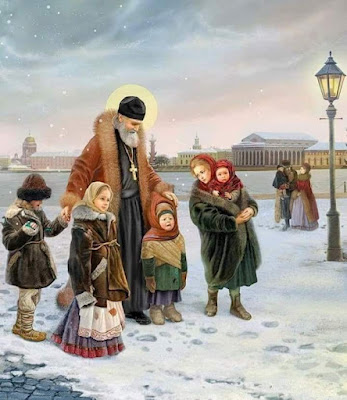
Showing posts with label St. John of Kronstadt. Show all posts

How Saint John of Kronstadt Explained To a Group of Priests His Miraculous Power


At a meeting with priests in Nizhny Novgorod in 1901 and Sarapul in 1904, [Saint John of Kronstadt] opened his soul about this gift of God and told how the healing of the sick began. On that occasion he said:

In your souls, fellow ministers, the question undoubtedly arises, how dare I travel all over Russia, to pray for so many people who beg for my prayers. Maybe someone will call it impudence... But I, brothers, would not have decided on such a great work, if I had not been called to it from above... This is how it started.

Homily Before Christmas (St. John of Kronstadt)


 By St. John of Kronstadt

Behold, beloved, the feast of the Nativity of Christ is near. Let us take care how to meet Him in a Christian, spiritual way. I know in advance how you intend to meet him: you will soon go to the markets and will bake there and talk about a lot, about the many different dishes of the feast, or you will only care about how to decorate your body with festive clothes, but one thing is needed (Luke 10:41): the thought of how to delight your soul with a spiritual blessing on the upcoming feast, how to decorate it with bright thoughts, or in a few words, how to be more worthy to meet and spend the feast - this rarely comes to anyone's mind. The flour, beloved, is always with us, and our clothes are also always with us, but the feast of the Lord is not always; therefore, we will not care much about the flour and clothes, but we will take care to be ready to meet the Most Pure Heavenly King. Let us all take care that we have a worthy, spiritual meeting of the upcoming feast. We have been singing for a long time: "Christ is born..." about why the Son of God came down to earth; why He was incarnated of the Holy Spirit and the Virgin Mary and became a man, without ceasing to be God.

The Church Where Saint John of Kronstadt Served for 53 Years


The Cathedral of Saint Andrew the First-Called was the main Russian Orthodox cathedral of Kronstadt.

The church was built in 1805–1817 to Andreyan Zakharov's designs to replace a wooden church dating from 1717 whose foundation stone was laid by Peter the Great.

In 1718, the original cathedral was ready for construction and on July 13 it was solemnly consecrated in the presence of the Emperor and his numerous retinue, as well as foreign ambassadors and envoys. It was dedicated to the Apostle Andrew, the patron saint of the Russian Navy.

Testimony of a Man That Was Healed of Blindness by Saint John of Kronstadt


In 1890, we lived in Shuvalov Park, a few kilometers from Petrograd on the railway to Finland. I was 6 years old at the time. In May, I was returning by train from the city, and on that occasion, through the window of the wagon, sparks from the locomotive flew into my right eye, after which a terrible burning occurred. The doctors tried diligently to save my sight, but in vain. There was complete blindness. I still remember being tortured with powerful lamps - projectors, which examined the inside of the eye. Because of the nerve connection, I also lost my left eye. The doctors decided to perform an operation and separate the uninjured left eye from the right one, thus saving the sight of this eye. With a bandage on the eyes, they drove me in a carriage.

Saint John of Kronstadt as a Wonderworker of our Days (St. Justin Popovich)

 
By Archimandrite Justin Popovich
 
Here is another Saint Nicholas the Wonderworker: by the power of faith, by the power of prayer, by the power of love, by the power of mercy, by the power of all the holy evangelical virtues, and therefore by the power of miracles. Yes, the same almighty Lord Christ is in Saint Nicholas the Wonderworker and in Saint John the Wonderworker of Kronstadt. The gospel is eternally true in both: "Jesus Christ is the same yesterday, today, and forever" (Heb. 13:8). He is the same, the All-Miraculous Savior, and His Saints are the same: Righteous, because He - the All-Loving - lives and works in all of them and through all of them at all times, even in our time. And Saint John of Kronstadt is, so to speak, our contemporary, he passed away on December 20, 1908. The Holy Father is righteous and entirely a Christ-bearer, He lives as an apostolic saint and works and performs miracles. His faith - apostolic, holy, strong and omnipotent - worked apostolic miracles. He passed through the vast land of Russia, performing countless and inexpressible miracles. People from all over Russia turned to him for help, for healing, for advice. He often did not have time to read countless telegrams, letters, requests, which were addressed to him for help. He blessed them at the holy proskomide, praying to the Lord to fulfill the prayers of the supplicants; and through his prayers there are healings throughout the vast land of Russia. This is what the Holy Word of God is about. There is no doubt, his help from heaven is needed by all of us people who live in this lost paradise called the earth.
 
Source: Lives of the Saints. Translated by John Sanidopoulos. 


Homily One on the Fourth Sunday of Luke (St. John of Kronstadt)

 
Homily on the Parable of the Sower

Fourth Sunday of Luke

By St. John of Kronstadt

Today, beloved, the Gospel parable was read about the sower and the seed, about the unequal quality of the land upon which the seed fell, and about the varying fates of the seed. At the end of the Gospel reading the Lord Himself, at the request of His disciples, explained the parable (Luke 8:5-15).

Pitiful man! Poor man! How many obstacles he has in this most important matter, that of saving his soul! In that he himself treads upon the saving seed of the word of God, which can make him wise unto salvation, treading upon it either intentionally, consciously, and sneeringly, or out of frivolity, neglect, and ignorance; in that the universal malefactor and blighter of the human race, the devil, snatches away the saving word; in that his hardened and obdurate heart does not permit him to be saved; in that thorns – or the various cares, passions, and pleasures of life, along with riches – set before him insurmountable barriers to salvation. Only a few, who with honest and goods hearts and true reason value their salvation as they should, patiently making use of the means for salvation that have been given us, are saved. Many are called, but few are chosen. Astonishing! What is ultimately happening here? Who is to blame for this absurdity, for this voluntary perdition of men? Man himself is to blame, for treading upon – and often learning to tread upon daily – the wondrous, great, and countless gifts of God. The Lord God, Who created him in His image and likeness, in righteousness and holiness, granted him every opportunity, every means and strength, for life and piety. Man, in his laziness and ignorance, his negligence and obstinancy, his unreasonable predilection for the here and now, is like a shadow passing through life, rushing headlong towards perdition while pushing aside the saving hand of God. Who is to blame for this perdition, if not man himself? You will say: it is impossible, or at least difficult, to be saved! But, in fact, countless multitudes of men like you have been saved; they are even now being saved, though not many. “Being saved is difficult!” But do you really want to obtain eternal life – in blessed union with God, the Mother of God, the Angels, and all the Saints – without labor? Without the labor of self-purification, assisted by grace, without the labor of prayer and vigilance, without almsgiving, without meekness, without humility, without abstinence? In the acquisition of earthly goods we do not judge labor to be superfluous, and we often work at this with all our strength; but when it comes to obtaining eternal blessedness, we throw up our hands. It is not as though the matter of salvation were extremely difficult: “For My yoke is easy, and My burden is light,” says the Saviour (Matthew 11:30). Yes, with God’s help it gradually becomes easy, though at first it is hampered by the persistent warfare with sin. But is not sin itself a matter of extreme difficulty, since it is unnatural and alien to our divine nature? Is sin not torturous? If we labor in sin, how then can we not labor in righteousness, in saving our soul from sin? There, the end is death; but here, eternal life. “For the wages of sin is death; but the gift of God is eternal life” (Romans 6:23).

Saint John of Kronstadt and the Students of the Revolution of His Time

 
Reading through the diaries and sermons of Saint John of Kronstadt, one will see that he had much to say about Russian society in his days, which was increasingly becoming more socialist and liberal, and often his observations presumed to be not very good for the future of Russia. Listener's could hear him say such things as this:

“Our ancestors sinned, but they called a sin a sin; today’s liberals however sin and try to justify the sin, as if it were a lawful deed. Take the sins of the flesh — all of this according to their opinion is not only simple weakness of human nature, but also the laws of nature and its demands. Russia is floundering, suffering, tormented by its bloody inner struggle, from bad harvests and famine, from terrifyingly high prices, from godlessness, from extreme moral degradation. Evil times — people have turned into animals, even into evil spirits. The government has become weak. It itself has falsely understood the freedom it has given to the people. Evil has increased in Russia to monstrous proportions and it has become almost impossible to set it right. When the consequences of all-around non-submission to the authorities and the inaction of the subordinate members of society, and with this inaction the action of the government ceases, as if the blood were to cease circulating in an organic body, then everything in society dies, descends, falls apart; social safety disappears and members of one society attack each other — a total rampage of thievery, plunder, enmity, and murder.”

Homily One on the Sunday Before the Nativity of Christ (St. John of Kronstadt)

 
Homily One on the Sunday Before the Nativity of Christ

By St. John of Kronstadt

We are approaching, beloved brethren, the world-saving feast of the birth in the flesh of our Lord God and Saviour, Jesus Christ. For several days before the feast, the holy Church will celebrate this wondrous mystery in the spiritual hymns of her daily services. These hymns remind us of our divine birthright, and the squandering of our sonship through sin; of its restoration through repentance of our common spiritual kinship and of the spirit of love and care for one another.
   
In order that we celebrate this feast of God's limitless love and His extreme condescension, not in a worldly, but in a spiritual manner, let us briefly consider the following: Why did God become man while remaining God? And what does God's incarnation require of us?
   

Homily Four on the Holy and All-Praiseworthy Apostle Andrew the First-Called (St. John of Kronstadt)


By St. John of Kronstadt

"What do you seek?" (John 1:38)

The Holy Apostle of Christ, Andrew the First-Called, was originally a disciple of Saint John the Baptist who prepared the people to receive the Messiah, When the Savior came out of the wilderness, the Forerunner told the people: "Behold, the Lamb of God" (Jn. 1:36). Immediately Andrew followed after Him. Turning round and seeing him together with John's other disciples, the Lord asked them: "What do ye seek?" They answered: "Master, where dost Thou dwell?" He said to them: "Come and see." The disciples saw where He lived and spent the day there with Him. Soon after this the Lord called Andrew and his brother Peter to follow after Him and told them that they were to become fishers of men unto the salvation of many. From that time forth, they remained with Christ; they were faithful to Him to the end and gave their very lives out of love for Him.

Homily One on the First Sunday of Luke (St. John of Kronstadt)


By Saint John of Kronstadt
 
“And when they had this done, they inclosed a great multitude of fishes: and their net brake” (Luke 5:6).
 
My beloved brethren, today the Gospel according to Luke was read concerning the Lord Jesus Christ’s preaching of the word of God from the ship on the lake of Gennesaret; then concerning the Lord’s command that the fisherman Peter cast his nets into the deep, and the unusually large catch of fish, from which the nets broke and the ships began to sink; concerning the fishermen’s terror at such a miraculous catch, Peter’s perception of Christ’s divine might, and his profound sense of his own weakness; and Peter’s calling from fisherman to fisher of men, and his speedy following after Him (Luke 5:1-11). Peter’s following is a miracle of Christ. 
 
We congratulate the simple, humble, and hardworking fisherman, Peter, for being raised to the rank of Apostle and fisher of men; as well as the other fishermen – James, John, and Andrew – for they all followed Christ and became His disciples and Apostles at the same time, marvelously accomplishing their saving work by catching the race of man from the depths of his sinful deception and vanity, each according to his measure.
 

Homily on the Fourth Sunday of Great Lent (St. John of Kronstadt)


By St. John of Kronstadt

Today, beloved brothers and sisters, was read the Gospel passage from the Evangelist Mark on how a father asked Jesus Christ to heal his son, a deaf and dumb child who was possessed, by casting out the evil spirit who was the reason the child was deaf and dumb. ‘Deaf and dumb spirit,’ said the Lord to the impure one, ‘I command you, come out of him and enter him no more.’ Then the spirit cried out, convulsed him greatly, and came out of him. And he became as one dead, so that many said, ‘He is dead.’ But Jesus took him by the hand and lifted him up, and he arose (Mark 9:25–27). But see how evil was the spirit who tormented the child. His father told the Lord how wherever it seizes him, it throws him down; he foams at the mouth, gnashes his teeth, and becomes rigid (Mark 9:18). This happened also at the time when the father brought his son to the Saviour. And when the Lord asked the father, as if he did not already know, even though, as God, He knows all, ‘How long has this been happening to him?’ And he said, ‘From childhood. And often he has thrown him both into the fire and into the water to destroy him,’ and he asked the Lord to have compassion on him and his son, and to help them, if He can do anything. Jesus told him: ‘If you can believe, all things are possible to him who believes.’ And the unfortunate father of little faith cried out with tears ‘Lord, I believe; help my unbelief!’ (Mark 9:21–24).

Homily Two for the First Sunday of Great Lent, the Sunday of Orthodoxy (St. John of Kronstadt)


Homily for the Sunday of Orthodoxy

By St. John of Kronstadt

"Behold an Israelite indeed, in whom is no guile!" (Jn.1:47)

Our Lord Jesus Christ said this of a certain Nathanael, an Israelite who dwelt in the Galilean town of Cana, when the latter, on the advice of his friend Philip, went to meet Jesus Christ to be assured whether He was the Messiah promised to Israel. Philip said to Nathanael, "We have found him, of whom Moses in the law, and the prophets, did write: Jesus of Nazareth, the son of Joseph!" But Nathanael said to him, "Can there any good thing come out of Nazareth?" Philip then said to him, "Come and see." When Jesus saw Nathanael coming toward Him, He said, "Behold an Israelite indeed, in whom is no guile!" Nathanael said to Him, "Whence knowest Thou me?" Jesus answered him, saying, "Before that Philip called thee, when thou wast under the fig tree, I saw thee," i.e., I knew all your thoughts, your faith, your hope for the Messiah, your future ministry. The Lord Who knows the hearts of men apparently touched the very heartstrings of Nathanael, his inmost thoughts, desires, aspirations, showing His divine omniscience plainly to him. Thus was Nathanael brought to faith in Christ, and he cried out, "Rabbi, thou art the Son of God; thou art the King of Israel!," and became His disciple.

St. John of Kronstadt: A Prophet Who Raised the Dead


By Eugene Rose
(Lay Sermon delivered in October 1966)

The newly-canonized Saint of God, John of Kronstadt [1829-1908], whose feast we celebrate on October 19/November 1, is surely one of the greatest of Orthodox Saints. Even in his own lifetime he performed, by the power of God, countless miracles. For believing Christians he was a fervent intercessor, and he healed thousands of the afflicted, whose letters and telegrams reached him every day. He was a prophet as well, and he foretold the coming Divine chastisement of the Russian people for their sins. He prophesied of the dispersion of the Orthodox Russian people to every corner of the globe, where by their presence they would make Orthodoxy known to the unbelieving world, as well as of their return to the homeland before the end of the world. And like the Prophet Elisha in the Old Testament [II Kings 4:32-37] he performed even the most impossible of miracles – he raised the dead, thus testifying to the undiminished power of God, which works even in our own day through men of faith and holy life. The following miracle is related by Eugene Vadimov in the book of I.K. Sursky, Father John of Kronstadt:

Homily One on the Day of the Foremost Apostles Peter and Paul (St. John of Kronstadt)


By St. John of Kronstadt

We magnify you, o holy foremost apostles Peter and Paul,
who have enlightened the whole world with your teachings
and brought all the ends of it to Christ.

The Lord worthily exalted the names of the holy Apostles throughout the universe: for they were the disciples and fellow laborers with Christ God, the ones who enlightened the entire world with their teachings, the world that was in darkness and in the shadow of death, they brought countless souls from the worship of idols to the knowledge of true God and from dishonor to righteous life, they lived on earth in a heavenly manner, like bodiless angels, having disdained all earthly things as corruptible and temporary, vain and sinful; they worked innumerable miracles, undertook unbelievably great labors, and finally gave their souls for the faith in their Lord. These, in general terms, are the merits of the holy Apostles, and especially of the holy Apostles Peter and Paul.

Saint John of Kronstadt on the Saints


By St. John of Kronstadt

As an ill-natured man, coming with a request to one who is kind, gentle and meek, for the greater success of his request tries to resemble him, so the Christian, approaching God with a prayer to Him, or to His most pure Mother, or to the angels and saints, in order to insure the success of his prayer, ought to try to resemble as far as possible the Lord Himself, or His most-pure Mother, or the angels and saints. In this lies the secret of drawing near to God, and of His speedily hearing our prayers.

Homily One on the Annunciation (St. John of Kronstadt)


By St. John of Kronstadt

The mystery that transpired upon this day awes not only the human mind; it likewise astonishes all angelic, exalted minds. They, too, are amazed at how God, Who is without beginning — Who is unencompassable, unapproachable — how He could lower Himself to the status of a servant and become a man, without ceasing to be God — and without in any way diminishing His Divine glory.

How could the Virgin contain within Her most-pure womb the unbearable fire of Divinity and remain unscathed — and, throughout all ages to come, be the Mother of God-incarnate?

Homily for the First Saturday of Great Lent (St. John of Kronstadt)


By St. John of Kronstadt

"Hereafter ye shall see heaven open." (John 1:51)

I congratulate myself and many of you, my beloved brethren, with the ineffable mercy of God, with spiritual renewal, obtained through the feat of spiritual preparation, prayer, fasting and repentance, and particularly through the Communion of the most pure and Life-giving Mysteries of the Body and Blood of the Lord. Even in this short time we were able to experience the benefit of fasting and prayer, let alone the benefit of spiritual preparation, confession and Holy Communion; if, of course, we wholeheartedly made use of that time for our salvation and sincerely abided by the conditions of the fast and carried out the spiritual preparation; if we abstained from the excesses in food and drink, prayed with all sincerity, humbled ourselves before God and before those who are close to us, showed mercy, learned of the multitude of our iniquities and sins and deeply regretted them, having taken a firm resolution to no longer commit them, and, finally, sincerely confessed them and received an absolution for them and their remission, and were deemed worthy to receive the Life-giving Bread.

Homily Three for Cheesefare Sunday (St. John of Kronstadt)


By St. John of Kronstadt

"For if ye forgive men their trespasses, your heavenly Father will also forgive you: But if ye forgive not men their trespasses, neither will your Father forgive your trespasses, says the Lord" (Matt. 6:14-15).

This Sunday is called Forgiveness Sunday, because today the Church directs us to read the Gospel teaching us to forgive the transgressions of others so that our heavenly Father might also forgive us our innumerable transgressions. For that reason, from the ancient times, among the pious Christians there has been a custom, in this day, and during any day of the Cheesefare week, to ask forgiveness from each other, in those things in which they may have sinned one against another. This is a beautiful, truly Christian custom, for who does not sin against his neighbor in word, deed, or thought; and asking forgiveness from another person proves our faith in Gospel, our humility, our meekness and love of peace; on the contrary, the unwillingness to ask forgiveness from those, before whom we are really guilty, reveals in the one who is unwilling to make peace, a lack of faith, pride, conceit, remembrance of wrongs, disobedience to the Gospel, resistance to God, agreement with the devil. Whereas we all are children of our heavenly Father by grace, members of Christ God, members of one body of the Church, which is His body, and members of one another; God is love 1), and more than any whole-burnt offerings and sacrifices, requires from us mutual love, that love, which is "long-suffering and kind, does not envy, does not make a vain display of itself, does not boast, does not behave itself unseemly, seeks not its own, is not easily provoked, thinks no evil, rejoices not over iniquity, but rejoices in the truth. Bears all things, believes all things, hopes all things, endures all things and never fails" 2). The entire Law of God consists of two words: love God and love your neighbor. With all that, the human heart is extremely selfish, impatient, self-willed, malicious and remembering of evil: it is ready to get angry at its neighbor not only for a direct evil, but also for an imaginary one, not only for an offensive word, but also for an unpleasant, or a harsh one, or even for a look, which appeared bad, or ambiguous, malicious, prideful, it almost gets angry even at the imagined thoughts of those around it. The Lord, Who sees the hearts, thus says of a human heart: "from within, out of the heart of men, proceed evil thoughts, adulteries, fornications, murders, thefts, covetousness, wickedness, deceit, lasciviousness, an evil eye, blasphemy, pride, foolishness" 3).

Two Homilies for the Sunday of the Last Judgement (St. John of Kronstadt)


HOMILY ONE

By St. John of Kronstadt

"I believe in the Lord Jesus Christ who will come in glory to judge the living and the dead." (7th article of the Symbol of Faith)

Who says these words? Every Christian does. Well, if every Christian says these words, then, without a doubt, so do I, and each and every one of you. Therefore, brothers and sisters, do you sincerely believe that Jesus Christ, the Righteous Judge of all those born on this earth, will come to judge the living and the dead, who will all be resurrected and receive either eternal blessedness or eternal damnation? Are you ready to meet the Judge of all and to give an answer at the terrible judgment seat of Christ for your every word and deed? Do you have any good deeds? Why do I keep asking? From the lives and deeds of Christians it is evident that they have long forgotten about the Righteous Judge, about the terrible judgment, about eternal life, and that with each passing day they rush toward eternal perdition, which they cannot even imagine. They hurry to receive their consolation here on earth, in order to be deprived of it in eternity, in heaven. They are more concerned with how to kill precious time, how to spend time in a pleasant way; but no one is concerned with how to spend time for the benefit of the soul, no one is concerned about preparing their outside work. Making it fit for themselves in the field (Prov 24:27).

Homily One for the Sunday of the Prodigal Son (St. John of Kronstadt)


By St. John of Kronstadt

"I will arise and go to my father" (Luke 15:18).

Brethren! All our attention must be centered on the parable of the Prodigal Son. We all see ourselves in it as in a mirror. In a few words the Lord, the knower of hearts, has shown in the person of one man how the deceptive sweetness of sin separates us from the truly sweet life according to God. He knows how the burden of sin on the soul and body, experienced by us, impels us by the action of divine grace to return, and how it actually does turn many again to God, to a virtuous life. We will repeat it and discuss how necessary and easy it is for a sinner to return to God.