Showing posts with label St. Epiphanios of Salamis. Show all posts

May 13, 2022

Saint Polybios, Bishop of Rhinocorura (the disciple and biographer of Saint Epiphanios of Salamis)

 
Saint Polybios probably came from Phoenicia (Lebanon). Information about his life comes from the Life of Saint Epiphanios of Salamis (Constantia), to whom he was a disciple and biographer. He became a monk from a young age, and "he was pious man and perfect in temperance", according to his biography. While Epiphanios was still in Phoenicia, and when he was a simple monk, the bishops of Palestine gathered in a Synod and decided to ordain him a bishop. So they sent to him the monk Polybios, to inform them how Epiphanios was doing in his monastery in the area of Spanhydrion, but was told not to inform him of his election, so that he could have an excuse to escape. But Saint Epiphanios recognized from divine revelation the truth, called on Polybios to remain with his brotherhood, and thus left the bishops to investigate the worthiness of another bishop.

May 12, 2022

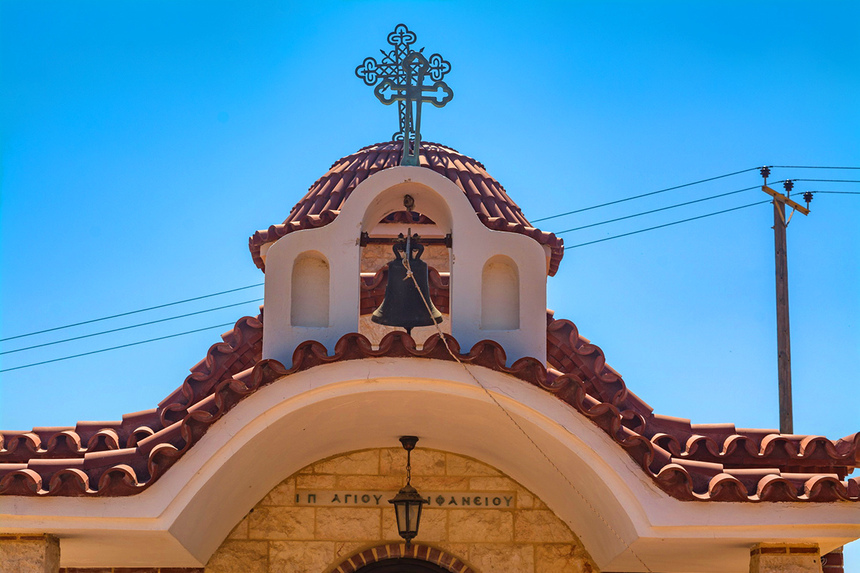
A Beautiful Chapel Dedicated to Saint Epiphanios of Salamis in Cyprus


A beautiful chapel, located east of the Cypriot village of Anarita, was recently dedicated to Saint Epiphanios of Salamis, who was Archbishop of the Church of Cyprus for 36 years, and was distinguished by his piety and love and spreading Orthodox Christianity in all corners of the island.


November 13, 2021

The Reconciliation of Saint John Chrysostom and Saint Epiphanios of Salamis

 
Archbishop Theophilos of Alexandria was the enemy of Archbishop John Chrysostom of Constantinople. Bishop Epiphanios of Salamis, an enemy of Origenism, was told by Archbishop Theophilos that Archbishop John was harboring Origenist fugitives. Epiphanios traveled to Constantinople and conspired to discredit John and cast doubts on his leadership, while John did his best to accommodate his elderly colleague from Cyprus, not knowing he had been duped by Theophilos. Their differences, however, were irreconcilable. In the end, each bishop wished a dubious fate for the other, both of which came true: Epiphanios died on his journey home, and John was deposed twice and died in exile.

May 12, 2021

Life, Works and Thought of Saint Epiphanios of Cyprus (Fr. George Florovsky)


By Fr. George Florovsky

I. Life.

Epiphanius was born in Palestine around 315. Exactly where he studied is unknown, but from his works it is evident that he was an extremely well-read man. He knew five languages: Greek, Hebrew, Syriac, Coptic, and some Latin. Epiphanius was an ascetic from his early youth. He was a close friend of Hilarion and visited the monasteries in the Egyptian desert. When he returned home, he founded a monastery near his native town of Eleutheropolis, which he directed for many years. He was a well-known figure far beyond the borders of Palestine, and in 367 he was elected bishop of Constantia (Salamis) in Cyprus. There he became renowned as an ascetic, thaumaturge, and defender of orthodoxy. From 370 he was involved in polemics with the Apollinarians. Epiphanius developed a close friendship with Jerome on the basis of their common interest in ascetic discipline, and through Jerome he became involved in the Origenist controversy in Palestine.
 

January 2, 2021

Juxtaposing the Birth and Rebirth of Christ (St. Epiphanios of Salamis)


By St. Epiphanios of Salamis

Listen now to the circumstances of Christ's twofold birth and acclaim the wonders.

An angel announced to Mary Christ's maternal birth, and an angel announced to Mary of Magdala His awesome rebirth from the grave.

At night Christ is born in Bethlehem, and at night at Sion He is reborn.

May 12, 2020

Saint Kallitropos, Sister of Saint Epiphanios of Salamis

Venerable Kallitropos (Feast Day - May 12)

Like Saint Epiphanios of Salamis, her brother, Saint Kallitropos was a Jew from Eleutheropolis in Palestine in the fourth century. When at a young age they were left orphans, Epiphanios at sixteen years old decided to convert to Christianity and to become a monk. When he approached his younger sister about his decision, he said to her: "I wish for you to become a Christian, and to take up the monastic life." His sister replied: "As you wish so I wish, as you do so I do."

A Biography of Saint Epiphanios of Salamis


EPIPHANIUS, bishop of Salamis, in the island of Cyprus, and one of the most zealous champions of orthodox faith and monastic piety, was born at Besanduke, a village near Eleutheropolis in Palestine. The year of his birth is unknown, but seeing that in A.D. 392, twelve years before his death, he was already an aged man, we may conjecturally set the date of his nativity in some year of the decade between A.D. 310 and A.D. 320. Much of his early lifetime was spent among the monks of Egypt, among whom he not only acquired a burning zeal for ecclesiastical orthodoxy and the new forms of ascetic life then coming into favour, but also came for the first time into contact with various kinds of heretics. It is probably a reminiscence of his life in Egypt, when he tells us that in his early youth, Gnostic ladies of seductive beauty had endeavoured to obtain his adhesion to their sect and given him some of their books to read. But the youthful anchorite, successfully resisting all temptations, revealed the matter to the bishops of the neighbourhood, and caused an investigation to be set on foot, which resulted in the banishment of eighty persons (Haer. xxvi. 17). At twenty years of age he returned home and built a monastery near Besanduke, of which he himself undertook the direction. It appears that he was ordained presbyter by Eutychius, then bishop of Eleutheropolis. With St. Hilarion, the founder of Palestinian monasticism, Epiphanius early stood in intimate relation, and at a time when the great majority of Oriental bishops favoured Arian or semi-Arian views, adhered with unshaken fidelity to the Nicene faith, and its persecuted champions, Eusebius of Vercelli and Paulinus of Antioch, whom Constantius had banished from their sees. In A.D. 367 he was elected bishop of Constantia in Cyprus, the ancient Salamis, where, for six and thirty years, he discharged the episcopal office with the like zeal to that with which he had presided over his monastery in Palestine. Under his influence the whole island was soon covered with monastic institutions. With the monks of Palestine, and especially those of his own monastery at Eleutheropolis, he continued as bishop to hold uninterrupted communication; and these last were unwearied in their efforts to extend his renown for piety, orthodoxy, and learning. It soon came to pass that people consulted him on all important questions of doctrine and discipline, and Epiphanius found no difficulty in convincing himself that a watchman of the church must reckon it among his duties to let his voice be heard in all the controversies of the time. Some years after his elevation to the episcopate, he addressed a letter to the faithful in Arabia, in defence of the perpetual virginity of Mary, which was afterwards incorporated, almost without alteration in his great work, Against all Heresies. {Haer. lxxviii.)

February 22, 2020

On the Commemoration of the Departed (St. Epiphanios of Salamis)


Aerius of Pontus in the fourth century rejected praying for the dead since he believed it promoted moral laxity in this life: "If the prayer of the people here has benefited the people there, no one would practice piety or perform good works." His objection was refuted by Epiphanios of Salamis.

August 12, 2019

The Russian Monk Who Drank Tea and Vodka Daily with Saint Silouan the Athonite


In a recorded talk (see video below), Metropolitan Athanasios of Limassol spoke about his first trip to Mount Athos with other young people, fellow students, when he went to visit with the great holy elders of the Holy Mountain at that time, especially Elder Ephraim of Katounakia and Elder Paisios. Those who were with him spoke about how they were miracle workers, shining with light, who had the ability to prophecy, read your thoughts and expose your sins. He thought he was going to see some larger than life figures, awesome to behold. But when he met them and saw they were simple people like himself, he was somewhat scandalized for a moment. He said: "This is the great Paisios? Who has only one blanket to sleep with? Who walks in a crooked manner, due to his asceticism? He jokes around, he gives us food to eat. We ask him one question and he responds with a different topic. This is the great saint that is spoken about. Strange indeed."

March 30, 2019

Saint John II, Patriarch of Jerusalem (+ 417)

St. John of Jerusalem (Feast Day - March 30);
Greek miniature depicts the Church of Holy Zion

Verses

The president of the perceptible throne of Zion,
Departed for the Zion which is invisible.

Our Holy Father John was born around 356 and succeeded Saint Cyril as Patriarch of Jerusalem in 387. Many scholars today ascribe to him the five Mystagogical Catecheses traditionally ascribed to his predecessor Cyril.

On September 15, 394 Patriarch John officiated in the Consecration of the Church of Holy Zion: the homily pronounced by John was preserved in Armenian and not published until 1973.

In 415, he took part in the translation of the relics of Saint Stephen the Protomartyr from his tomb in the village of Kafargamala to Jerusalem in cooperation with Bishops Eusthonos of Sebaste and Eleutheros of Jericho.

June 3, 2018

Saint Pappos the Confessor, Bishop of Chytri in Cyprus (+ 368)

St. Pappos of Chytri (Feast Day - June 3)

Verses

Pappos died not as a grandfather of grandchildren,
But as a father of daughters that were virtues.

Our Venerable Father Pappos was the first Bishop of Chytri (mod. Kythrea) in Cyprus and is known to us from the Life of Saint Epiphanios of Salamis. There we are told he was Bishop for 58 years of an insignificant town, who was revered by all for having suffered during the persecution against the Christians. Pappos was made Bishop in the year 309. The meeting between Pappos and Epiphanios took place in the following manner.

May 12, 2018

The Church and Cave of Saint Epiphanios in Ayia Napa of Cyprus


Salamis, where the Basilica of Saint Epiphanios was together with his tomb, was abandoned during the Arab invasions of the seventh century after destruction by Muawiyah I. The inhabitants thus moved to Arsinoë (Famagusta). Nearby, outside the village of Ayia Napa, was a cave on a hill associated with Saint Epiphanios, where he did his writing and praying, and there also it is said was an old church built by Saint Epiphanios himself, later dedicated to him. This church was later destroyed, leaving only the foundations.

The Basilica of Saint Epiphanios in Salamis of Cyprus


Saint Epiphanios was the Bishop of Salamis, known then as Constantia (named after Emperor Constantius II who had rebuilt Salamis after the devastating earthquakes in 350), from 368 to 403 AD; it is believed that it was during this period the basilica was built, probably around 400. It was constructed to proclaim the predominance of Christianity in a setting that was still mixed with paganism and shifting. Salamis was the administrative capital of the island, the former home town of Saint Barnabas, and it served as the seat of the Archbishop. One tradition also says that the basilica was built on the site where Saint Barnabas was martyred. According to the Acts of Barnabas, he was taken out of town and burned by the hippodrome. Nearby the basilica is a massive temple of Zeus, where Epiphanios miraculously found a large amount of gold in this temple with which to finance his building project. Along with this money, he also used the donations of grateful patrons who ascribed miracles to the Saint.

The Skull of Saint Epiphanios of Salamis


Saint Jerome calls Saint Epiphanios "the last relic of ancient piety," due to his zeal for Orthodoxy and simplicity of faith. Upon his repose in 403 he was buried in Salamis (Constantia), after serving as Bishop there for 36 years. His sacred relic was brought to Constantinople under Emperor Leo the VI the Wise (886-912). Today his holy head, or skull, is kept at Kykkos Monastery in Cyprus, as one of its most precious treasures.

May 12, 2017

Synaxarion of Saint Epiphanios the Bishop of Cyprus

St. Epiphanios, Bishop of Constantia (Feast Day - May 12)

Verses

You appeared Epiphanios as great in Cyprus,
Your fame there and death being great.
On the twelfth Epiphanios was seized by death.

The great and wonderworking Epiphanios lived during the reign of Emperors Arcadius (383-408) and Honorius (393-423). He was from the land of Phoenicia, near Eleutheropolis, the son of parents who occupied themselves with their own hands, working as farmers. Having been raised in a small home, which belonged to his poor and farming parents, he by his own labors shined in the world. For by his virtue according to God, the renowned one was raised to the extreme heights of piety and divinely-pleasing conduct.

Saint Epiphanios of Salamis Resource Page

St. Epiphanios, Bishop of Cyprus (Feast Day - May 12)

Verses

You appeared Epiphanios as great in Cyprus,
Your fame there and death being great.
On the twelfth Epiphanios was seized by death.
 
About 


Teachings and Writings 


Shrines

May 12, 2014

Saint Epiphanios of Cyprus as a Model for our Lives

St. Epiphanios of Salamis (Feast Day - May 12)

By Protopresbyter Fr. George Papavarnavas

Saint Epiphanios came from Eleutheroupolis in Palestine and lived in the fourth century. His parents were poor farmers who were Jews and raised him in the teachings of Judaism. After their death he was baptized and became a member of the Church of Christ, after being catechized by two scholar ascetics, Lucian and Hilarion. He then went to the desert of Palestine and was taught near famous ascetics. The reputation of Saint Epiphanios reached Cyprus, where he was elected Bishop of Constantia (Salamis).

May 12, 2012

St. Epiphanios of Salamis' Preface to the "Panarion"


Preface to the Panarion

By St. Epiphanios of Salamis

Greetings in the Lord from Epiphanios to his highly esteemed brothers and fellow presbyters, Masters Acacius and Paul!

By drawing up a preface, or set of remarks, as a sort of title, ancient authors would give a glimpse of the whole work following through their riddle. Hence, beloved, since I am the same sort, I am writing you a preface to give the gist of my treatise against sects. Since I shall be telling you the names of the sects and exposing their unlawful deeds like poisons and toxic substances, matching the antidotes with them at the same time - cures for those who are already bitten, and preventatives for those who will have this experience - I am drafting this Preface here for the scholarly, to explain the "Panarion", or chest of remedies for the victims of wild beasts' bites. It is a work in three volumes and contains eighty sects which stand symbolically for wild animals or snakes.

But "one after the eighty" is at once the foundation of the truth, the teaching and the saving treatment of it, and Christ's "holy bride", the Church. The Church has always been, but was revealed in due course by Christ's incarnation, during the period of these sects. I mention it in connection with the preaching of Christ. And again, after all the iniquities of these sects, I give a concise, clear account of it in accordance with the apostles' teaching, to refresh those who have read through all the laborious work on the sects.

Please, all you scholarly readers of the Preface, the Sects that follow it, and the Defense of the Truth, Exposition of the Truth, and Faith of the Holy Catholic Church, I am only human, and am trying my best to defend true religion, with hard work and zeal from God. I beg your pardon if I attempt too much in my desire to make the best defense I can in the all-holy, all-august Name itself. For God allows me this, though I am investigating matters too difficult for me, since my discussion is for truth's sake, and my work is for the sake of piety.

And further, if you should find - it is surely not my way to mock people or make fun of them. But please pardon me if, from anger over the sects and for the reader's protection, I should speak under provocation, or call certain persons "frauds", or "scum" or "pathetic". It is the very necessity for the words of the debate that puts me in such a sweat - to protect the reader and show that their practices, mysteries and teachings are the furthest thing from my mind. Also to prove my independence of them by those words and the intensity of my opposition, and wean some people away from them, precisely by the words that appear too harsh.

The Rocky Relationship Between John Chrysostom and Epiphanios of Salamis

By John Sanidopoulos

When St. John Chrysostom was Patriarch of Constantinople he became involved in the Origenistic controversies. The object in dispute was the orthodoxy of the great Origen, which long after his death was violently defended and as violently assailed.

Theophilus of Alexandria, an able and vigorous but domineering, contentious and unscrupulous prelate, was at first an admirer of Origen, but afterwards in consequence of a personal quarrel joined the opponents, condemned his memory and banished the Origenistic monks from Egypt. Some fifty of them, including the four “Tall Brethren,” so-called on account of their extraordinary stature, fled to Constantinople and were hospitably received by Chrysostom (401). He had no sympathy with the philosophical speculations of Origen, but appreciated his great merits, and felt that injustice was done to the persecuted monks. He interceded in their behalf with Theophilus, who replied with indignant remonstrance against protecting heretics and interfering in another diocese.

Theophilus, long desirous of overthrowing Chrysostom, whom he had reluctantly consecrated, set every instrument in motion to take revenge. He sent the octogenarian bishop Epiphanios of Salamis, a well-meaning and learned zealot for orthodoxy, to Constantinople, as a tool of his hierarchical plans (402). Socrates Scholasticus, the historian and a defender of Origen, admits that it was due to Epiphanios' simple mindedness that he became a tool of Theophilus. The historian Sozomen further tells us: "Epiphanios had long regarded the writings of Origen with peculiar aversion, and was therefore easily led to attach credit to ... Theophilus."

While in Constantinople Epiphanios ordained a deacon, without the permission of Chrysostom and contrary to canon law. He also refused Chrysostom's hospitality to remain at the episcopal palace. According to Socrates: "He [Epiphanios], however, replied that he would neither stay nor pray with him, unless he would expel Dioscorus and his brethren from the city, and with his own hand subscribe the condemnation of Origen's books." John's position was that "nothing ought to be done rashly before investigation by a general council". This led Epiphanios to condemn Chrysostom's behavior towards the Origenists, and prompted Chrysostom to write the following letter to Epiphanios:

You do many things contrary to the canons, Epiphanios. In the first place you have made an ordination in the churches under my jurisdiction: then without my appointment, you have on your own authority officiated in them. Moreover, when heretofore I invited you hither, you refused to come, and now you take that liberty yourself. Beware therefore, lest a tumult being excited among the people, you yourself should also incur danger therefrom.


Socrates then informs us of the following shocking details, which took place in 403:

Epiphanios becoming alarmed on hearing these admonitions, left the church; and after accusing John of many things, he set out on his return to Cyprus. Some say that when he was about to depart, he said to John, "I hope that you will not die a bishop": to which John replied, "Expect not to arrive at your own country." I cannot be sure that those who reported these things to me spoke the truth; but nevertheless the event was in the case of both as prophesied above. For Epiphanios did not reach Cyprus, having died on board the ship during his voyage; and John a short time afterwards was driven from his see, as we shall show in proceeding.

However, Sozomen reports further details that show a certain repentance on the part of Epiphanios. He says that Epiphanios met with the Tall Brothers, who asked Epiphanios why he considers them heretics and if he had ever read their books on the disputed subject. Epiphanios replied that he had not. The Tall Brothers then went on to speak of their admiration for Epiphanios and his writings, which they read and defended, and asked for a fair appraisal of their writings as well. This led Epiphanios to have a change of heart and Sozomen tells us that it was for this reason he decided to abandon hs plans in Constantinople and leave again for Cyprus.

Sozomen then tells us:

Soon after he [Epiphanios] embarked for Cyprus, either because he recognized the futility of his journey to Constantinople, or because, as there is reason to believe, God had revealed to him his approaching death; for he died while on his voyage back to Cyprus. It is reported that he said to the bishops who had accompanied him to the place of embarkation, "I leave you the city, the palace, and the stage, for I shall shortly depart." I have been informed by several persons that John predicted that Epiphanios would die at sea, and that this latter predicted the deposition of John. For it appears that when the dispute between them was at its height, Epiphanios said to John, "I hope you will not die a bishop", and that John replied, "I hope you will never return to your bishopric".

Whether these last words recorded by both Socrates and Sozomen are true or not is debateable, since they are based on hearsay. But we are sure of the conflict between these two great saints of the Church, who it seems died unreconciled on this issue of conflict, but are still recognized by the Church throughout history, even by their contemporaries, as holy men of God who defended the Faith with the right intentions. Perhaps they both were right on certain issues, and both were wrong in areas as well. Of course, Epiphanios was an extremist, whose anti-Origenism went so far as to condemn icons in churches. Perhaps Chrysostom was also an extremist for not condemning certain works of Origen which indeed showed heresy. Many profitable lessons can be learned from this dispute, and the avoidance of extremes may be the most clear one.

Documentary: Saint Epiphanios, Bishop of Cyprus (Greek)

Support the Mystagogy Resource Center

For more than fifteen years, the Mystagogy Resource Center has been a labor of love dedicated to making the riches of the Orthodox Christian tradition freely available to people throughout the world.

Thousands of articles, translations, lives of saints, theological reflections, historical resources, and daily materials have been published across this ministry’s websites, all offered free of charge for anyone seeking a deeper understanding of the Orthodox faith.

This is a one-man ministry that requires countless hours of research, translation, writing, editing, and maintenance each day.

If this work has spiritually benefited, educated, encouraged, or inspired you in any way, I humbly ask you to consider supporting this ministry financially.

Generous annual and monthly benefactors make possible the continuation and expansion of this work for the future, for without such support this ministry cannot exist.

Every contribution, whether large or small, truly makes a difference and is deeply appreciated. May God bless you abundantly for your generosity and prayers.

❖ ❖ ❖
PayPal • Credit Card • Debit Card • Venmo
Become a Patron on Patreon