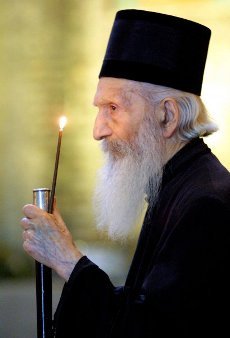
Patriarch Pavle of Serbia reposed one year ago today on 15 November 2009. He was a righteous man who has been honored with stories of his way of life. The following is from a conversation between Nikolai Kokukhin and Deacon Neboisha Topolic concerning Patriarch Pavle:
"By God’s mercy we have such a spiritual pastor as His Holiness, Patriarch Pavle… He leads an ascetic life and is a living example of an evangelical pastor. He lives in Christ in the full sense of this word… As an Orthodox monk he fasts, that is, does not eat meat, and keeps a very strict fast on Mondays, Wednesdays, and Fridays… He serves the Liturgy every morning in a small chapel in the building of the patriarchate. There is no choir there, and only parishioners sing…
He vests himself before the service and unvests after the service, he Confesses and Communes parishioners himself. He has worn the same raso and cassock from the time of his tonsure to the angelic order (and this was fifty years ago). He does not replace them. He washes, irons, and mends them himself. He prepares his own food. Once he told me that he had made himself a pair of good boots out of women’s boots. He has all the instruments for fixing boots; he himself can fix any shoes. He frequently serves in different churches, and when he sees that a priest has a torn raso or phelonion, he says to him: ‘Bring it, and I’ll fix it’… Being around such a person is a great benefit for the education of the soul, for spiritual growth."
