Showing posts with label Saints of Sinai. Show all posts

April 30, 2022

Venerable Stephen the Chorebite, Whose Incorrupt Relics Rest in the Ossuary of Saint Katherine's Monastery of Mount Sinai


The Ossuary of the Monastery of Saint Katherine, at the foot of Mount Sinai, occupies the ground floor beneath the Chapel of Saint Tryphon. When bones have been disinterred from the cemetery, they are placed in the Ossuary in an orderly manner. Memorial services are regularly held in the ossuary, commemorating those who have gone before to their rest. It is edifying to recall that our life here has its appointed end. It is also important to remember that these are the bones of those who have fallen asleep, and who lie here awaiting the Resurrection and the Second Coming of Christ.

March 11, 2021

Oikos to Saint George the Arselaites

 
On the 11th of March we commemorate Venerable George, of the Lavra of Arsela, who lived in asceticism in the land of the Sinai Fathers.
 
Oikos

Behold now, a luminous day has risen, the divine commemoration of our Venerable Father George. Come O godly-minded, with joyful leaps, let us hasten, that we may worthily honor, with divinely-inspired hymns, this ascetic who is worthy of admiration, and is a fervent intercessor to our God, imitating his conduct which is beyond reproach, and behavior which was loved by God, his contests and bouts, his sweat and ascetic toils. With this, and the innumerable miracles he performed, which were gifted to him by the compassion of God, he even as much atoned by fasting and prayer, humility and love, obedience and meekness, and every other virtue, especially temperance and righteousness. Thus, rejoicing in him let us cry out with longing: Arselaites, the ornament of the Fathers.


March 11, 2020

Saint George the Arselaites of Sinai

St. George Arselaites (Feast Day - March 11)

Verses

How did you swiftly make such a long journey?
If you weren't fleshless, then what were you in life Father?

Our Venerable Father George was an ascetic of Sinai who lived in the remote area known as Arselaou (or the Lavra of Arsela), which today is known as Wadi Remhan (or Rumhan, Rimhan), a tributary valley of Wadi Isla (which is why he is sometimes called Saint George the Islaelites). In the Ladder of Divine Ascent, Saint John Climacus mentions him as being a contemporary of his and even a spiritual father, who advised him before he embarked on holy solitude as follows (Step 22.57):

January 5, 2019

Venerable Menas of Sinai

St. Menas of Sinai (Feast Day - January 5)

Venerable Menas lived in asceticism for fifty-nine years in a certain monastery of Sinai, where he died peacefully in the second half of the sixth century. Myrrh flowed from his holy relics, which was noticed three days after his death. Saint John Climacus speaks of this wonderful man in his book The Ladder of Divine Ascent (Step 4:34), where he is portrayed as a model of blessed and ever-memorable obedience. He writes of him:

May 1, 2017

Saint Symeon of Trier, known as the Five-Tongued (+ 1035)

St. Symeon of Trier (Feast Day - May 1);
Icon in the Orthodox Chapel of Saint Athanasius the Great in the Cathedral of Trier.

Saint Symeon was born in the late 10th century in Syracuse, Sicily, to a Greek father and a Calabrian mother, during the period of Arab rule of the island. His father, who had been a soldier of the Byzantine army, sent him to Constantinople when he was seven years old to learn to read and write their native Greek language. As he grew older, Symeon decided to lead a life of a monk, so he set out on a pilgrimage to the Church of the Holy Sepulchre in Jerusalem. Afterwards, for seven years, he became a guide, leading pilgrims to the holy places, before tiring of this life and preferring instead to live as a recluse.

Having heard of a holy recluse who lived in a tower on the bank of the Jordan River, Symeon went to work as his servant, living in the lower room of the tower, while learning from his new master how to practice the life of a recluse. Forced to depart, he realized after reading and re-reading the Lives of the Fathers, that in order to become a recluse he should train for a time in a monastery. As a result, he entered the Monastery of the Virgin Mary in Bethlehem and became a monk. After two years there, he transferred to the famed Saint Catherine's Monastery on Mount Sinai in Egypt. While he was a member of that community, he was ordained as a deacon.

April 21, 2017

Narrations Concerning the Holy Fathers in Sinai (St. Anastasios of Sinai)


By St. Anastasios of Sinai

1. Ten years ago a certain two of the fathers of Holy Mount Sinai went up to worship on the Holy Summit. One of them is still alive. When they arrived at a distance of about two bow-shot from (the chapel of) Saint Elias they smelled a fragrance unlike any worldly fragrance. Then the disciple thought that the one who dwelt there was offering incense. The elder, his spiritual guide who is still living said, “The fragrance is not of this earth.”

Therefore, approaching the church, behold they saw within it like a fiery flaming kiln with tongues of fire coming from all the doors (and windows). Then, seeing this the disciple feared the sight. But the elder reassured him saying, “Why are you afraid, my child. It is an angelic power and our fellow servant; don’t lose courage. They venerate our nature in heaven; not we theirs.” Thus they fearlessly entered the church as if (going) into a kiln. They prayed and thus they ascended to the summit in the morning.

Beholding them, the guardian (of the peak) saw their faces glorified and shining like the face of Moses and he said to them, “Did you see anything unusual coming up?” Wanting to conceal the matter, they said, “No”. Then he said to them, Believe me, you saw some vision for behold your faces are radiant with the glory of the Holy Spirit.” They bowed to him and related the matter, asking that he tell nobody.

April 6, 2017

Saint Gregory of Sinai Resource Page

St. Gregory the Sinaite (Feast Days - November 27, February 11, April 6)

Verses

Saint Gregory of Sinai (+ 1346)

St. Gregory of Sinai (Feast Days - November 27, February 11, April 6)

Verses

Perceived O Gregory as the consummate standard,
You encourage all to divine prayer.

By Monk Moses the Athonite

Venerable Gregory the Sinaite was a great neptic father and teacher of noetic prayer to Mount Athos and the Balkan people.

January 29, 2017

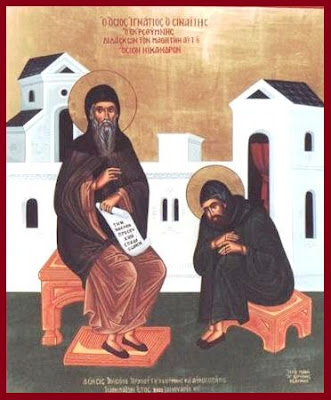
Saint Ignatios the Sinaite of Rethymno (+ 1632)

St. Ignatios the Sinaite of Rethymno (Feast Day - January 29)

Verses

Fragrant with non-possessiveness and prayer,
You gladdened Mount Sinai Ignatios.
Nikandros your subordinate O Ignatios,
You unusually saw justified.

In the sixteenth century there was a very virtuous hieromonk named Ignatios from Rethymno in Crete at Sinai in the Monastery of Saint Katherine. Ignatios took Nikandros as his novice. Since both desired to know the monasteries and hermitages of Mount Athos, they went and remained there for five years. But they again returned to the place of their repentance at Sinai believing they could find more quietness, and there they lived for the rest of their lives.

December 7, 2016

Saint Gerasimos of Euripos


Saint Gerasimos was a missionary in Greece during the years of the Frankish occupation (around the 1320's). He was born on the island of Euripos, which was a name for the island of Evia (Euboea) in the Middle Ages. His parents were from the Western French family of Regas Fatzou.

November 12, 2016

Saint Nilus the Ascetic of Mount Sinai

St. Nilus the Ascetic (Feast Day - November 12)


Verses

Nilus refreshes Egypt as well as creation,
For the great Nilus refreshed with his words and died.

Saint Nilus had been the Prefect of Constantinople in the late fourth or early fifth century. Having found a modest woman he married and had two children, one son and one daughter. Desiring to flee the glory of this world, they decided to leave Constantinople in order to live monastic lives in Egypt, each taking with them one of their children. From Alexandria therefore Nilus went to Mount Sinai with his son Theodoulos and became a monk, while his wife and daughter retired into a convent. Nilus and Theodoulos lived there in quietude and prayer, until one day the defenseless ascetics were attacked by marauding Saracens, and were slaughtered. Saint Nilus managed to flee, while his son Theodoulos was captured together with another young monk, and they were dragged away by force.

June 15, 2016

Saint Savvas of Vatopaidi, the Fool for Christ (+ 1349)

St. Savvas of Vatopaidi (Feast Day - October 11 and June 15)

Saint Savvas was born around 1283 in Thessaloniki, the son of virtuous parents, who eventually became monastics. His name in the world was Stephen. Having received his education in his native city and learning to love virtue, at the age of eighteen he secretly left his family and went to the Holy Mountain of Athos, where he subjected himself to a strict elder who lived at a cell of Vatopaidi in Karyes. There he was tonsured and took the name of Savvas. Patiently he endured the rigorousness of his elder and the difficulties of chastity, hunger, thirst, vigils, standing and unceasing prayer. And Savvas loved his elder for his strictness, for he considered him to be a sure guide to salvation. His asceticism and his virtues soon made him known among his fellow-monks.

March 29, 2016

Saint John Climacus Resource Page


Verses

John, who when alive in the flesh was dead,
Liveth eternally, though he appeareth a breathless corpse.
He left a writing, in which he showeth
A Ladder of Ascent, the journey of his own ascent.
 
About St. John and His Work


Teachings


January 14, 2016

Thirty-Three Holy Fathers Massacred at Raithu


Verses

Just as Rachel once did for her children, now for the Abbas,
Raithu weeps, having been slaughtered together with swords.

Raithu is two-days journey from Mount Sinai, on the shores of the Red Sea, where the Hebrews, in the course of their journey to the Promised Land, had found twelve springs of water and seventy palm trees (Ex. 15:27). There holy ascetics lived in quietude and prayer, until one day during the reign of Diocletian (284-305) when 300 Blemmyes from Ethiopia came ashore and killed 147 Christians from Pharan like wild animals, and captured their wives and children. They then came upon the fortified church of Raithu, where thirty-three fathers had taken refuge. There the Abbot Paul encouraged his monks to persist to the end and rejoice in joining the choir of holy Martyrs in heavenly glory.

Thirty-Eight Holy Fathers Massacred at Mount Sinai

38 Holy Fathers Massacred at Mount Sinai (Feast Day - January 14)

Verses

Swords exacted many murders,
Ill-treating men who loved virtue.
On the fourteenth the Abbas were slain with the sword.

Long before Emperor Justinian built the great Monastery on the slopes of Mount Sinai in 527 like a desert fortress to protect the monastic fathers from dangerous marauders, many ascetics were scattered throughout the wilderness in their longing to attain union with God by abandoning all things temporal and vain for a life of prayer and beloved asceticism.

Saint Theodoulos, the Son of Saint Nilus of Sinai

Venerable Theodoulos (Feast Day - January 14)

Verses

Theodoulos was seen to be great in virtue,
Imitating indeed the life of his father.

Theodoulos was the son of the wise and holy Nilus (Nov. 12), who had been the Prefect of Constantinople, but fled the glory of this world and went to Mount Sinai with his son Theodoulos and became a monk. His wife and daughter also went to Egypt and together retired into a convent. Nilus and Theodoulos lived there in quietude and prayer, until one day the defenseless ascetics were attacked by marauding Saracens, and were slaughtered. Saint Nilus managed to flee, while his son Theodoulos was captured together with another young monk, and they were dragged away by force.

April 21, 2015

Saint Anastasios of Sinai

St. Anastasios the Sinaite (Feast Day - April 21)

Verses

On Sinai, Anastasios, you became like a new Moses,
And before your end you saw the God you bear.

Our holy father among the saints, Anastasios, lived in the seventh century, and was born of pious parents, likely in Amathos of Cyprus, though he is traditionally said to have been from Alexandria. At an early age he renounced the world and all in it and took up his cross, according to the command of the Lord. He was tonsured a monk and followed Christ with eagerness, pursuing the great struggles that lead toward virtue. After visiting Jerusalem as a pilgrim and venerating the holy places in the Holy Land, he went to Mount Sinai where he found monks that lived an austere life at the Monastery of Saint Katherine, and he stayed with them. There he served with perfect obedience and extreme humility, on account of which he received gifts from God, such as wisdom and knowledge, which he used to record the many lives of the holy fathers and wrote soul-benefitting works. Having arrived at a ripe old age, he reposed in peace in the early eighth century.

April 6, 2015

Saint Gregory of Sinai as a Model for our Lives

St. Gregory of Sinai (Feast Day - April 6)

By Protopresbyter Fr. George Papavarnavas

Saint Gregory of Sinai was born in 1255 in Klazomenae, an ancient city of Asia Minor, forty kilometers southwest of Smyrna. His parents were wealthy yet pious, and raised him in "the education and admonition of the Lord." He did not love material wealth, bodily comforts and sensual pleasures, but rather the hesychastic life, which helps a person find the true purpose for their existence, which is loving communion with God and people. First he went to Cyprus, then to Alexandria, and after many adventures he arrived at Mount Sinai, where he was tonsured a monk. With asceticism and obedience he ascended the highest stages of the spiritual life, which brought envy to some monks, and this resulted in his departure for Jerusalem and from there to Crete. He then went to Mount Athos, where several monks gathered around him. Raids of the Hagarenes forced him to move first further into the Holy Mountain and then to the cities of Thessaloniki, Chios, Mytilene and Constantinople, and after a short time he returned to Mount Athos.

Eventually he settled in Adrianople, at Mount Katakekryomene, where he built a monastery and after an adventurous life he reposed there in peace.

The life and conduct of Saint Gregory of Sinai gives us the opportunity to highlight the following:

March 11, 2015

Saint George of Sinai (6th cent.)

St. George the Sinaite (Feast Day - March 11)

Our holy father, George of Mount Sinai, lived at the time of Justinian I (527-565), and during the tenure of Patriarch Peter of Jerusalem, who served for twenty-eight years (524-552).

According to Saint Sophronios (also celebrated this day), the venerable George lived and struggled virtuously in asceticism on Mount Sinai. It is said that once he had a desire to receive Holy Communion in the Church of the Resurrection of our Lord in Jerusalem and - lo, the miracle! - he found himself in that very sacred place. Indeed, a twelve-day journey was traversed in seconds! He arrived just when they were celebrating the Divine Liturgy, and received the Holy Mysteries at the hands of Patriarch Peter. (Some say that Saint George had this holy desire on the Day of the Holy Resurrection).

November 24, 2014

A Synoptic View of the Orthodox Ascetical Tradition of Mount Sinai


By Archimandrite Isaias Simonopetritis

As we approach the beginning of the third Millenium of the Christian era, we would do well to orientate ourselves meditatively, spiritually, to that sacred place, where many centuries before the Incarnation of the Second Person of God the Holy Trinity, He Who is above and beyond time and space and all created things, He Who is ever God and everywhere present, the Creator and the Icon of the Invisible Father (Col. 1:15), made His appearance to His prophet Moses, in the form of a burning bush, burning but not consumed by fire (Exodus 3:2-6).

This was the historic moment, when the Mountain of Sinai was consecrated to the unceasing worship of the Living God, the "God of Abraham, Isaac and Jacob", the God of our fathers. This was also the beginning of a meta-historic experience, whereby man approached God, so as to know himself better, and ascending in stages, reached the summit of perfection, of which the craggy peak of Sinai was, and is, such an eminent and inspiring symbol.

But, theologically also, the appearance of the Incomprehensible Divinity in a bush, burning but not consumed, was an important symbol of the visit from on high of the pre-eternal Son of God, born of a Virgin, whose womb remained intact as before.

Sinai's mystical consecration as the Mountain on which God walked and talked with his chosen servants, is contrasted with an episode of a very different kind, also in the Book of Exodus.

Support the Mystagogy Resource Center

For more than fifteen years, the Mystagogy Resource Center has been a labor of love dedicated to making the riches of the Orthodox Christian tradition freely available to people throughout the world.

Thousands of articles, translations, lives of saints, theological reflections, historical resources, and daily materials have been published across this ministry’s websites, all offered free of charge for anyone seeking a deeper understanding of the Orthodox faith.

This is a one-man ministry that requires countless hours of research, translation, writing, editing, and maintenance each day.

If this work has spiritually benefited, educated, encouraged, or inspired you in any way, I humbly ask you to consider supporting this ministry financially.

Generous annual and monthly benefactors make possible the continuation and expansion of this work for the future, for without such support this ministry cannot exist.

Every contribution, whether large or small, truly makes a difference and is deeply appreciated. May God bless you abundantly for your generosity and prayers.

❖ ❖ ❖
PayPal • Credit Card • Debit Card • Venmo
Become a Patron on Patreon