Showing posts with label Philokalia. Show all posts

March 5, 2022

Introduction to the Writings of Saint Mark the Ascetic in the 'Philokalia' (St. Nikodemos the Hagiorite)


By St. Nikodemos the Hagiorite

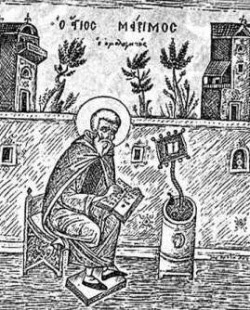
Our venerable father Mark the Ascetic thrived in the year 430. He was a disciple of Saint John Chrysostom, according to Nikephoros Kallistos (vol. 2, bk. 14. ch. 53), and was a contemporary of Saint Nilus and Isidore of Pelusium, who were famous ascetics. Diligent in the study of the Scriptures, he wrote many discourses full of abundant learning and spiritual benefit. Of these, 32 are mentioned by Nikephoros Kallistos, which teach the entire path of the ascetic life, though they have not been preserved. Only eight of his discourses survive, different from the above, which are mentioned by both Kallistos and the critic Photios (codex 200).

February 9, 2022

Introduction to the Writings of Saint Peter of Damascus in the 'Philokalia' (St. Nikodemos the Hagiorite)


By St. Nikodemos the Hagiorite

Our Venerable Father Peter, who served as Bishop of Damascus, lived during the reign of Constantine Copronymus in the year 775. Having first lived ascetically as a monk and anchorite, he lived with such non-possessiveness that he did not even have a book of his own, as he testifies of himself. However, taking books from others, I mean the Old and New Testaments, the great teachers of the Church and all the other Neptic and God-bearing Fathers in general, he showed such diligence that, studying day and night the law of the Lord and drinking from their life-giving waters, he showed himself truly to be like a tree that is tall and heavenly, according to the Psalmist (Psalm 1:3), planted by these springs of waters of the Spirit. With one difference: the tree bears its fruit in a single season; the other tree, however, namely the Venerable Peter, does not do the same, but remaining continuously and relentlessly sturdy, in every season it bears spiritual fruit that is beautiful to the sense of sight, sweet to the sense of taste, fragrant to the sense of smell, which satiates every sense of body and soul with the immortal and fragrant sweetness they emit.

January 21, 2022

Introduction to the Writings of Saint Maximos the Confessor in the 'Philokalia' (St. Nikodemos the Hagiorite)


 Introduction to Saint Maximos the Confessor 
 
By St. Nikodemos the Hagiorite

(The Philokalia, vol. 2)

Our Holy Father Maximos the Confessor lived during the reign of Constantine Pogonatos, around the year 670, and was, of all, the chief destroyer of the ill-famed Monothelite heresy.

At first he distinguished himself in the royal palaces and was honored with the office of Chief Secretary, then, leaving worldly endeavors behind, he engaged himself in ascetic combat. His mouth approached the fount of wisdom, and drinking incessantly from the fountains of the divine Scriptures which flow with life, he made to gush forth from his belly rivers of divine doctrines and writings which flooded the ends of the universe.  

September 19, 2021

Galatians 2:20 in Light of the Fathers of the "Philokalia"


"I have been crucified with Christ; it is no longer I who live, but Christ who lives in me; and the life I now live in the flesh I live by faith in the Son of God, who loved me and gave himself for me."

- Paul the Apostle 
(Galatians 2:20)

+ + +

74. He who yokes the practice of the virtues to spiritual knowledge is a skillful farmer, watering the fields of his soul from two pure springs. For the spring of spiritual knowledge raises the immature soul to the contemplation of higher realities; while the spring of ascetic practice mortifies our earthly members: ‘unchastity, uncleanness, passion, evil desire’ (Col. 3:5). Once these are dead, the virtues come into flower and bear the fruits of the Spirit: ‘love, joy, peace, long-suffering, kindness, goodness, faith, gentleness, self-control’ (Gal. 5:22-23). And then this prudent farmer, having ‘crucified the flesh together with the passions and desires’ (Gal. 5:24), will say together with St Paul: ‘I no longer live, but Christ lives in me; and the life I now live ... I live through faith in the Son of God, who loved me and gave Himself for me’ (Gal. 2:20). 

- Theodoros the Great Ascetic 
(A Century of Spiritual Texts)

April 17, 2021

Saint Makarios of Corinth as a Model for our Lives

St. Makarios of Corinth (Feast Day - April 17)

 By Protopresbyter Fr. George Papavarnavas

Saint Makarios lived in the 18th and beginning of the 19th centuries (1731-1805). He was born in Trikala, Corinth, came from the famous Notaras family, and his parents were named George and Anastasia. His baptismal name was Michael. He was first educated in the Monastery of the Panagia, in his own homeland, by the teacher Eustathios who was from Kefallonia. He loved prayer and the hesychast life, and for this he went to the Holy Monastery of Mega Spelaion to become a monk, but his father had him return home. After his teacher reposed, he occupied himself with the work of a teacher successfully for some time. He was loved by the Corinthians for his learning, and especially for his ethos and the modesty of his life. For this reason, after the death of the Archbishop of Corinth, he was proposed to the Ecumenical Patriarch Samuel to be his successor. As Archbishop of Corinth he was devoted to the rational flock entrusted to him by Christ through the Church.

January 17, 2020

"On the Character of Men and On the Virtuous Life": 170 Texts (St. Anthony the Great)


The first of the five volumes of the Philokalia of Sts. Nikodemos the Hagiorite and Makarios of Corinth begins with 170 texts attributed to St. Anthony the Great, titled "On the Character of Men and On the Virtuous Life." Unfortunately, in the English translation of Kallistos Ware, G.E.H. Palmer, Philip Sherrard this work is relegated to the Appendix, due to the belief that it is not an authentic work of St. Anthony. Whether or not it is an authentic work of St. Anthony, there is a purpose for it being the first work of the Philokalia that the aforementioned translators didn't seem to understand, thus tainting the publication. Dumitru Staniloae, in his Romanian translation of the Philokalia, defends the authorship of St. Anthony the Great of this work and places it in its right place (even though he changes the order of other authors), as did Dr. Constantine Cavarnos in his English translation of the Philokalia. Fr. Staniloae makes references to the studies of F. Klejan, M. Viller and K. Rahner, but he ignores I. Hausherr's article in 1933 [Irénée Hausherr, “Un écrit stöicien sous le nom de Saint Antoine Eremite”, Orientalia Cristiana 30 (1933) 212-216.] which sets to prove that Anthony is not the author of this work but that it has Stoic origins. Dr. Cavarnos includes footnotes in his translation showing the comparisons and similarities between this work and the letters attributed to St. Anthony.

The Introduction below was translated by Cavarnos, and the 170 texts themselves were translated by Ware, Palmer and Sherrard.

November 15, 2019

The Life and Mission of St. Paisius Velichkovsky (1722-1794)


THE LIFE AND MISSION OF ST. PAISIUS VELICHKOVSKY 1722-1794

An Early Modern Master of The Orthodox Spiritual Life

By John A. McGuckin

Spiritus: A Journal of Christian Spirituality
(Volume 9, Number 2, Fall 2009, pp. 157-173)

Many people today have become familiar with the figure of the Russian Pilgrim. The book, The Way of a Pilgrim, purports to have been written as the autobiographical record of a poor and barely educated Russian peasant of the 19th century. Treading his way across the Steppes, enduring countless hardships and adventures as he persevered, gripped only with the reading of his beloved book of the spiritual writers of the Early Church, he directed all his mental energies around the countless recitation: “Lord Jesus Christ, Son of God, have mercy on me a sinner.” This famous story is designed to advocate how the prayer of the heart can happen if one wills it: a mystical transitioning from prayer on the lips, to prayer in the mind, to prayer of the heart: namely, prayer in the deepest levels of the human spirit’s personal communion with the Risen Christ.

March 29, 2019

Introduction to the Philokalic Writings of Saint Hesychios of Sinai


By Elder Basil of Poiana Marului
Spiritual Father of St. Paisius Velichkovsky

In a certain sense, the life and teachings of the holy fathers is like the way men provide for all their bodily needs and necessities. A person who has mastered some craft or skill uses it to support himself. Another person puts his efforts into the various chores of farming and procures all the necessities for his household this way. Still others, who are more enterprising, instead of such crafts and occupations as these, acquire, say, a ship or a vineyard and thus satisfy their needs free from all the anxiety and instability and vicissitudes of working for a living.

This pattern can also be observed in the spiritual life. Some of the holy fathers, in view of the weakness of those who have just entered into monasticism, assign them, along with fulfilling the commandments of Christ, prolonged reading of the psalms, canons and troparia which have been instituted by the Holy Spirit for the glorification of God and as a rule for monastics. But there are others who have learned the refined skill of spiritual understanding and who do not want beginners to be occupied only with physical training. Together with the commandments of Christ, they give them a moderate rule of psalmody, that is nocturns, matins, the hours, vespers and compline, and in place of lengthy psalmody they lay down the rule of practicing noetic prayer, with this additional condition: should the Holy Spirit visit a person through the activity of prayer of the heart, then he should by all means leave off the above said external rule, because internal prayer fulfills it. Such instructors impart noetic work in part, but not to a very great extent, says St. Gregory of Sinai. There is a third group who from great skill and examination of the lives and writings of all the saints, and especially through the action and wisdom of the Holy and Life-giving Spirit, lay down the learning and practice of noetic prayer as a general rule, especially for beginners; for this, they say, is the mortification of the passions by fulfilling the commandments of Christ. They divide it into two principalities, like a second Paradise which gushes forth an ocean divided into two streams, that is active and spiritual prayer.

March 4, 2019

Which is the Greatest Virtue? (St. John Cassian)


By St. John Cassian

On the Holy Fathers of Sketis
And on Discrimination

Written for Abba Leontios

I remember how in my youth, when I was in the Thebaid, where the blessed Anthony used to live, some elders came to see him, to enquire with him into the question of perfection in virtue. They asked him: "Which is the greatest of all virtues - we mean the virtue capable of keeping a monk from being harmed by the nets of the devil and his deceit?" Each one then gave his opinion according to his understanding. Some said that fasting and the keeping of vigils make it easier to come near to God, because these refine and purify the mind. Others said that voluntary poverty and detachment from personal possessions make it easier, since through these the mind is released from the intricate threads of worldly care. Others judged acts of compassion to be the most important, since in the Gospel the Lord says: "Come, you whom my Father has blessed, inherit the kingdom prepared for you from the foundation of the world; for I was hungry and you gave Me food" and so on (Matt. 25: 34-36). The best part of the night was passed in this manner, taken up with a discussion in which each expressed his opinion as to which virtue makes it easiest for a man to come near to God.

August 25, 2018

The One-Hundred Texts of Saint John of Karpathos: "For the Encouragement of the Monks in India"


For the Encouragement of the Monks in India

One Hundred Texts

By St. John of Karpathos

When making a request to an earthly king, sometimes men bring with them as an offering nothing more than a bunch of spring flowers; yet often, so far from rejecting their request, the king has even presented them with gifts in return. In the same way I, at your command, have gathered from various sources a century of spiritual texts: this is my offering to you who are 'citizens of heaven' (Phil. 3:20). I hope that you will accept what I offer and grant me in return the gift of your prayers.

June 26, 2018

Saint Theoleptos, Metropolitan of Philadelphia (+ 1322)

St. Theoleptos of Philadelphia (Feast Day - June 25)

Saint Nikodemos, in his Introduction to the writings of Saint Theoleptos in the Philokalia, tells us the following about him:

"Theoleptos, the truly great luminary of Philadelphia, flourished during the reign of Andronikos II Palaiologos, around the year 1325. He first lived the solitary life at the Holy Mountain, and from there received the dignity of Primate of the Metropolis of Philadelphia. Saint Gregory (Palamas) the Archbishop of Thessaloniki was his guide and mystagogue in lessons of excellence. He initiated him in sacred watchfulness and noetic prayer, although he still lived in the world, as is written in the life of Gregory written by Patriarch Philotheos.

May 20, 2018

Saint Thalassios of Libya (+ 648)

St. Thalassios of Libya (Feast Day - May 20)

Verses

Thalassios dwelling in the grave,
Gushes forth a sea of grace from the grave.

Our holy Father Thalassios was from Libya in Africa, and both a priest and an abbot, who lived during the reign of Constantine Pogonatos (668-685). He was an ascetic author, whose four centuries titled On Love, Self-control and Life in accordance with the Nous appears in the Philokalia. This is his only known writing.

He was a personal friend of Saint Maximus the Confessor, whose largest work, To Thalassios: On Various Questions Relating to Holy Scripture, consists of answers to difficulties raised by Saint Thalassios. The Two Hundred Texts on Theology by Saint Maximus are also dedicated to Saint Thalassios, and in addition five of Saint Maximus’ letters are addressed to him. Twice Saint Maximus describes himself as a disciple of Saint Thalassios. Perhaps this is no more than an expression of courtesy towards someone older than himself, and it may have been Saint Thalassios who was in reality the disciple: but it is not impossible that Saint Maximus was indeed decisively influenced by him.

Saint Thalassios, like Saint Maximus, sees self-love as the source of all the vices, and the two agree in emphasizing the supreme importance of love. He reposed in peace in the year 648.

April 17, 2018

Saint Makarios of Corinth Resource Page

St. Makarios Notaras (Feast Day - April 17)
 
Life and Veneration 


The Kollyvades Movement 


The New Martyrs and Saint Makarios


Miracles and Shrines 


April 14, 2018

The Kollyvades Movement as it Appears Throughout History and in the Present


By Archimandrite Ephraim, Abbot of Vatopaidi Monastery

Throughout the history of the Church, the Holy Spirit has been endorsing some spiritual figures who not only leave their mark in their times but also become illuminating beacons for the future generations. Therefore, by looking up to them, we “the ones who have reached the end times” are able to sail through the seas of tribulation, of passions and of the devil’s delusions without danger, without “wetting our feet” to reach the port of the “true life”, of dispassion, of Sabbatism and thus accomplish our deliverance. Such personalities were the Three Hierarchs, St Maximus the Confessor, St Symeon the New Theologian, St Gregory Palamas as well as the Fathers of the Kollyvades movement.

March 29, 2018

"On Watchfulness and Holiness" (St. Hesychios of Sinai)


Introductory Notes

Saint Nikodemos the Hagiorite identifies the writer of this work that follows, "On Watchfulness and Holiness", with Saint Hesychios of Jerusalem, author of many Biblical commentaries, who lived in the first half of the fifth century. But it is today accepted that "On Watchfulness and Holiness" is the work of an entirely different Hesychios, who was abbot of the Monastery of the Mother of God of the Burning Bush (Vatos) at Sinai. Hesychios of Sinai's date is uncertain, as well as any details of his life, though he is commemorated in the Greek Orthodox Church on March 29th. He is probably later than St John Climacus (sixth or seventh century), with whose book The Ladder of Divine Ascent he seems to be familiar; possibly he lived in the eighth or ninth century though he is not mentioned in any source until the thirteenth century. As well as drawing upon Climacus, he incorporates in his work passages from Saint Mark the Ascetic and Saint Maximus the Confessor.1

July 19, 2017

Saint Theodore the Sabbaite, Bishop of Edessa

St. Theodore of Edessa (Feast Day - Slav. July 9 & Gr. July 19)

Verses

You were a gift of God thrice-blessed Theodore,
As one who is great you gave much to Edessa.

Our Holy Father Theodore was born in the Mesopotamian city of Edessa and lived during the ninth century. His parents, Symeon and Maria, who were pious Christians, had given birth to a daughter but also desired a son, for which they prayed. One night both had the same vision of Saints Theodore and Paul the Apostle, telling them that they would indeed be granted a son. At the age of two he was baptized by the Archbishop and given the name Theodore, which means "gift of God." At the age of five, his parents began his schooling, but he had great difficulty grasping his lessons, and for this his parents reproached him, and his teacher even struck him.

July 3, 2017

On Guarding the Nous: Twenty-Seven Texts (St. Isaiah the Anchorite)


According to St. Nikodemos the Hagiorite, St. Isaiah the Anchorite, or the Solitary, lived around the year 370 and was a contemporary of Makarios the Great of Egypt. Most historians today consider him to be later in date. He is now usually identified with a monk who lived initially at Scete in Egypt, and who then moved to Palestine at some date subsequent to 431, eventually dying in great old age as a recluse near Gaza on 11 August 491 (according to others, 489). Whichever date is preferred, it is evident that the author reflects the authentic spirituality of the Desert Fathers of Egypt and Palestine during the fourth and fifth centuries. St. Nikodemos commends in particular his advice on the rebuttal of demonic provocations and on the need to be attentive to the conscience. St. Nikodemos here gives in the first volume of the Philokalia no more than short extracts from a much longer work.

On Guarding the Intellect:*
Twenty-Seven Texts

By St. Isaiah the Anchorite

1. There is among the passions an anger of the intellect, and this anger is in accordance with nature. Without anger a man cannot attain purity: he has to feel angry with all that is sown in him by the enemy. When Job felt this anger he reviled his enemies, calling them "dishonorable men of no repute, lacking everything good, whom I would not consider fit to live with the dogs that guard my flocks' (cf Job 30:1, 4. LXX). He who wishes to acquire the anger that is in accordance with nature must uproot all self-will, until he establishes within himself the state natural to the intellect.

May 4, 2017

Saint Nikephoros the Monk, also known as the Hesychast

St. Nikephoros the Hesychast (Feast Day - May 4)

Verses

You know grace well O Father Nikephoros,
The art of prayer, you dispatched in life.

Saint Nikephoros the Monk, also known as the Hesychast, is known to us from the life of Saint Gregory Palamas, who had Saint Nikephoros as a teacher and guide. According to Gregory he was ‘an Italian’ who converted from Catholicism to Orthodoxy. This could mean that he was of Greek descent, from Sicily or Calabria, but whose family had been forced into union with Rome, or it could mean that he was an Italian of mixed Greek and Italian parentage. This we shall never know for certain. However, we do know that when he came to Constantinople, Nikephoros opposed the Unionist policies of Emperor Michael VIII Palaeologos (1259-1282) which were later agreed upon at the Synod of Lyon in 1274. Because of this, he was imprisoned in 1267-8 and later wrote an account of his ordeal. Moreover, by his stand for Orthodoxy, he won many disciples among the elite of the Imperial Capital.

April 25, 2017

Saint Basil the Hesychast, Abbot of Poiana Marului Skete (+ 1767)

St. Basil the Hesychast (Feast Day - April 25)

In his autobiography, Saint Paisius Velichkovsky calls his spiritual father Saint Basil the Hesychast "our common teacher and instructor, the most pious and holy elder and schema monk Basil." He was born near Poltava (Ukraine) in 1692 and is a representative of the Russian-Ukrainian monastic migration that occurred in the 18-19th centuries because of the reforms of Peter the Great in Russia and the persecution of the Orthodox believers in Ukraine which was under Polish rule.

He went to Wallachia with his disciple Monk Michael and received monastic tonsure at Dalhautsi-Focshani Skete in 1705 or 1706, laboring in asceticism with great fervor. There he studied the depths of the Holy Scriptures and read many writings of the Holy Fathers. Saint Basil was ordained to the holy priesthood and became abbot of Dalhautsi in 1715. He remained in that position for twenty years, and was a wise instructor of about forty monks, teaching them obedience, humility, and the art of Noetic Prayer. The art of Noetic Prayer he learned at the Pocrov Skete, initiated by Saint Pachomius the Bishop of Roman (+ 1726), decades before the compilation of the Philokalia.

April 22, 2017

Kollyvades Movement Resource Page

Holy Kollyvades Fathers (Feast Day - Bright Saturday)

Verses

Rejoice thou Kollyvades of Athos,
Now the Bride of Christ, the Church, rejoices.

+++

The Kollyvades sowed the knowledge of God,
Reaping a bounteous sheaf of life.

+++

Let us rest on this Bright Day,
Crowning the Kollyvades as workers of light.
 
About 


Figures 


Support the Mystagogy Resource Center

For more than fifteen years, the Mystagogy Resource Center has been a labor of love dedicated to making the riches of the Orthodox Christian tradition freely available to people throughout the world.

Thousands of articles, translations, lives of saints, theological reflections, historical resources, and daily materials have been published across this ministry’s websites, all offered free of charge for anyone seeking a deeper understanding of the Orthodox faith.

This is a one-man ministry that requires countless hours of research, translation, writing, editing, and maintenance each day.

If this work has spiritually benefited, educated, encouraged, or inspired you in any way, I humbly ask you to consider supporting this ministry financially.

Generous annual and monthly benefactors make possible the continuation and expansion of this work for the future, for without such support this ministry cannot exist.

Every contribution, whether large or small, truly makes a difference and is deeply appreciated. May God bless you abundantly for your generosity and prayers.

❖ ❖ ❖
PayPal • Credit Card • Debit Card • Venmo
Become a Patron on Patreon