Showing posts with label Saints of July. Show all posts

The Appearance of Saint Kosmas Aitolos to a Woman in Arnaia on July 23, 1943


Saint Kosmas Aitolos visited Arnaia and Halkidiki in 1775. The memory of this visit is still alive today in the consciousness of the local Christians. Monuments to the passage of the Saint are the shrine under the Mathitiki Estia and the icon which records the prophecy of the Saint for the liberation of Arnaia. Since then, the Saint placed the area of ​​Holomontos under his blessing. 
 
"The aprons of Holomontos will be without blood. They will go to sleep as slaves and in the morning they will wake up free." 
 
The prophecy was fulfilled, and in 1912 Arnaia was freed "without blood", according to the prophecy of the Saint.
 

Saint Eugenios the Aitolos, A Supporter of the Greek Nation in Difficult Times


By Fr. Elias Makos

Saint Eugenios Yiannoulis the Aitolos, from Megalo Dendro in Thermo, who celebrates on August 5 (he reposed on August 6, 1680, but the celebration of his memory was moved a day earlier, due to the great feast of the Transfiguration of the Savior), may not be particularly well known nowadays, however, his contribution to the enslaved Greek nation, through education, was very great.

Indeed, he paid the heavy price of being removed from the priesthood for his contribution to the Fatherland, but in 1639 he was restored with honors by Patriarch Parthenios, while in 1982 he was canonized.

Homily on Saint Paraskevi the Wonderworker (Metr. Hierotheos of Nafpaktos)

 
 By Metropolitan Hierotheos of Nafpaktos and Agiou Vlasiou

Saint Paraskevi is honored not only by those women who bear her name, but also by all Christians. This happens especially in our Province, since there are many parish churches, but also chapels that are honored with her name and on this day they celebrate brilliantly.

The life of Saint Paraskevi is wonderful. Her parents were pious and virtuous, her birth was by God's intervention, she herself grew up in a Christian way, distributed her property to the poor, became a nun, preached Christ, confessed Him and finally suffered many tortures and was martyred for the love of Christ. That's why she is called a Venerable Martyr.

Crypt of Santa Cristina in Carpignano Salentino


A gate and small baroque facade may mislead you into thinking there is not much to see at the Crypt of Santa Cristina (also known as the Crypt of Madonna delle Grazie) in Carpignano Salentina, but that would be wrong. Because once inside you'll descend some steps and enter two chambers carved out of limestone, where you'll discover that the Crypt of Santa Cristina is a big deal, after all. It contains the oldest Byzantine frescoes in Puglia, the most ancient inscription dates them to 959, signed by Teofilatto. Santa Cristina is also one of oldest place of worship in Puglia.

Monastery of Saint Eupraxia in Hydra


The picturesque island of Hydra, located in the Saronic Gulf, is one of the most popular tourist destinations in Greece.

One of the main and, perhaps, the most interesting sights of the island of Hydra is the Convent of Saint Eupraxia. It is located in an amazingly beautiful place among pines and cypresses on the slope of the islands highest peak, Mount Eros (588 m), at an altitude of about 500 meters above sea level. Nearby is the slightly older Monastery of the Prophet Elias.

The Monastery of Saint Eupraxia was built in 1819, while the katholikon, or central church, was built in 1829. The builder was Fr. Hierotheos Dokos, who named the monastery after the patron saint of his daughter, who bore the name Eupraxia, and from a young age dedicated her life to Christ as a nun.

Saint Symeon the Fool for Christ as a Model for our Lives

St. Symeon the Fool for Christ (Feast Day - July 21)

By Protopresbyter Fr. George Papavarnavas

Saint Symeon the Fool for Christ came from Edessa in Syria and lived in the 6th century AD. Together with his friend John, they set out, both young, to go to Jerusalem to worship. With them were the mother of Symeon, the father of John, and his young wife whom he had married a short time earlier. Along the way, the desire to dedicate themselves to God ignited in them. That is why they prayed fervently and begged God to lead them to a monastery, and to take care of their relatives and comfort them, and it happened so. Therefore, they both went to the desert of Jordan and decided to go to a monastery where they will find a welcoming door.

Synaxarion of the Finding of the Honorable Head of our Venerable Mother Matrona of Chios


 By St. Nikephoros of Chios

Synaxarion

On the 15th of this month [July], we commemorate the finding of the honorable Head of our Venerable Mother Matrona of Chios.

Verses

You departed the world completely unworldly,
The virgin approaching Christ as a bride.
On the fifteenth the head of Matrona was taken from the earth.


A sufficient amount of years passed after the death and burial of the Saint, and her miracles, as a bottomless well, were increasing for those who came with faith to her temple (those bound came from everywhere and received their desired health). The people of Chios, whose children are tenderly loved by the Saint, wanted to restore her sacred temple, and they made it spacious, so that the crowds can go through the entrance. In an attempt to move her grave, they found inside her holy Head, as an inviolate treasure, a wealth that cannot be taken away, and they breathed in a wondrous fragrance, which everyone could smell. At the time it was found, many miracles occurred - a paralytic stood up, and a stammering woman rose from her bed glorifying God with clear words, on her own behalf and on behalf of the paralytic that was healed. These and other things always take place until today by the Saint, which is why the commemoration of the finding was established to be celebrated today, for our benefit, and the honor and glory of the Saint, and those who have been healed by God glorify him.

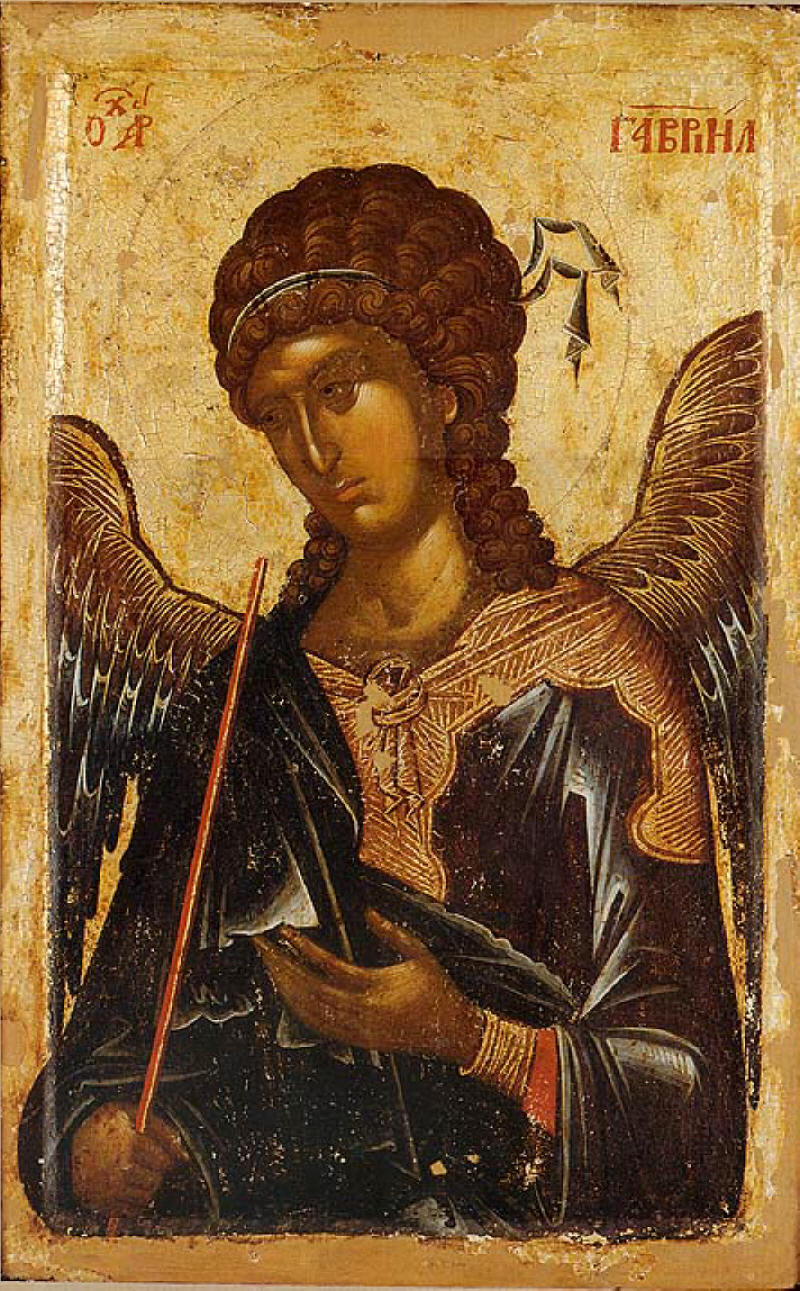
On the Synaxis of the Archangel Gabriel in July (St. Justin Popovich)

Synaxis of the Archangel Gabriel (Feast Day - July 13)

 By St. Justin Popovich

We praise with songs the harbinger of our salvation, the great servant of God, and the joyful messenger to the Most Pure Virgin Mary, the Archangel Gabriel, organizing a festive synaxis for him for the second time. His first synaxis is celebrated the day after the Annunciation of the Blessed Virgin Mary, the twenty-sixth of March; and now that synaxis of his is being celebrated again in the holy Church, and his miraculous appearances are again being mentioned and celebrated by God's order.

He taught Moses, who escaped from Pharaoh, in the desert to write books, telling him the origin of the world, the creation of the first man Adam, his life and that of the patriarchs after him, the latter times, the flood and the division of the people; he explained to him the position of the heavenly planets and the elements; taught him arithmetic, geometry, and all wisdom.

Saint Sophrony of Essex Resource Page

St. Sophrony of Essex (Feast Day - July 11)

Verses

Sophronios greatly shined in his life,
Now he more than shines in the chorus of the Saints.
On the eleventh Sophronios was placed with the Spirit of God.


Two Chapels Dedicated to the Newly-Canonized Saints Kallinikos of Edessa and Sophrony of Essex in Nafpaktos  
 

Holy New Martyr Athanasios of Lemnos (+ 1846)


He was from the village of Repanidi on the island Lemnos and after receiving an education he went to become a monk on Mount Athos, at the Great Lavra Monastery.

During the Greek Revolution of 1821 he was captured and sent to Egypt. There they sold him as a slave to a Hagarene lord, who converted him to Islam, circumcised him, and married him to a Christian captive woman. He became a wealthy aga and lived a secluded life with his wife on a large property.

Photos of the Home and Parish Church of the Holy Neomartyr Michael Paknanas the Gardner


The first photo above is the residence of the Holy Neomartyr Michael Paknanas in the old quarter of Vlassaros (Vrisaki) in the ancient Agora near the Church of Saint Philip and the adjacent Church of Panagia Vlassaros (first photo below), which ware also located in the archaeological site of the ancient Agora and where the Neomartyr worshiped. All the original buildings have now been demolished.
 

A Miracle of Saint Thomas of Maleon in Casablanca in 1991

 
By Archimandrite Daniel Gouvalis

July 1991. A coach from Athens visited Velanidia (a village built on the southernmost edge of the Parnon mountain range). Fifty Christians wished to worship at the Church of Saint Thomas of Maleon and receive the sanctifying grace from its spring. Out of bad judgment, a large coach was used, while they should have taken a small one. How it managed to take the turns, as it approached the village, is inexplicable. It can only be explained as a miracle of Saint Thomas.

The devout pilgrims, after making a supplication to the Saint and after prostrating before his holy relic – some felt that it gave off a divine aroma – reverently drank from the holy water. Moreover they took some with them in bottles. One of these bottles of Saint Thomas's holy water traveled a long, long way. It reached Morocco, to the great city of Casablanca.

The Veneration of Saint Asteios (Asti) in Albania


The Church of Durrës (ancient Dyrrachium), one of the most important Churches in Albania, was founded by Paul the Apostle, although an ancient tradition says that the first to pass through was Saint James, on his way to Spain. Near Durrës, where the town of Shijak (Saint James) now stands, there was a large cathedral dedicated to Saint James, just beyond the hill, where according to tradition he had given his first sermon. According to old documents, in 58 AD, the Church of Dyrrachium had about 70 Christian families.

The Cave-Tomb of Saint Juvenal, the First Patriarch of Jerusalem


By Fr. Elias Makos

On July 2nd, the Church honors the memory of the first Patriarch of Jerusalem, Juvenal.

The Cave-Tomb of Saint Juvenal in Jerusalem is preserved within the Monastery of Saint Onouphrios in the area of Siloam.

Gradually the Bishopric of Jerusalem, which was founded on the day of Pentecost with the Bishop James the Apostle, developed into a pan-Christian place of pilgrimage, and it became the Metropolis of the Three Palestines (beginning of the 5th century).

Venerable Stephen the Chorebite, Whose Incorrupt Relics Rest in the Ossuary of Saint Katherine's Monastery of Mount Sinai


The Ossuary of the Monastery of Saint Katherine, at the foot of Mount Sinai, occupies the ground floor beneath the Chapel of Saint Tryphon. When bones have been disinterred from the cemetery, they are placed in the Ossuary in an orderly manner. Memorial services are regularly held in the ossuary, commemorating those who have gone before to their rest. It is edifying to recall that our life here has its appointed end. It is also important to remember that these are the bones of those who have fallen asleep, and who lie here awaiting the Resurrection and the Second Coming of Christ.

Smiling Bolsheviks at the Scene of the Brutal Murder of Tsar Nicholas and his Family


In the late 1920s and 1930s, it was common for the Communist Party apparatchiks (obedient executives who held various state positions) to go to the Ipatiev House in Sverdlovsk (Ekaterinburg) in large tour groups.

Holy Confessor Matrona Belyakova of Anemnyasevo (+ 1936)

St. Matrona of Anemnyasevo (Feast Day - July 29)

Matrona was born on November 6, 1864 in the village of Anemnyasevo, of the Ryazan province, to her peasant farming parents Gregory and Eudokia, who were physically frail and underdeveloped. Her family was considered the poorest in the village, and her father was a bitter drunkard. After seven years, Matrona suddenly fell ill with smallpox. The parents did not treat the girl, and after an illness she went blind.

The Great Miracle at the Monastery of the Life-Giving Spring in Paros in July of 1944

Monastery of Longovarda of the Life-Giving Spring in Paros

On May 14, 1944, an English submarine anchored in the bay of Piso Livadi, Paros, and the soldiers were divided into three groups led by the residents of the island Antonios Delenta, Manolis Gryllakis and Nikolaos Stella. They went up to the village of Tsimpidos (Marpissa) and captured seven German soldiers that were sleeping, killed two radio operators who had just managed to send out a telegram about the raid, and injured the commander of the airport Lieutenant Tampe; communication cables were also found cut. In retaliation, the Germans arrested the young Nikolaos Stella from Leukes at the airport the next morning. Having reasonable suspicions against him, they killed him, hanging him on a tree in a high place to be seen by the surrounding villages for intimidation on May 21st.

Synaxis of the Saints of Aegina


On July 30th the eleven Saints associated with the Greek island of Aegina are commemorated together. The celebration of this feast takes place in the Church of the Saints of Aegina which is in Livadi, often confused as the Church of Saint Thomas, which is wrong, because the adjacent chapel located in the courtyard of the church is alone dedicated to Saint Thomas.

Saints Constantine and Cosmas of Kosinsky (+ 13th cent.)


Our Venerable Fathers Constantine and Cosmas were monastic followers of Saint Barlaam of Khutyn (Nov. 6) and his successor, Saint Anthony of Dymsk (Jan. 17). About the year 1220, they left the Khutyn Monastery and settled on a wilderness peninsula, situated 3 versts from the city of Staraya Rus, between the Rivers Polista and Smezhnya. In time they founded a monastery there in the name of Saint Nicholas, headed by Saint Constantine until his death (ca. 1240). Saint Cosmas continued with the exploits of his mentor. He was buried in the same grave with Saint Constantine. Their bodies rest in the Nikolo-Kosinsky Monastery beneath the vestibule of the Nikolaev Church, built in 1820 over the tomb of the Saints.