Having entered the Christmas season, we ask those who find the work of the Mystagogy Resource Center beneficial to them to help us continue our work with a generous financial gift as you are able. As an incentive, we are offering the following booklet.

In 1909 the German philosopher Arthur Drews wrote a book called "The Myth of Christ", which New Testament scholar Bart D. Ehrman has called "arguably the most influential mythicist book ever produced," arguing that Jesus Christ never existed and was simply a myth influenced by more ancient myths. The reason this book was so influential was because Vladimir Lenin read it and was convinced that Jesus never existed, thus justifying his actions in promoting atheism and suppressing the Orthodox Church in the Soviet Union. Moreover, the ideologues of the Third Reich would go on to implement the views of Drews to create a new "Aryan religion," viewing Jesus as an Aryan figure fighting against Jewish materialism. 

Due to the tremendous influence of this book in his time, George Florovsky viewed the arguments presented therein as very weak and easily refutable, which led him to write a refutation of this text which was published in Russian by the YMCA Press in Paris in 1929. This apologetic brochure titled "Did Christ Live? Historical Evidence of Christ" was one of the first texts of his published to promote his Neopatristic Synthesis, bringing the patristic heritage to modern historical and cultural conditions. With the revival of these views among some in our time, this text is as relevant today as it was when it was written. 

Never before published in English, it is now available for anyone who donates at least $20 to the Mystagogy Resource Center upon request (please specify in your donation that you want the book). Thank you.


May 2, 2010

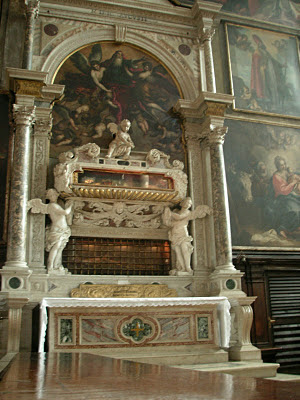
The Relics of Saint Athanasius the Great


These are the supposed relics of St. Athanasius the Great, in the Church of San Zaccaria, in Venice, Italy. However, they are not in fact the relics of St. Athanasius the Great, Patriarch of Alexandria. They were brought to Venice from Constantinople in 1455 by the Venetian shipowner Domenico Zottarello after the Fall of Constantinople and were falsely labelled as the relic of St. Athanasius of Alexandria, which is how they are erroneously venerated today in Venice. In reality, it is the relic of St. Athanasios I, Patriarch of Constantinople, who died around 1310. In 1705 the head of the Saint was destroyed in a fire, and it was replaced with a gold-plated head. In 1807 the relic was transferred to the Church of San Zaccaria in Venice.

Portions of the relics of St. Athanasius can also be found in the Church of Saint Nektarios in Kamariza Lavriou in Attica, the Athonite Monasteries of Iveron, Zographou and Esphigmenou., as well the Monasteries of the Great Cave in Kalavryta, Prousos in Eurytania and Agathonos in Fthiotida.

Pope Shenouda III restored portions of the relics of St. Athanasius to Egypt on 15 May 1973, after his historical visit to the Vatican and meeting with Pope Paul VI. The relics of St. Athanasius the Great of Alexandria are currently preserved under the new St. Mark Coptic Orthodox Cathedral in Deir El-Anba Rowais, Abbassiya, Cairo, Egypt. (Below)


BECOME A PATREON OR PAYPAL SUBSCRIBER