Showing posts sorted by date for query Theotokos. Sort by relevance Show all posts

Homily Two on the Feast of the Lord’s Theophany (St. John Maximovitch)

 
By St. John Maximovitch

"Today You appeared to the world, and Your light, O Lord, has left its mark upon us."

The feast of the Baptism of the Lord was called in ancient times "the Day of Lights".

The Baptism of Christ is the beginning of our enlightenment - the appearance of Christ to the world, the revelation of the Holy Trinity to people.

“Why,” the Golden-mouthed Teacher asks, “not the day on which He was born, but the day on which He was baptized, is it called the Theophany? Because now He has manifested to the world.”

2022 Pastoral Encyclical for Christmas (Metr. Hierotheos of Nafpaktos) 


Pastoral Encyclical for Christmas

2022


Which Christ Are We Celebrating?

By Metropolitan Hierotheos of Nafpaktos and Agiou Vlasiou

We are passing through the days of Christmas and we feel the great joy of the feast of the Birth of our Lord and God and Savior Jesus Christ in the flesh. This phrase is accurate, according to the doctrinal teaching of our Church, because in Christ we confess two births, the first birth is according to His divine nature from the Father before all ages, and the second birth is according to human nature from the Most Holy Theotokos, when the fullness of time came.

Thus, these days we celebrate the birth of Christ in the flesh, and the name "Christ" is of the hypostasis, and it is not only said of one nature, but it means both natures. Because He Himself anointed Himself, as God, giving the anointing to the body with His divinity, and receiving the anointing as a man, and the anointing of humanity is divinity, according to Saint John of Damascus. It is indeed a great mystery, how the two natures were united in Christ, divine and human in one hypostasis, therefore the name "Christ" is the name of the hypostasis, and not of one of the two natures.

The Humble Message of Christmas (Archimandrite George Kapsanis)

 
By Archimandrite George Kapsanis

(Delivered in 1986 at Gregoriou Monastery)

In the entire mystery of the incarnate economy of the Lord, which we experienced today and truly enjoyed, as well as with the successful passing of the holy fast and the joyful arrival at this festival, which the sacred Chrysostom calls the Metropolis of Feasts [i.e. Mother of all the feasts of the Church], we admire the love of God the Father towards His creature, man. And we don't just admire. We are astonished when we see that the all-good God, rich in His divinity, entered the poverty and sickness of human flesh, to give us His Grace and union with Him.

Venerable Elder Symeon Vroulos of Psara (+ 1944)


The Venerable Elder Symeon Vroulos was born in 1853 in the village of Agios Ioannis on the island of Chios, and from an early age left for the Monastery of the Dormition of the Theotokos on the neighboring island of Psara, where he served as Abbot for a number of years.

Fr. Andreas Daphnos, in an interview with the magazine Apostoli (no. 55, 2003-4), was asked by the journalist about what made himself feel blessed. He answered: "I was found worthy to meet and receive the blessing, even while they were alive, of two holy persons who became saints. One was Saint Anthimos of Chios.... The other holy person I had the blessing to meet was another Saint of Chios, Saint Symeon the Abbot of Psara. From the age of eight he went to the Monastery and there he learned letters from the Psalter of David! He was, I remember, a very strong man and he cultivated the Monastery's estates with great love. At night they heard him go to a ravine next to the Monastery and break stones, in order to tame himself with work, as he said, and not allow the devil to fight him. In the morning he was regularly at his services. I was lucky enough to meet him when I was five years old. He took me into his arms and gave me his blessing."

The Mother of God Saves a Man From Drowning


In the Monastery of Saint Savvas in Palestine there is an icon of the Mother of God, in which she is painted in a black garment, as nuns wear. Once someone asked the fathers of this monastery:

"Isn't it a sin to paint the Mother of God as a nun?"

Then they answered him:

"We do not paint the Mother of God as a nun, but this is how the Lady of the world appeared in the depths of the sea to the one who she saved from drowning."

"From drowning?" he asked. "Please tell me this incident, because having been here for many days looking at this icon, I sinfully judged that she should not be painted like this."

What Vasiliki Rallis Revealed About the Soul of Her Departed Husband


 By Alexios the Reader

Vasiliki Rallis told us what took place as soon as the soul of her husband Angelos left his body. Angelos Rallis was the vessel of the Lord's election who took the lead in the holy cause on behalf of the Newly-Revealed Neomartyrs Raphael, Nicholas and Irene, in Karyes of Thermi on the island of Lesvos.

So she told us that her late husband fell asleep on the Feast of the Dormition of the Theotokos, after chanting and taking communion of the Immaculate Mysteries, and in the following hours in his sleep, his blessed soul flew silently to the Heavenly Father!

"I Expect the Resurrection of the Dead" Were the Last Words of Saint Parthenios of Chios


The time came when Saint Parthenios of Chios (+ 1883) received the heavenly message of his departure... since he longed for heaven all his life. A day of joy was the day he realized that the time had come for the heavenly journey. He lived for this hour. "When will I face the unspeakable beauty face to face? When shall I come and behold the face of God?' he wondered.

45 years of rigorous asceticism had passed. He had been an ascetic since he was 23 years old and was now 68 years old.

One night, as he slept peacefully in his wet and wild cave, a dream filled him with joy. He saw our Lady the Theotokos!

"Parthenios," she said to him, "in three days your resting place will be ready. The saints are waiting for you!"

Vasiliki Rallis, the First Visionary of Saints Raphael, Nicholas and Irene, Has Reposed at the Age of 100


The blessed nun Irene, more famously known by her secular name Vasiliki Rallis, has reposed at the age of 100, as of this past Monday on the 5th of December 2022, at around 8:00 am. This took place at the Sacred Monastery of Panagia Eleousa in Patras. Her funeral took place on December 6th.

Vasiliki was born in Thermi on the island of Lesvos, a few months after the Asia Minor Catastrophe. Her family was from Moschonisi (Cunda Island) of Asia Minor. Her father, Nicholas Maragos, was imprisoned, while her pregnant mother went to Lesvos as a refugee, escaping as if by a miracle from the massacre, in that tragic September of 1922. They crossed to the hospitable coast of Lesvos and settled in the area of Thermi, where she was born on January 28, 1923. In Mytilene she received her general education, in the  Girls' High School and the French School of the time. Over time, she married Angelo Rallis and had two daughters and one grandchild named Panagiotis.

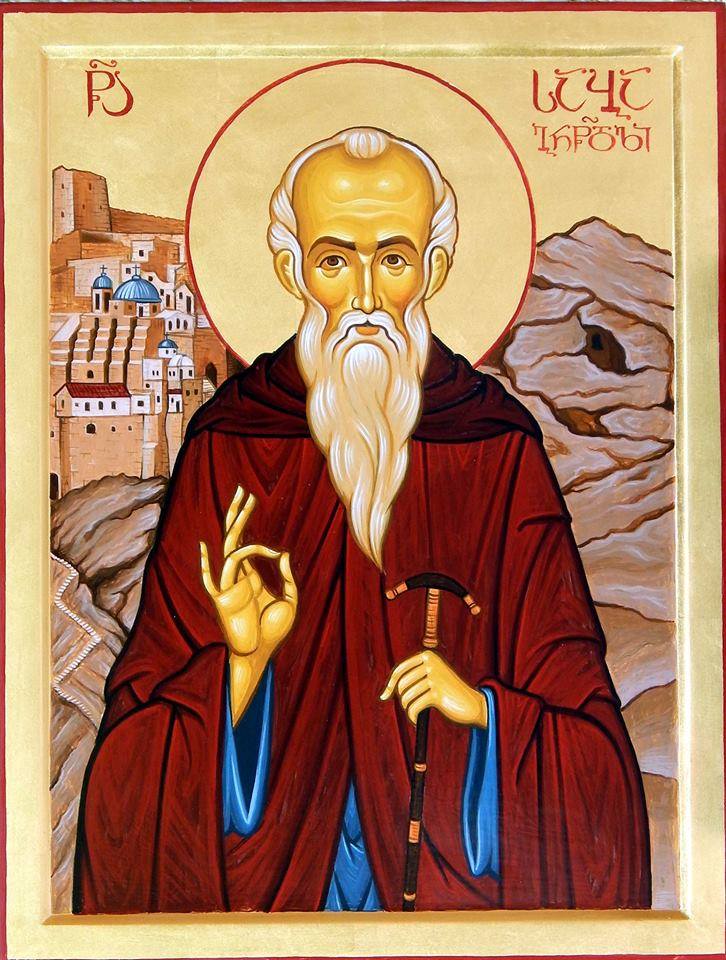
The Veneration of Saint Savvas the Sanctified in Georgia


The popularity of Saint Savvas the Sanctified in Georgia is reflected in the numerous depictions of him in works of art and the churches dedicated to him.

It is further reflected in the fact that his Life written by Cyril of Scythopolis was translated into Georgian as early as the late 6th or early 7th century, although the earliest Georgian manuscript dates to 864 (Sinai georg. MS 32, 33, 57). Sinai georg. MS 65 includes "Old Georgian Hymns" dedicated to Saint Savvas.

These seem to have been translated and composed and then brought to Georgia by Georgian authors who lived and labored at the Lavra of Savvas in Palestine since the 6th and 7th century, such as Martviri (6th-7th cent.) and Seity (late 8th cent.).

Elder Isidoros the Blind of Philotheou Has Reposed


Elder Isidoros the Blind of Philotheou reposed on Sunday November 27, 2022 at the Athonite Monastery of Philotheou at the age of 87.

Thousands of souls found comfort and benefit both with his words and prayers throughout the years when he would come out of Mount Athos twice a year.

The late Elder Isidoros was born in Patras with impaired vision.

At the age of 15, he underwent eye surgery, leaving him completely blind.

Homily Four on the Entrance of the Most Holy Theotokos (St. Luke of Simferopol)


 By St. Luke, Archbishop of Simferopol and All Crimea

(Delivered in 1958)

From statistical data on people who have reached a very advanced age, we learn that they are especially numerous among those living on the high mountains of the Caucasus and Azerbaijan and on other high mountains. And in our time, somewhere in Azerbaijan, there lives an extraordinary old man who has reached one hundred and fifty years, and there are many centenarians there.

How can we explain this extraordinary influence of high mountains on the longevity of people's lives?

Undoubtedly, to a very large extent because the highlanders breathe the purest air all their lives and eat mainly dairy products and the meat of healthy sheep.

Homily Three on the Entrance of the Most Holy Theotokos (St. Luke of Simferopol)


 By St. Luke, Archbishop of Simferopol and All Crimea

(Delivered in 1957)

The life of the Most Holy and Most Pure and Most Blessed Theotokos and Ever-Virgin Mary, who was the Most Pure Temple of the Savior, who was above all Cherubim and Seraphim, could not begin life the way every ordinary person begins: the glorious beginning of Her life should have been marked. Thus the Lord God placed in the hearts of Her holy parents Joachim and Anna a presentiment that the Most Pure Maiden, their only daughter, was prepared by God for some extraordinary path, a path much higher than the usual path of people. And guided by this presentiment, even before the birth of the Blessed Virgin Mary, they dedicated Her to God: they made a vow to God that She would serve Him.

Panagia of the Stable in Nichori of the Bosphorus


Churches, chapels and holy springs are scattered throughout the length and breadth of Constantinople and its suburbs. Many of them with a great historical background, some in full connection with the rise and fall of Roman civilization and other modest ones that await the pilgrim to visit them.

Nichori (or Neochori, known today as Yeniköy) is located on the European shores of the Bosphorus strait, between the neighborhoods of İstinye and Tarabya. Nichori was until the 1955 Istanbul pogrom a neighborhood with a considerable Greek (Roman) population as well as Armenian and Jewish communities. It was here behind the yali of Ahmed Afif Pasha, where Agatha Christie stayed as a guest in 1933 while writing Murder on the Orient Express. There are several Christian churches in the neighborhood. The Greek Orthodox Church of Dormition of the Theotokos (Panayia Kumariotisa Rum Ortodoks Kilisesi) was built in 1837 at the request of Sultan Mahmud II′s personal physician Stephanos Karatheodoris.

Synaxis of the Kupyatich Icon of the Mother of God

Synaxis of the Kupyatich Icon of the Mother of God (Feast Day - November 15)

The Kupyatich Icon of the Mother of God appeared in the year 1182 near the village of Kupyatich in the area of the former Pinsk district of the Minsk governance. The icon was found in the forest on a tree by the peasant girl Anna, a cattle herder.

While guarding the flock, Anna saw a light in the forest. When she got close to that light, she saw on a tree a medium cross with the image of the Theotokos. Anna took that cross and brought it home, then she returned to her flock. Again she saw the same cross on the same tree. She took it, put the image in her bosom, and once again brought it home. When she wanted to show the cross to her father, she put her hand into her bosom, but the cross was not there. She told her father everything; so she left with her father, saw the cross in the forest and carried it home. The next day the cross was not in the house again. They alarmed the whole village, and all the villagers went and saw the cross and venerated it.

Elder Cornelius Marmarinos of Chios (+ 1975)


Chios is an island of many churches, chapels and monasteries. There are 22 native born saints from Chios, the most famous of which are Isidore, Markella and Matrona. This list is soon to include Elder Cornelius Marmarinos, who is in the process of being canonized.  

Cornelius Marmarinos was born in Halkios on the island of Chios in 1885. His birth name was Constantine and his parents were the notary Demetrios Marmarinos and Evanthia Flatsousis. His parents were thrifty and managed to ensure him a good future through education. He attended the Zografio High school of Constantinople.

Homily Four on the Holy Protection of the Most Holy Theotokos (St. Luke of Simferopol)

 
 By St. Luke, Archbishop of Simferopol and All Crimea

(Delivered in 1958)

Many times the Most Holy Theotokos appeared to a separate great saint, usually accompanied by one or two apostles of Christ, and she appeared to Saint Seraphim of Sarov alone. But she never appeared to anyone in such glory as in the Blachernae Church in Constantinople, on this great feast, named after her Protection.

There were many people in the temple, and among them were blessed Andrew, a holy fool for Christ's sake, with his disciple Epiphanios.

There was an all-night vigil. The people fervently prayed for deliverance from the invasion of the barbarians, who had already approached Constantinople itself.

Homily Three on the Feast of the Holy Apostle and Evangelist Luke (St. Luke of Simferopol)

 
 By St. Luke, Archbishop of Simferopol and All Crimea

(Delivered on October 18/31, 1951)

You have now heard in the Gospel reading the great words of Christ addressed to His disciples, the apostles, the saints: “He who hears you hears Me; and whoever rejects you rejects Me; but whoever rejects Me rejects the One who sent Me” (Luke 10:16).

Oh, how terrible!

If we do not listen to the holy apostles, if we do not consider them the lamps of our life, then this means that we reject both the Lord Jesus Christ and His Beginningless Father.

Homilies on the Great Litany of the Divine Liturgy - Mary the Theotokos (Metr. Hierotheos of Nafpaktos)


Homilies on the Great Litany of the Divine Liturgy

Mary the Theotokos  

By Metropolitan Hierotheos of Nafpaktos and Agiou Vlasiou

Every time we celebrate the Divine Liturgy and every Sacred Service, and we pray to God, either to the Triune God - the Father, the Son and the Holy Spirit - or to the God-man Christ, we also ask for the intercessions of Mary the Theotokos, our Panagia. This is because the Panagia played an important role in the incarnation of the Son and Word of God and our salvation. The "homeless" God acquired a "home", that is, he entered the world through our Panagia.

The Relics of Saint Methodia of Kimolos


Saint Methodia of Kimolos, after living as a recluse for several years, reposed in the Lord at the age of 47 on October 5, 1908. The day after her repose, it was noticed that her limbs were still flexible. She was then initially buried in the Church of Saint Spyridon on the island of Kimolos.

On August 15th 1946 she was locally recognized as the "patron and guardian of the island and its great benefactor."

By 1962 her monastic cell had fallen into ruin. For this reason a small church was built over the ruins dedicated to the Panagia Eleousa and Venerable Methodia. Her relics were then transferred from the Church of Saint Spyridon to a crypt in the new church.

Saints Domnina, Bernike and Prosdoke as Models for our Lives

 
 By Protopresbyter Fr. George Papavarnavas

Saint Domnina came from Antioch and lived in the years of Emperor Diocletian. She embraced the Christian faith together with her two daughters, Bernike and Prosdoke. After their baptism, their way of life changed, since their hearts overflowed with love, joy, peace, and in general with all the fruits of the Holy Spirit, which resided in their hearts. This change in their way of life and behavior did not take long for Domnina's idolatrous husband to understand, who tried to convince his wife and daughters to sacrifice to the idols. And because they refused to do so, then, full of hatred, he wanted his own daughters to be dishonored. Domnina, however, self-sacrificingly protected them, and they all preferred to suffer martyrdom by drowning in a river, rather than lose their faith, their inner purity and the peace of their souls, these precious and priceless goods.