Showing posts with label Divine Liturgy. Show all posts

What the Spirit of His Dead Aunt Told Saint Iakovos of Evia


Saint Iakovos Tsalikes said:

"Since I was a child, I go to the cemetery every day and think about death. All my relatives have died. Anyway, I commemorate an aunt of mine. I saw the aunt also and she told me:

'Ah, my nephew Iakovos, thank you for what you are sending me. You send me a lot, but you know there are other people who are unfortunate and hungry and have no one in the world to think of them, to care for them.'

Homilies on the Great Litany of the Divine Liturgy - Mary the Theotokos (Metr. Hierotheos of Nafpaktos)


Homilies on the Great Litany of the Divine Liturgy

Mary the Theotokos  

By Metropolitan Hierotheos of Nafpaktos and Agiou Vlasiou

Every time we celebrate the Divine Liturgy and every Sacred Service, and we pray to God, either to the Triune God - the Father, the Son and the Holy Spirit - or to the God-man Christ, we also ask for the intercessions of Mary the Theotokos, our Panagia. This is because the Panagia played an important role in the incarnation of the Son and Word of God and our salvation. The "homeless" God acquired a "home", that is, he entered the world through our Panagia.

Homilies on the Great Litany of the Divine Liturgy - Our Fellow Human Beings (Metr. Hierotheos of Nafpaktos)


 Homilies on the Great Litany of the Divine Liturgy

Our Fellow Human Beings  

By Metropolitan Hierotheos of Nafpaktos and Agiou Vlasiou

The Church is a great spiritual family, to which belong many members from all ethnicities, who live all over the world and who, while we are at this time in the temple, they are doing something else and are not with us. That is why we feel the need, as brothers and sisters that we are, to pray for them as well. Also, we pray for all the people who are currently doing some kind of work.

Thus, the Priest exhorts us: "For those who travel by land, sea, and air, for the sick, the suffering, the captives and for their salvation, let us pray to the Lord." Of course, one should not travel during the Sunday Divine Liturgy, but the Church, as a loving Mother, also prays for those who, due to various urgent needs, do not attend the holy church during the Divine Liturgy.

Homilies on the Great Litany of the Divine Liturgy - Prayer for the Environment (Metr. Hierotheos of Nafpaktos)


Homilies on the Great Litany of the Divine Liturgy

Prayer for the Environment 

By Metropolitan Hierotheos of Nafpaktos and Agiou Vlasiou
 
 Man is not an autonomous being, a solitary person, a being who lives in an infinite solitude, but is born and lives in an environment, material, social and familial. This environment is a universal home in which there is a whole world, with all its elements, that is, air, land and sea. After all, God first created the material world and then man, so that he could enter as a king in his kingdom.

This is the reason why in the Great Petitions we address to God, the so-called "Great Litany", at the beginning of the Divine Liturgy, we also pray for the world that surrounds us. "For favorable weather, for an abundance of the fruits of the earth, and for peaceful times, let us pray to the Lord." That is, let us pray to the Lord for good conditions - mildness in the air, for the fruitfulness of the earth and for peaceful times.

Homilies on the Great Litany of the Divine Liturgy - City and Citizens (Metr. Hierotheos of Nafpaktos)

 
 Homilies on the Great Litany of the Divine Liturgy

City and Citizens  

By Metropolitan Hierotheos of Nafpaktos and Agiou Vlasiou

The Divine Liturgy is held at a certain place and time, but it is held for the inhabited world, for the people who are traveling, who are sick, in general for the whole world. Thus, the liturgist exhorts the people: "For this City, every City, Country and the faithful who live in them, let us pray to the Lord." In other words, let us pray for this City or County, in which the Divine Liturgy is held, for every City and for every Country, but also for those who live in them with faith - that is to say, with Orthodox Christian faith - that is, the Orthodox Christians.

Why Elder Athanasios Hamakiotis Didn't Allow His Altar Servers in the Sanctuary During Communion


 Testimonies on Elder Athanasios Hamakiotis
 
Testimony of Metropolitan Ignatios of Arta:

"Such was his piety and his devotion to the Divine Liturgy, that even if snakes bit him, he would not notice."

"When he said 'thine own of thine own' there was a thump and everyone fell to their knees. No one could stand up. Who can describe the tone and color of his voice when he uttered the words of consecration."

"The time for Divine Communion was coming. The Divine Liturgy at its peak. The children brought him the boiling hot water, known as zeon, at the appropriate moment; that's how he wanted it:
 
'Let it boil, my child, the zeon must be burning hot.'"


Testimony of One of His Altar Boys:

"When we brought him the zeon, the vessel burned. You could not touch it. He wasn't bothered at all. He would touch it with his hand and pour it crosswise into the Holy Chalice. All the kids were wondering how it didn't burn him. Every time we went to touch it, we got burned. Then he would take us out of the sanctuary. He wanted to be alone in this sacred moment."


Testimony of Father A.P.:

"He had special pedagogical concepts. He took special care of the education of the children who ministered to him at the Sacred Bema. He loved them fatherly. He taught them and kept things authentic. When it came to the point in time when he was going to 'divide the holy Bread' and to receive communion, he had to be alone, which to him was a unique and timeless moment.

'And now, Lord, it is You and I,' he would say.

Perhaps the children could not receive with due respect his 'expressions' to his Lord. The presence of others, at such moments, negatively affects devotion. The Elder would not, or could not, commune without tears. He spoke to his Lord warmly and simply, 'village-like'.

As his tears flowed - sometimes like a faucet - his faint cry sounded solemn and pleading, persistent and repetitive:

'Forgive me, forgive me...'

And then, a divine earthquake pierced through him, visibly and perceptibly!

After every Divine Liturgy, he was soaked, and was obliged to change."


Testimony of Metropolitan Iakovos of Argolidos:

"During the time of communion, he strictly forbade the presence of another person in the Sacred Bema. The children would go out. When he communed, his form changed. As a deacon I had witnessed an extraordinary sight.

He was crying like a little child. If you were to see a little child crying or Father Athanasios, it was the same.

And at the same time his form shone with a strange light when he was receiving communion of the Immaculate Mysteries. Then I understood why he wouldn't allow the children or anyone else to stay inside."
 
Source: From the book by Metropolitan Nektarios (Antonopoulos) of Argolidos Ιερομόναχος Αθανάσιος Χαμακιώτης. Translation by John Sanidopoulos.


Homilies on the Great Litany of the Divine Liturgy - Clergy and Laity (Metr. Hierotheos of Nafpaktos)


 Homilies on the Great Litany of the Divine Liturgy

Clergy and Laity

Metropolitan Hierotheos of Nafpaktos and Agiou Vlasiou

We are interpreting in these eucharistic sermons, during the Summer Sundays, the petitions we address to God at the beginning of the Divine Liturgy, every Mystery and Sacred Service. Today we will look at the petition we are called to address to God for all the members of the Church. The Priest exhorts us: "For our Archbishop, the Honorable Presbyters and those who minister in Christ, all the Clergy and the people, let us pray to the Lord", that is, let us pray for the Archbishop, namely, the Metropolitan of this region - and mention his name - for the Presbyters and Deacons, for all the Clergy and the laity of the Sacred Metropolis.

Homilies on the Great Litany of the Divine Liturgy - The Sacred Temple (Metr. Hierotheos of Nafpaktos)


 Homilies on the Great Litany of the Divine Liturgy

The Sacred Church


Metropolitan Hierotheos of Nafpaktos and Agiou Vlasiou

During the Great Litany, as the prayer to God is called at the beginning of the Divine Liturgy, after the petition for peace, we also pray for the Sacred Temple in which the Divine Eucharist is celebrated. "For this holy house and those who enter it with faith, reverence and the fear of God, let us pray to the Lord", that is, let us pray for this Holy Temple and for those who entered it with faith, reverence and fear of God.

The Sacred Temple is the place where the members of the Church gather to pray to God and to perform the Sacred Mysteries, especially the great Mystery of the Divine Eucharist. It is called a Temple because God dwells there, in the sense that in this space the energy of God is manifested.

Homilies on the Great Litany of the Divine Liturgy - The Peace of God (Metr. Hierotheos of Nafpaktos)

 
 Homilies on the Great Litany of the Divine Liturgy

The Peace of God

Metropolitan Hierotheos of Nafpaktos and Agiou Vlasiou

The Divine Liturgy, beloved brethren, is the great Mystery of the Church, since in it the bread and wine are transformed into the Body and Blood of Christ and we commune Christ, who is the source of life and immortality. Thus, you cannot be a Christian who does not go to church, does not attend liturgy without having a serious reason.

The Divine Liturgy begins with the proclamation: "Blessed is the Kingdom of the Father and of the Son and of the Holy Spirit, now and ever and unto the ages of ages." It is a doxology of the Triune God, namely the Father, the Son and the Holy Spirit. Immediately after the remembrance of the Triune God, the Priest asks the Christians present to pray to the Triune God and to mention their petitions to Him and to ask Him for their needs.

Holy Apostle Carpos of the Seventy (St. Justin Popovich)

 
By St. Justin Popovich

The Holy Apostle Carpos, one of the Seventy Apostles, was a companion and servant of the Holy Apostle Paul; he distributed his epistles to those for whom they were intended. Striving much with the Apostle Paul in preaching the gospel of Christ, Saint Carpos suffered many temptations. He was then appointed Bishop of the city of Beroea in Thrace by the Apostle Paul. Saint Carpos also made an effort to preach the gospel of Christ on the island of Crete. There he received Saint Dionysius the Areopagite into his home. There he also saw the Lord who appeared to him in a vision, when Carpos begged Him to punish two sinners, and he heard the voice of the Lord saying to him: "Strike me, because I am ready to be crucified again for the salvation of men."

Homilies on the Divine Liturgy - Holy Communion (Metr. Hierotheos of Nafpaktos)


  Homilies on the Divine Liturgy
 
Holy Communiont

By Metropolitan Hierotheos of Nafpaktos and Agiou Vlasiou 

All the Mysteries of the Church, my beloved brethren, are closely connected with the Divine Eucharist. We are baptized and chrismated with the Holy Myrrh so that as members of the Church we can take part in this Secret Supper and receive Christ in us. The Mystery of the Priesthood is made so that there may be Bishops who will perform the Divine Liturgy and who will ordain Presbyters to perform the Divine Eucharist on their behalf. The Mysteries of Confession and Anointing are made to prepare us to truly participate in the Divine Eucharist, but also the Mystery of Marriage is made so that the couple can participate in the Divine Eucharist, to feel united not only on a biological level, but as unity with Christ.

Homilies on the Divine Liturgy - Preparation for Holy Communion (Metr. Hierotheos of Nafpaktos)

 
 Homilies on the Divine Liturgy

Preparation for Holy Communiont

By Metropolitan Hierotheos of Nafpaktos and Agiou Vlasiou 

After the prayer of the anaphora, my beloved brethren, which is the most central part of the Divine Liturgy during which, by the Holy Spirit, the bread and wine is changed into the Body and Blood of Christ, and in our prayers we address Christ on behalf of our ecclesiastical government, our Church prepares us to commune of the Body and Blood of Christ.

The Divine Liturgy is not done just to pray, because if it had this purpose, then we could replace it with other services, namely Vespers, Matins, Paraklesis, etc. Rather, the Divine Liturgy is done to commune, that is, to receive the Body and Blood of Christ and to have communion with Christ. It does not mean that the Clergy liturgy in the Holy Bema and we do not commune with the Body and Blood of Christ. In ancient times, all Christians communed, as long as they did not have an obstacle to Divine Communion.

Homilies on the Divine Liturgy - The Ecclesiastical Government (Metr. Hierotheos of Nafpaktos)


Homilies on the Divine Liturgy

The Ecclesiastical Government

By Metropolitan Hierotheos of Nafpaktos and Agiou Vlasiou 

When an official visits our land, an audience usually follows, that is, the meeting, to which we report our requests, and we ask them to satisfy some of our desires that refer to the life and society in which we live. The same happens with the Divine Eucharist. After the coming of Christ on the Holy Table there follows our requests and the expression of our inner feelings. Three main things will be mentioned.

First, immediately after the change of the Holy Gifts we feel the need to say to the Father - our God - that we offer the Divine Liturgy to honor the Saints, the Prophets, the Righteous of the Old Testament, the Venerables and the Confessors and every righteous person who ended their life in Christ. Above all, we offer the Divine Liturgy to our Panagia, which is why we say "especially our all-holy, immaculate, most-blessed, glorious Lady the Theotokos and Ever-Virgin Mary." The Saints were united with Christ. At this time we also mention the Saint who celebrates that day, because we believe that this day they are especially among us.

Second, we remember our living and reposed brethren. We first mention those who have fallen asleep, because they are in great need of our prayers, since now they can do nothing for themselves and expect them of us. The commemoration takes place at this time - the memorial service for our brethren, our relatives. That is why at the time when the chanter chants "Axion Estin" we should mention the names of the people we love and who have left this world. Then we mention the names of the living, we pray for the world, the Church that is all over the world, for the priests and deacons, for those who struggle to live with purity and modesty and for the rulers, so that there is peace in the nation. We also pray for the city in which we live and for those who live in it in faith, for those who travel in various ways, for the sick and the demon-possessed, the captives, for those who help the Church in various ways, for those who help the poor and finally we pray for ourselves, to receive the mercy of God.

Third, we mention our Bishop, in whose name the priest performs the Divine Liturgy. "And first remember Lord our Archbishop ... to whom you have given your holy Churches peace, salvation, honor, health, length of days, correctly dividing the word of your truth."

The Metropolitans commemorate the Holy Synod to which they belong, the leaders of the Autocephalous Churches and the Patriarchs, and mention "every Diocese of the Orthodox". This utterance shows our ecclesiastical government. The Church is not an abstract faith and ideology, but a specific organization, structured in Patriarchates, Autocephalous Churches, Dioceses and Parishes. Everyone mentions their immediate superior, to whom they refer. There is no individual ecclesiasitcal life. The Hieromonk who liturgizes in the wilderness of Mount Athos mentions the Ecumenical Patriarch, to whose jurisdiction Mount Athos belongs. If this mention is omitted then the Divine Liturgy suffers from being uncanonical. And we say this because a Eucharist that takes place outside the Church is not a real Divine Eucharist, but a conventicle. And of course it is not enough to mention one's Bishop and not to have a meaningful communication with him.

The Church is one body, the Body of Christ. To this Body belong the Saints, the Angels, the dead who departed with repentance and the living who struggle to be united with the Body of Christ. One cannot live alone and independently of one's brethren. Also, one cannot live outside his Bishop, who is in "the type and place of the head of the Church, that is, of Christ." Worse still, a priest cannot perform the Divine Liturgy in the name of his Bishop, mention him, so that God may preserve him in peace, salvation, honor, health, longevity and the orthodoxy of the word of truth, and yet with his daily actions to slander him, to demonize him, to fight him in various ways.

Today we do not need an individual religiosity, but a stable ecclesiastical experience and mindset. We must live in the spiritual family called the Church and respect the Bishops God has placed in the Church organization.

Source: Translated by John Sanidopoulos.


Homilies on the Divine Liturgy - The Holy Anaphora (Metr. Hierotheos of Nafpaktos)

 
 Homilies on the Divine Liturgy

The Holy Anaphora

By Metropolitan Hierotheos of Nafpaktos and Agiou Vlasiou
 
Analyzing the Divine Liturgy in these sermons, my beloved brethren, we have reached the central part of the Divine Eucharist  which is called the "anaphora" (or the "elevetation"), during which through the Holy Spirit the bread and wine will be changed into the Body and Blood of Christ. We will analyze this in a few simple words today.

The prayer of the anaphora is recognized by the exhortation of the deacon "let us stand well, let us stand in fear, let us be attentive to the holy anaphora which we offer in peace." It is called an anaphora, because this prayer and sacrifice is offered not on an earthly altar, but on the heavenly altar. In fact the prayer of the anaphora begins with the apostolic blessing: "The Grace of our Lord Jesus Christ and the love of God the Father and the fellowship of the Holy Spirit be upon us all," and ends again with the prayer and blessing "and may the mercies of our great God and Savior Jesus Christ be with us all.” The greatest events in our lives are done with the blessings of God.

Homily on the Wednesday of the First Week of Great Lent (Archpriest Rodion Putyatin)

 
By Archpriest Rodion Putyatin

"Now the Powers of Heaven serve with us invisibly; behold, the King of Glory enters."

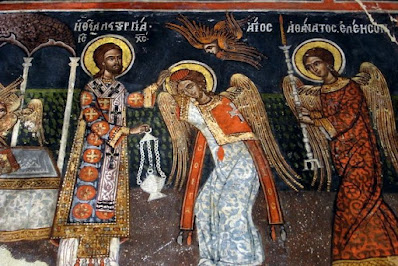
What are these Heavenly Powers invisibly serving with us, listeners? Archangels and Angels, Cherubim and Seraphim and other Incorporeal Powers, whose main dwelling is Heaven, that is why they are called Heavenly. Yes, these are the Heavenly Powers that serve with us. In addition, each of us has, as you know, our own Guardian Angel. These Guardian Angels also belong to the Powers of Heaven, so they also serve invisibly with us. Now they serve with us. When is now? At the Liturgy of the Presanctified Gifts. However, at every Liturgy, the Heavenly Powers invisibly serve with us, and not only at the Liturgy, but also at every church service, they serve with us. It is only during the Liturgy that the Heavenly Powers serve invisibly with us. Why? Because the King of glory, the Lord of hosts, Jesus Christ, is with us primarily at the Liturgy.

Homilies on the Divine Liturgy - Catechumens and the Faithful (Metr. Hierotheos of Nafpaktos)

 
Homilies on the Divine Liturgy

Catechumens and the Faithful

By Metropolitan Hierotheos of Nafpaktos and Agiou Vlasiou
 
The Divine Liturgy, which we are interpreting in these sermons, my beloved brethren, is divided into two basic parts. The first is the Liturgy of the Catechumens and the second is the Liturgy of the Faithful. From the beginning of the Divine Liturgy until the Gospel and the prayers that follow, the catechumens could also be present, that is, those who are preparing to be baptized, but when the deacon says, "As many of you as are catechumens depart; catechumens depart. As many of you as are catechumens depart: let there be no catechumen. As many as are faithful, again and again, in peace let us entreat the Lord," then the catechumens leave and there remains until the end in the Divine Liturgy those who were baptized and therefore are Orthodox Christians.

Homilies on the Divine Liturgy - The Readings (Metr. Hierotheos of Nafpaktos)

 
  Homilies on the Divine Liturgy

The Readings

By Metropolitan Hierotheos of Nafpaktos and Agiou Vlasiou
 
After the Small Entrance, during the Divine Liturgy, the Trisagion Hymn and the two readings are read, namely the Apostolic and the Gospel readings. The Apostle is read by the Reader, who has the special blessing from the Bishop to do this work, because in the Church everything is done in the appropriate and blessed way, and the Gospel reading is read by the Deacon from a special place, which is called the Pulpit, or by the Priest from the Beautiful Gate.

Homilies on the Divine Liturgy - The Small and Great Entrance (Metr. Hierotheos of Nafpaktos)


 Homilies on the Divine Liturgy

The Small and Great Entrance

By Metropolitan Hierotheos of Nafpaktos and Agiou Vlasiou
 
The Divine Liturgy, my beloved brethren, is a great festival. We do not have the senses to understand this, but when we acquire other noetic senses then we will be enchanted by what is taking place, by what is said and chanted in the Divine Liturgy.

The way in which the Divine Liturgy is performed today is not exactly the same as it was done in the ancient Church, because over time new sections entered and it became all this greatness that we enjoy today.

With today's sermon we will briefly look at the two entrances, or as they are called in the liturgical language, the Small and the Great Entrance.

Homilies on the Divine Liturgy - The Antiphons and the Trisagion Hymn (Metr. Hierotheos of Nafpaktos)

 
Homilies on the Divine Liturgy

The Antiphons and the Trisagion Hymn

By Metropolitan Hierotheos of Nafpaktos and Agiou Vlasiou
 
We will continue today with some comments on the Divine Liturgy, which is the greatest good that God has given us, because in it we can feel His love, pray to Him, partake of the Body and Blood of Christ and we taste of Paradise. Because by participating in the Divine Liturgy and by trying to concentrate our mind and live out everything that happens in it, we are in a certain sense preparing to participate in the great festival of the Kingdom of Heaven.

Homilies on the Divine Liturgy - The Beginning (Metr. Hierotheos of Nafpaktos)


 Homilies on the Divine Liturgy

The Beginning of the Divine Liturgy

By Metropolitan Hierotheos of Nafpaktos and Agiou Vlasiou

As you know, every year during the summer months of July and August we usually send short written sermons to all the Parishes of our Metropolis, to be read in the Sacred Temples during the Divine Liturgy. We are doing this again this year with the Grace of God.

The short sermons this year will refer to the Divine Liturgy and will try to show its great importance for our lives, as well as to interpret some points of the Divine Liturgy, so that when we go to church we know exactly what is happening.