Showing posts with label Dormition Fast. Show all posts

The Monastery of Panagia Agrilion in Sami of Kefallonia, Which Hosted Saint Kosmas Aitolos in 1777 and Lord Byron in 1823


The Monastery of Panagia Agrilion is just 3 km east of Sami, on a green hill with an altitude of 180 m and in a magnificent location with a wonderful view.

The Monastery was founded by two shepherds who encountered a miraculous icon of the Panagia, known today as Panagia Agriliotissa, at this location in 1722. Iakovos and Symeon then decided to lead a monastic life and were the first residents of the Monastery they established. The primary feast of the Monastery is celebrated on August 15th, in honor of the Dormition of the Theotokos.

Homily on the Dormition of the Theotokos: The Most Holy Theotokos in the Iconography of the Byzantine Temple (Metr. Hierotheos of Nafpaktos)

 
Homily on the Dormition of the Theotokos: 
The Most Holy Theotokos in the Iconography of the Byzantine Temple 
 
By Metropolitan Hierotheos of Nafpaktos and Agiou Vlasiou

(Delivered in 2021)

In the "Symbol of Faith", or what we call "The Creed", we confess that the Church is "One, Holy, Catholic and Apostolic", because it is connected to Christ. The Church is "One", because one is its head, Christ, and one is His Body; it is "Holy" because its head is holy; it is "Catholic", because Christ assumed from the Panagia the entirety of human nature and came to save all people; and it is "Apostolic", because Christ sent the Apostles to the whole world, to spread the message of the Kingdom of God and eternal life.

The Church, while it is "One", at the same time has two "aspects", the earthly and the heavenly. To the earthly aspect of the Church belong all of us Orthodox Christians who strive to be living members of the Church, and to the heavenly aspect of the Church belong all the saints who have left this world, and the holy angels, as the Book of Revelation of Saint John the Theologian wonderfully describes.

Panagia Prousiotissa and the Woman Who Fell Down a Steep Cliff With Her Baby


On the right side of the church of the Monastery of Panagia Prousiotissa there is a frightening cliff with a very deep chasm. If someone falls it is considered certain that they will be killed. Even to approach it and look down, it is difficult to bear and you step back.

Once, during the celebration of the Monastery on August 23rd in honor of the Apodosis of the Dormition of the Theotokos, the wife of a Priest happened to be standing in this dangerous spot, holding her baby in her arms.

However, due to the overcrowding she was pushed and tumbled into this "deadly abyss" along with her child, falling into this steep cliff and pit.

Homily Two on the Dormition of the Theotokos (Archimandrite George Kapsanis)


By Archimandrite George Kapsanis

(Delivered in 1981)

We all have joy because today is the real Mother's Day. Only the Lady Theotokos is our true mother, because she transmits to us our true Life, which is our Christ. And today all mothers should celebrate Mother's Day in an Orthodox manner, because every mother is recognized as a mother only if she aspires to be like and if she receives the blessing and grace of the Mother of God, the Most Holy Theotokos.

But the world with the worldly spirit, with secularization, which advances and erodes the soul and the heart and the mind of our people, has begun to artificially replace the feasts of Orthodoxy with secular holidays, such as the Mother's Day, Children's Day and others like it, such as birthdays, which people celebrate, while we should celebrate the memories of the Saints, whose names we bear. And all this is an attempt to alter the God-anthropocentric mindset of our people, and for our people to become anthropocentric and not have Christ as the center of their lives. Not to live an ecclesiastical life, but to live a life far from the Church and from our God-man Christ.

The Miracle with the Lilies of the Panagia Gravalliotissa in Pastra, Kefallonia


Near the southeastern villages of Demoutsanata and Pastra on the island of Kefallonia, there is a strange phenomenon in the village church that takes place annually.

In the courtyard of the Church of the Dormition, there are various flower beds, where the women of the village plant parthenocrine bulbs (Virgin's Lily). This is done on March 25th, which is the Feast of the Annunciation.

When the Feast of the Ascension comes around in May or June, the lilies begin to bloom, so they are cut and placed in bouquets in front of the holy and miraculous icon of the Panagia Gravalliotissa. In a few days the lilies dry up, according to the laws of nature.

Homily Three on the Dormition of the Theotokos (Archimandrite George Kapsanis)


By Archimandrite George Kapsanis

(Delivered in 1985 at Gregoriou Monastery on Mount Athos)

My fathers and brothers, throughout the holy vigil, and with the discourses of praise and with the sacred encomiums, our holy Church extols and praises and glorifies the Ever-Virgin Theotokos, and indeed today on her revered Dormition.

She ascended very high, higher than all men and Angels.

So it was said in the discourse of Saint Gregory Palamas that we read.

Of all the rational beings of God, the Panagia ascended higher and closer to God.

Why did she rise so high? Because she stooped so low.

If she had not descended in blessed humility and perfect obedience to the holy will of God, lower than all men on earth, she would not have risen higher than all.

This is the secret of the ascent of our Panagia, which presupposes her descent.

The Theotokos On Her Deathbed (St. Nikolai Velimirovich)


By St. Nikolai Velimirovich
 
The last page of the holy book has been read, the content of which from cover to cover exudes holy innocence and piety. This is the book at the sight of which even the most cruel critics, bearing the burden of biases and prejudices, silently stopped and, having read it from beginning to end, left with a softened heart and rejuvenated spirit. That book is closed, the first words of which are - "In the Jewish town of Nazareth lived the childless pious old man Joachim and his wife Anna ...".

How bright are the first pages of this story - as if illuminated by that evening's soft and quiet blush of the sunset, seeing off the sun, so that after the night it would shine with light from the east. Who would not rejoice at the happiness of these elderly people, who were visited only at their parting with the world, to add a drop of honey to their life poisoned by sorrow!

Homily Four on the Feast of the Dormition of the Theotokos (St. Luke of Simferopol)


By St. Luke, Archbishop of Simferopol and All Crimea

(Delivered in 1958)

Our Lord Jesus Christ was pleased to mark the death of His Most Pure Mother in human flesh as a great event in the history of the Church and even in the history of the world.

The Holy Church honors the Dormition of the Most Holy Theotokos with a two-week fast, equal in severity to Great Lent.

Do you remember the deeply disturbing words of our Lord Jesus Christ, hanging on the cross, spoken shortly before the terrible words “It is finished”: “Woman! Behold, thy son” (John 19:26), and turning his gaze to his beloved disciple John: “Behold, thy mother” (John 19:27).

The Snakes of the Panagia Have Made Their Appearance in Kefallonia (2022)


Just as every year, from the feast of the Transfiguration of Christ till the feast of the Dormition of the Theotokos, or from August 6th to the 15th, snakes appear in a wondrous manner in two villages of Kefallonia with chapels dedicated to the Dormition of the Theotokos, in Markopoulo and Arginia, that appear to worship among the pilgrims who flock to these chapels, and venerate of their own accord the icon of the Panagia. Many noted miracles are associated with these snakes.

Homily One on the Dormition of the Theotokos (Archimandrite George Kapsanis)


 By Archimandrite George Kapsanis

With the Feasts of our Panagia, the Feasts of the Mother of God, among them the greatest is the Feast of the Dormition of the Theotokos, a small Easter, an Easter in the summer, giving us the opportunity to express our deep gratitude to the Mother of our Redeemer and our Mother for what she has done for the human race and for each one of us. Because, without her own synergy and offering to the Holy Triune God, the Word of God would not be incarnated. God was waiting for such a holy soul to be found, all-immaculate and all-pure, who would offer all their freedom to God, so that God would also offer Himself entirely to them.

And this was the blessed Mary, the humble maiden of Nazareth. We thank her. She gave us the most precious thing we have in our lives. Our Savior. What would we be without Christ the Savior? Despairing prisoners of death. The eternal prisoners of the devil. No hope. The fact we have a Savior and a Redeemer and a God, the Lord Jesus Christ our God incarnate, we owe it to the Mother of God.

On the Dormition of our Most Holy Lady Theotokos and Ever-Virgin Mary (St. Theophan the Recluse)


By St. Theophan the Recluse

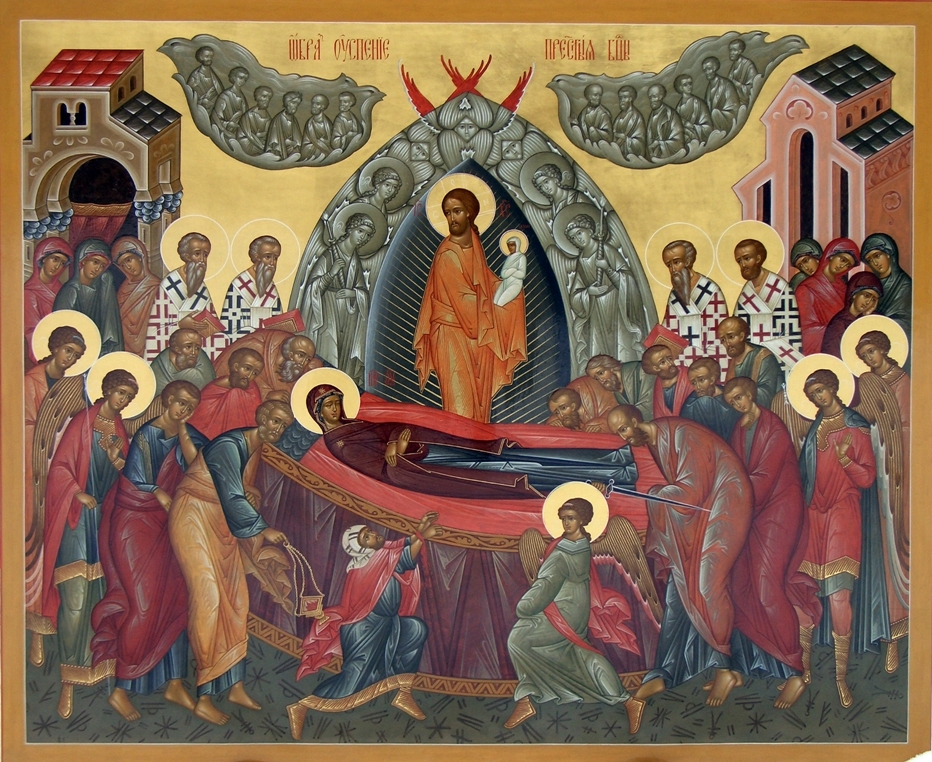
After the death of Jesus Christ on the Cross, His Most Pure Mother lived for about fifteen years in Jerusalem, in the house of the holy Apostle John the Theologian, to whom the Lord Himself entrusted her from the Cross. The time came for her to move on to the heavenly abode of her Son. When the Mother of God was praying on the Mount of Olives, the legend tells, the Archangel Gabriel appeared to her, bringing a date branch, and announced her death would take place in three days.

The Most Pure One was overjoyed to hear such news, and began to prepare. By the day of her repose, by the command of God, there appeared miraculously in Jerusalem, except for the Apostle Thomas, all the apostles who had been scattered for preaching throughout the world. They were witnesses of Her peaceful, quiet, holy and blessed death. The Lord Jesus Christ Himself, in heavenly glory, surrounded by an innumerable multitude of angels and righteous spirits, appeared to receive the soul of His Most Pure Mother and with glory ascended her to heaven.

Homily Two on the Feast of the Dormition of the Theotokos (St. Luke of Simferopol)


By St. Luke, Archbishop of Simferopol and All Crimea

(Delivered on August 15/28, 1951)

Who among earthly people died like the Most Holy Theotokos? Whose deathbed was surrounded by the apostles? At the head of whose deathbed the heavenly branch shone with heavenly light, brought by the archangel Gabriel three days before the death of the Most Holy Theotokos?

Whose soul did the Lord Himself and our God Jesus Christ come to accept?

Oh no one, no one, of course, no one!

The Theological August: 2022 Pastoral Encyclical for the Feast of the Dormition of the Theotokos (Metr. Hierotheos of Nafpaktos)


The Theological August
 
Pastoral Encyclical for the Feast of the 
Dormition of the Theotokos (2022)

In the middle of Summer, and in fact in the middle of the month of August, we celebrate the feast of the Dormition of the Most Holy Theotokos, from whom Christ took on human nature and entered history as the God-man Christ.

In the first days of August until the eve of August 15th, we chant in the sacred churches the Supplicatory Canons to the Most Holy Theotokos, the Small and the Great Parakleseis, which are full of theological and spiritual meanings. With theological words and wonderful images, the entire universal work of Christ and His Mother is presented.

When the Mother of God Sent Aid to Saint Paisios the Athonite


Saint Paisios narrated the following story of a personal intervention of the Mother of God in his life:
 
I had been fasting and keeping vigil. In those days I split the fast of the Fifteenth of August into two: until the Transfiguration I did not eat anything, on the day of the Transfiguration I ate, and then until the Panagias again I did not eat anything. So I left immediately after the vigil and didn't even think to take a little dried bread with me.

I arrived at the Monastery of Iveron, gave the letter and went down to the dock to wait for the boat. It was supposed to come at four in the afternoon, but it was late. In the meantime I started to get dizzy. Beyond was a stack of tree trunks, like telegraph poles, and I said with my thoughts:

Monastery of the Panagia Kyparissiotissa and Saint Hierotheos in Megara


The Monastery of the Panagia Kyparissiotissa and Saint Hierotheos is located 8km northweest of the city of Megara in West Attica, in the area of Derveni. According to tradition, Saint Meletios built this monastery in the 11th century in honor of Saint Hierotheos, the first Bishop of Athens, because it was in this location he lived in asceticism and was buried.

The tomb of Saint Hierotheos is located in the katholikon of the monastery, and its most treasured relic is the sacred head of Saint Hierotheos.

Next to the tomb of Saint Hierotheos is the icon of Panagia Kyparissiotissa.

The Monastery of Panagia Tourliani in Mykonos


According to tradition, the Monastery of Panagia Tourliani was built by fugitive monks from Paros who sought asylum on the island of Mykonos in 1542 AD. The monks took refuge in the upper part of the island, in the small church dedicated to the Entrance of the Theotokos, where the nun Tourli served. The place of their settlement thus became known as Ano Mera.

Also according to tradition, the miraculous icon of the Panagia was found floating on the beach of the island, near the bay of Tourlos (hence the name Tourliani) on the west side of the island, a few kilometers north of Chora in Mykonos and is considered the work of the Evangelist Luke. What has been observed with the icon is that woodworms do not attach to it because it is painted on a plate of chewed wax and mastic from Chios, a mixture invulnerable to insects.

Homily Two on the Dormition of the Mother of God (Archpriest Rodion Putyatin)

 
 By Archpriest Rodion Putyatin

When the Mother of God revealed to her relatives and friends that she would soon die, and when they began to cry, she told them in order to comfort them: "Do not cry, but you should rejoice when I die, for after death I will be closer to the Throne of God and, conversing face to face with God, my Son, it is more convenient to pray to Him for you and to ask His mercy for you."

Christian listeners! Can we, when we die, also console our relatives and friends with the same, with what the Mother of God did? Can any of us say before death: "Do not cry, do not grieve, when I die, you will be well without me; I will pray for you there, it will be more convenient for me to pray for you there."

Homily on the Dormition of the Theotokos: The Relationship of the Panagia with Orthodox Ecclesiology (Metr. Hierotheos of Nafpaktos)

 
Homily on the Dormition of the Theotokos: 
The Relationship of the Panagia with Orthodox Ecclesiology 
 
By Metropolitan Hierotheos of Nafpaktos and Agiou Vlasiou

(Delivered in 2002)

The Church of Christ, my beloved brethren, is the Body of the God-man Christ. The Church of the Old Testament was spiritual and consisted of the righteous, who did not overcome death, but with the incarnation of Christ the Church became physical, that is, she was received by Christ and became His Body. And the Panagia cooperated in this, because she gave her body to Christ, who deified it and made it a Church. This alone shows the great value of our Panagia, and that this is the joy and the cause of our deification.

Therefore, when we say Church we mean the Bridegroom Christ, the Mother of the Bridegroom Christ and the friends of the Bridegroom Christ, the saints. In this society the deification of man and the sanctification of creation are achieved and of course all the great changes take place in society and the world.

Homily One on the Dormition of the Mother of God (Archpriest Rodion Putyatin)


By Archpriest Rodion Putyatin

I choose not a cheerful subject for this joyful day: I want to talk with you about death.

And more often we ought to talk about it, pious listeners. We ought not think we can run away from death; it's better to think about it. The more often we think about death, the less we will be afraid of it. It is precisely because we are too afraid of death, that we rarely think about it or think in the wrong way about it.

And truly, what is terrible about death, if you look at it from the best point of view - the way it should seen? Tell me, why are you so afraid of death? Because, you will say, I want to live, life has not bored me yet. Indeed, it is very natural for us to want to live: animals are irrational - and they do not like to die. But judge, will death take your life? After all, you will live after death. For what does it mean to die? To die is the same as going from an old, bad house to a new, good one: death is a means of moving from one place to another. What is so terrible about it?

Reflection on the Dormition of the Theotokos (St. Theophan the Recluse)


By St. Theophan the Recluse

"Mary hath chosen that good part" (Luke 10:42). The Dormition of the Mother of God represents a good end to such a choice. The Savior Himself received her soul in His arms at her Dormition. Many saints were made worthy of the same. In various ways and degrees, all those who choose that good part meet with this. At the time this choice was made, the saints foresaw this end through hope, and even felt it to a certain degree; but then come labors, struggle and forcing oneself, shrouding the chosen path. The good end of that good part remains as a guiding star. It is as a faraway shining light for a traveler who is overtaken by darkness. Hope is the stimulator of energy and the maintainer of patience and constancy in what was begun, while hope itself is strong through faith. People make their choice according to faith, and through hope they are firm in their choice; while through patience they attain that good end.