Showing posts with label Almsgiving. Show all posts

December 5, 2021

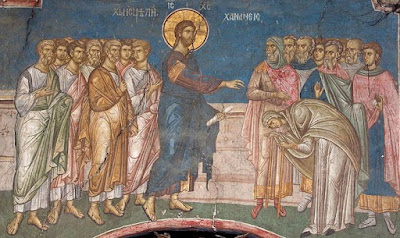
Homily on the Tenth Sunday of Luke (Archpriest Rodion Putyatin)

 
By Archpriest Rodion Putyatin

"And when Jesus saw her, he called her to him, and said unto her, 'Woman, thou art loosed from thine infirmity'" (Luke 13:12).

In one of the Jewish synagogues, Jesus Christ taught the people on the Sabbath. There was a woman who had been afflicted by an unclean spirit for eighteen years; she was twisted and could not stand up straight. Jesus, seeing her, called to her and said: “Woman, thou art loosed from thine infirmity." And he laid his hands on her, and she immediately straightened up and began to praise God.

Jesus Christ Himself therefore found a woman possessed by an ailment, He Himself found her, He Himself volunteered to give her help. So we, the listeners, must always do the same: not only must we help others in need, we must ourselves look out for and seek out those in need of our help. We should especially do this on feast days. These holy days are sacred by deeds of mercy. If you go to church for a feast, bring a gift to the altar, but you won't help those in need - you will not have a complete feast yet.

April 3, 2021

The Grass of the Grandmother


By St. George Karslides
 
A church was being built in a village and everyone was helping as much as they could.

Whoever had an animal had them carry stones and those who were strong worked.

There was also a very poor grandmother in the village, who had nothing to give for the church. Her soul ached for this and as the animals carrying the stones passed by, she would pick up grass and throw them so they could eat to gain strength.

When the church was finished, they consecrated it and wrote the name of the Bishop on an inscription.

March 13, 2021

Which Is Better for the Dead, Prayer or Almsgiving?


In a recorded discussion, Saint Iakovos Tsalikes said the following:

Someone once told me:

"Father, our relatives drowned while out on a boat."

"Won't you do a memorial for your husband, your relatives?"

"Nah, memorials aren't necessary," she said. "I gave 5,000 drachmas to the Orphanage in Halkida. It's the same thing. My Father, what do you have to say about this?"

June 4, 2020

Synaxarion of our Venerable Mother Sophia of Ainos

St, Sophia of Ainos (Feast Day - June 4)

Verses

The world did not hinder you Sophia,
To attain perfection in the virtues.

This Saint was from the city of Ainos, the daughter of pious parents who were well-known in that area. When she attained the proper age, her parents wedded her to a lawful husband, with whom she gave birth to six children. Even though she lived in the midst of the cares and tumults of the world, she showed through her works that the cares and tumults of the world were no hindrance to her pleasing God, who desires that we only accomplish the commandments of the Lord and pursue God-loving actions and virtues. This blessed woman was never absent from the Church of God, and even when she was in her house she would keep vigil all night and abided in prayers.

April 29, 2020

Saint John Kaloktenes the New Merciful, Metropolitan of Thebes


On the 29th of April we commemorate our Holy Father John the Metropolitan of Thebes and leader of all Boeotia who is called Kaloktenes and the New Merciful.

Verses

Like the Archangel you spoke with the Virgin,
And heard her say Rejoice to you, John.
The New Merciful had mercy on the poor,
Receiving his wages though having no wealth.
On the twenty-ninth the New Merciful John,
Received a peaceful lot.

Saint John Kaloktenes lived in the twelfth century, and was born to noble and virtuous parents in Constantinople, his father's name being Constantine and mother's name being Maria. His birth was the fruit of prayer, as John's parents were sterile for many years. This resulted in John being a lover of prayer from early childhood. Growing up he was an excellent student. Because of his great love for the Mother of God, he was made worthy one day to hear her voice as he read the Salutation, "Rejoice, bride unwedded," to which he heard her voice say to him, "Rejoice you as well, protector of Thebes."

February 22, 2020

On Praying for the Dead (St. Augustine of Hippo)


Aerius of Pontus in the fourth century rejected praying for the dead since he believed it promoted moral laxity in this life: "If the prayer of the people here has benefited the people there, no one would practice piety or perform good works." His objection was refuted by Augustine of Hippo.

By St. Augustine of Hippo

The prayer either of the Church herself or of pious individuals is heard on behalf of certain of the dead; but it is heard for those who, having been regenerated in Christ, did not for the rest of their life in the body do such wickedness that they might be judged unworthy of such mercy, nor who yet lived so well that it might be supposed they have no need of such mercy. (The City of God Bk. 21.24)

On the Benefits of Memorials for the Dead (St. John Chrysostom)


By St. John Chrysostom

(Excerpt from Homily 3 on Philippians)

Not in vain did the Apostles order that remembrance should be made of the dead in the dreadful Mysteries. They know that great gain results to them, great benefit; for when all the people stand with uplifted hands, a priestly assembly, and that awesome Sacrifice lies displayed, how shall we not prevail with God by our entreaties for them? And this we do for those who have departed in faith, while the catechumens are not thought worthy even of this consolation, but are deprived of all means of help save one. And what is this? We may give to the poor on their behalf. This deed in a certain way refreshes them. 


November 30, 2019

The Archbishop of Greece Helps a Homeless Elderly Couple


On the afternoon of Friday 22 November 2019, Archbishop Hieronymos of Athens and All Greece visited a church in Kerameikos, which is an area of Athens located to the northwest of the Acropolis, to meet an elderly couple, 84-year-old Philip and his 82-year-old wife Helen.

March 4, 2019

On Giving Without Discrimination: The Example of St. John the Merciful

John the Merciful, second half of the 15th century, Warsaw  National Museum

By Leontios

Life of St. John the Almsgiver

Whilst this same crowd of people (refugees from Syria) was still in the city (Alexandria), one of the strangers, noticing John (the Merciful's) remarkable sympathy, determined to try the blessed man; so he put on old clothes and approached him as he was on his way to visit the sick in the hospitals -- for he did this two or three times a week -- and said to him: "Have mercy upon me for I am a prisoner of war."

March 3, 2019

St. Symeon the New Theologian, Matthew 25, and a Critique of the Social Gospel


By St. Symeon the New Theologian

Catechetical Discourse 9

On Almsgiving

"As you did it to any one of the least, you have done it to Me" (Matt. 25:40). The Lord did not, as some imagine, say this merely of those who are stricken with poverty and destitute of bodily food. He said this no less of all of our other brethren who are wasting away, not through any famine of bread and water, but from the famine of the neglect of God's commandments and failure to obey them. To the extent that the soul is more valuable than the body (Matt. 6:25; Lk. 12:23), so much more is spiritual food necessary than bodily food. It is of this I think the Lord spoke when He said, "I was hungry and you gave Me no food, I was thirsty and you gave Me no drink" (Matt. 25:42), rather than of bodily food, which is subject to corruption; for He truly suffers thirst and hunger for the salvation of each one of us. Our salvation consists in abstaining from all sin; but apart from the practice of the virtues and the fulfilling of all the commandments it is impossible to achieve abstinence from all sin. It is by fulfilling His commandments that we usually "feed" our Master and God, the Lord of all; for our holy fathers tell us that just as the demons are fed by our evil deeds and so prevail against us, so, when we abstain from evil, they become weak through starvation and lose their vigor. So I think that He who became poor for the sake of our salvation is thus nourished by us, and suffers hunger when we neglect Him. Of this the lives of the saints can instruct and inform us.

March 20, 2018

On Gaining Riches as a Pretext for Almsgiving


By St. Nikolai Velimirovich

You will hear this kind of justification from many who pursue riches: "When I become rich, I will be able to perform good works!" Do not believe them, for they deceive both you and themselves. St. John Climacus knew in depth the most secret motives of men's souls when he said, "The beginning of love of money is the pretext of almsgiving and the end of it is hatred of the poor" (Step 16). This is confirmed by all lovers of money, the rich or the less rich. The average man says, "If only it were that I had money, I would carry out this and that good work!" Do not believe him. Let him not believe himself. Let him look at himself, as in a mirror, at those who have money and who are not willing to do this or that good work. That is how he would be if he acquired some money.

January 2, 2018

Saint Juliana the Merciful of Lazarevo (+ 1604)

St. Juliana of Lazarevo (Feast Day - January 2)

By St. Dimitri of Rostov

During a moment of ardent supplication to God, the great Christian ascetic Macarius of Egypt heard a voice from heaven, saying: "Macarius! thus far thou hast not attained the spiritual level of two women who live in the town nearby!" The elder straightway took his staff in hand and went to seek out the righteous women of whom the voice from on high had spoken. After a lengthy search, he knocked on the door of a certain house in the town, and two women admitted him with kindness. Macarius said to them: "I have left the desert specifically to meet you, that I might acquaint myself with your works. Tell me of yourselves." "O man of God," the women answered, abashed, "can one expect anything God-pleasing from those who are continually occupied with domestic tasks and must need fulfill the responsibilities of marriage?" But the ascetic persisted, asking the women to disclose to him their manner of life. And they answered him, saying: "We are two sisters-in-law, the wives of brethren. For fifteen years we have lived together, and all throughout that time we have not spoken to each other a single word in vexation. We do not have children, but if the Lord will grant them, we will entreat Him to help us raise them in the faith and in piety. We treat our servants with kindness. Many times we have taken counsel one with another as to whether we ought to enter a community of nuns, but our husbands have declined to give us their permission. And seeing their love for us, we have resolved not to part with them, but to serve them with diligence. Yet to make our life a little like that of the holy desert-dwellers, we have set it in our hearts to avoid loud conversations, to remain at home as much as possible, to take care of the running of our household." To this the venerable Macarius said: "Truly God doth not look to see who is a virgin or who is married, who is a monastic or who is in the lay state, but only looketh for the inclination of the heart toward good deeds. This He accepteth, and in accordance therewith He sendeth the Holy Spirit down upon anyone who desireth to be saved. And the Holy Spirit, the Comforter, directeth the thoughts and will of such a one to the everlasting life of heaven."

December 22, 2017

Sermon 8 on the Fast of Advent (St. Leo the Great)


By St. Leo the Great

(Sermon 19: On the Fast of The Tenth Month, VIII)

I. Self-restraint leads to higher enjoyments

When the Savior would instruct His disciples about the Advent of God's Kingdom and the end of the world's times, and teach His whole Church, in the person of the Apostles, He said, "Take heed lest haply your hearts be overcharged with surfeiting and drunkenness, and care of this life" (Lk. 21:34). And assuredly, dearly beloved, we acknowledge that this precept applies more especially to us, to whom undoubtedly the day denounced is near, even though hidden. For the advent of which it behooves every man to prepare himself, lest it find him given over to gluttony, or entangled in cares of this life. For by daily experience, beloved, it is proved that the mind's edge is blunted by over-indulgence of the flesh, and the heart's vigor is dulled by excess of food, so that the delights of eating are even opposed to the health of the body, unless reasonable moderation withstand the temptation and the consideration of future discomfort keep from the pleasure. For although the flesh desires nothing without the soul, and receives its sensations from the same source as it receives its motions also, yet it is the function of the same soul to deny certain things to the body which is subject to it, and by its inner judgment to restrain the outer parts from things unseasonable, in order that it may be the oftener free from bodily lusts, and have leisure for Divine wisdom in the palace of the mind, where, away from all the noise of earthly cares, it may in silence enjoy holy meditations and eternal delights. And, although this is difficult to maintain in this life, yet the attempt can frequently be renewed, in order that we may the oftener and longer be occupied with spiritual rather than fleshly cares; and by our spending ever greater portions of our time on higher cares, even our temporal actions may end in gaining the incorruptible riches.

December 21, 2017

Sermon 6 on the Fast of Advent (St. Leo the Great)


By St. Leo the Great

(Sermon 17: On the Fast of The Tenth Month, VI)

I. The duty of fasting is based on both the Old and New Testaments, and is closely connected with the duties of prayer and almsgiving.

The teaching of the Law, dearly beloved, imparts great authority to the precepts of the Gospel, seeing that certain things are transferred from the old ordinances to the new, and by the very devotions of the Church it is shown that the Lord Jesus Christ "came not to destroy but to fulfill the Law" (Matt. 5:17). For since the cessation of the signs by which our Savior's coming was announced, and the abolition of the types in the presence of the Very Truth, those things which our religion instituted, whether for the regulation of customs or for the simple worship of God, continue with us in the same form in which they were at the beginning, and what was in harmony with both Testaments has been modified by no change. Among these is also the solemn fast of the tenth month, which is now to be kept by us according to yearly custom, because it is altogether just and godly to give thanks to the Divine bounty for the crops which the earth has produced for the use of men under the guiding hand of supreme Providence. And to show that we do this with ready mind, we must exercise not only the self-restraint of fasting, but also diligence in almsgiving, that from the ground of our heart also may spring the germ of righteousness and the fruit of love, and that we may deserve God's mercy by showing mercy to His poor. For the supplication, which is supported by works of piety, is most efficacious in prevailing with God, since he who turns not his heart away from the poor soon turns himself to hear the Lord, as the Lord says: "Be ye merciful as your Father also is merciful....forgive and you shall be forgiven." What is kinder than this justice? What more merciful than this retribution, where the judge's sentence rests in the power of him that is to be judged? "Give," he says, "and it shall be given to you." How soon do the misgivings of distrust and the puttings off of avarice fall to the ground, when humanity may fearlessly spend what the Truth pledges Himself to repay.

December 16, 2017

Sermon 5 on the Fast of Advent (St. Leo the Great)


By St. Leo the Great

(Sermon 16: On the Fast of The Tenth Month, V)

I. The prosperous must show forth their thankfulness to God, by liberality to the poor and needy

The transcendent power of God's grace, dearly beloved, is indeed daily effecting in Christian hearts the transference of our every desire from earthly to heavenly things. But this present life also is passed through the Creator's aid and sustained by His providence, because He who promises things eternal is also the Supplier of things temporal. As therefore we ought to give God thanks for the hope of future happiness towards which we run by faith, because He raises us up to a perception of the happiness in store for us, so for those things also which we receive in the course of every year, God should be honored and praised, who having from the beginning given fertility to the earth and laid down laws of bearing fruit for every germ and seed, will never forsake his own decrees but will as Creator ever continue His kind administration of the things that He has made. Whatever therefore the cornfields, the vineyards and the olive groves have borne for man's purposes, all this God in His bounteous goodness has produced: for under the varying condition of the elements He has mercifully aided the uncertain toils of the husbandmen so that wind, and rain, cold and heat, day and night might serve our needs. For men's methods would not have sufficed to give effect to their works, had not God given the increase to their wonted plantings and waterings. And hence it is but godly and just that we too should help others with that which the Heavenly Father has mercifully bestowed on us. For there are full many, who have no fields, no vineyards, no olive-groves, whose wants we must provide out of the store which God has given, that they too with us may bless God for the richness of the earth and rejoice at its possessors having received things which they have shared also with the poor and the stranger. That garner is blessed and most worthy that all fruits should increase manifold in it, from which the hunger of the needy and the weak is satisfied from which the wants of the stranger are relieved, from which the desire of the sick is gratified. For these men God has in His justice permitted to be afflicted with various troubles, that He might both crown the wretched for their patience and the merciful for their loving-kindness.

November 15, 2017

Sermon 1 on the Fast of Advent (St. Leo the Great)


By St. Leo the Great

(Sermon 12: On the Fast of The Tenth Month, I)

I. Restoration to the Divine image in which we were made is only possible by our imitation of God's will

If, dearly beloved, we comprehend faithfully and wisely the beginning of our creation, we shall find that man was made in God's image, to the end that he might imitate his Creator, and that our race attains its highest natural dignity, by the form of the Divine goodness being reflected in us, as in a mirror. And assuredly to this form the Saviour's grace is daily restoring us, so long as that which, in the first Adam fell, is raised up again in the second. And the cause of our restoration is naught else but the mercy of God, Whom we should not have loved, unless He had first loved us, and dispelled the darkness of our ignorance by the light of His truth. And the Lord foretelling this by the holy Isaiah says, "I will bring the blind into a way that they knew not, and will make them walk in paths which they were ignorant of. I will turn darkness into light for them, and the crooked into the straight. These words will I do for them, and not forsake them." And again he says, "I was found by them that sought Me not, and openly appeared to them that asked not for Me." And the Apostle John teaches us how this has been fulfilled, when he says, "We know that the Son of God has come, and has given us an understanding, that we may know Him that is true, and may be in Him that is true, even His Son ," and again, "let us therefore love God, because He first loved us." Thus it is that God, by loving us, restores us to His image, and, in order that He may find in us the form of His goodness, He gives us that whereby we ourselves too may do the work that He does, kindling that is the lamps of our minds, and inflaming us with the fire of His love, that we may love not only Himself, but also whatever He loves. For if between men that is the lasting friendship which is based upon similarity of character notwithstanding that such identity of wills is often directed to wicked ends, how ought we to yearn and strive to differ in nothing from what is pleasing to God. Of which the prophet speaks," for wrath is in His indignation, and life in His pleasure," because we shall not otherwise attain the dignity of the Divine Majesty, unless we imitate His will.

April 11, 2017

The Oil of Fellowship (Metropolitan Seraphim of Kastoria)


By Metropolitan Seraphim of Kastoria

"On Holy and Great Tuesday, we commemorate the Parable of the Ten Virgins in the Holy Gospel."1

In this simple way the sacred Synaxarion indicates what Holy and Great Tuesday is dedicated to. The words of Saint John Chrysostom are both characteristic and moving regarding the Parable of the Ten Virgins: "There were ten virgins, the Gospel says, five who were foolish and five who were prudent. The wise ones had oil; however, since the foolish ones did not, their lamps were extinguished... Virginity is the fire, almsgiving the oil. Therefore, when the fire does not have oil to burn safely and steadily, it is extinguished. Virginity is likewise extinguished when it lacks almsgiving... Who are the dealers of this oil? The poor, the ones who sit in front of the church in order to ask for alms. How much do they sell it for? As much as you want. I do not put a price on it so that you do not qualify the poverty. Buy as much as you can... Give to the poor, so that even if you keep silent (and thousands upon thousands of mouths defend you) almsgiving will take your side and plead on your behalf. Almsgiving is the salvation of the soul."2

March 3, 2017

Saturday of Souls Resource Page


Praying for and Remembering the Departed


Saturdays Before Meatfare and Cheesefare


First Saturday of Great Lent


Second, Third and Fourth Saturday of Great Lent


Saturday Before Pentecost


Saint Demetrios Ancestral Saturday
 

December 1, 2016

Synaxarion of Saint Philaret the Merciful

St. Philaret the Merciful (Feast Day - December 1)

Verses

You who were adorned with every virtue have died,
Truly full of compassion you loved father.

Philaret lived during the reign of Emperors Constantine (780-797) and Irene (775-802), and was from the land of Paphlagonia, the son of George and Anna. Taking a lawful wife by marriage, he occupied himself as a farmer of the earth, and from this he brought in the necessities of life. Having become wealthy he distributed it as alms to the poor. Wherefore by the envy of the devil, the renowned one came to such a state of poverty, that like another Job, he was without even needed food. But God did not overlook him till the end so that he should be distressed with want. Rather He economized by His foreknowledge for Constantine, the son of Empress Irene, to take as a wife the granddaughter of Saint Philaret, whose name was Maria, for she was full of every form of beauty both in her soul and her body. He also economized for Saint Philaret to be honored with the office of consul. By this he became a very wealthy lord, which he distributed abundantly to the poor.

November 12, 2016

Saint John the Merciful as a Model for our Lives

St. John the Merciful (Feast Day - November 12)

By Protopresbyter Fr. George Papavarnavas

In His Sermon on the Mount, Christ blessed the merciful: "Blessed are the merciful for they shall obtain mercy." Happy are those who are merciful to their fellow people, for God will be merciful to them. In other words, He will offer them His uncreated grace, His love, and all His "worldly and otherworldly goods."

Mercy is a selfless offering. To be merciful means to offer something, as well as to offer myself. I offer myself to serve others. I offer my love and my heart. The offering of material goods is, of course, something important, but it is not the greatest and most important thing someone can do. Material goods can be offered by someone who does not believe in God and does it out of natural goodness, or even selfishness and ulterior motives. The most important and the most difficult thing is for someone to offer their love and their heart. To sacrifice themselves daily for others, even though they may not be their friends or they do not know who they are. Not just anyone can do this, but only someone who knows Christ personally and sees Him in the face of his fellow human beings, of each and every person, regardless of nationality, race, and language, for they see Christ Himself and are ready at any moment to sacrifice themselves for that which the Lord called the least of His brethren.

Support the Mystagogy Resource Center

For more than fifteen years, the Mystagogy Resource Center has been a labor of love dedicated to making the riches of the Orthodox Christian tradition freely available to people throughout the world.

Thousands of articles, translations, lives of saints, theological reflections, historical resources, and daily materials have been published across this ministry’s websites, all offered free of charge for anyone seeking a deeper understanding of the Orthodox faith.

This is a one-man ministry that requires countless hours of research, translation, writing, editing, and maintenance each day.

If this work has spiritually benefited, educated, encouraged, or inspired you in any way, I humbly ask you to consider supporting this ministry financially.

Generous annual and monthly benefactors make possible the continuation and expansion of this work for the future, for without such support this ministry cannot exist.

Every contribution, whether large or small, truly makes a difference and is deeply appreciated. May God bless you abundantly for your generosity and prayers.

❖ ❖ ❖
PayPal • Credit Card • Debit Card • Venmo
Become a Patron on Patreon