|
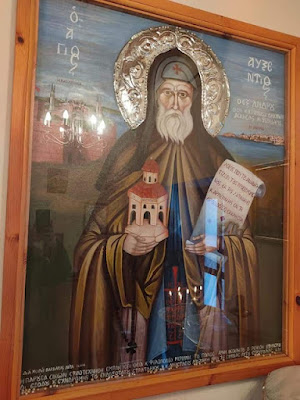
| St. Auxentios of Katirli (Feast Day - February 14) |
Venerable Auxentios was born in Andros at the beginning of the 18th century. He first served as a sexton in the Church of the Savior Christ in Galata of Constantinople, and was later ordained a deacon. As a deacon he settled in the coastal town of Katirli of Nicomedia and lived as an ascetic on Mount Katirli of Propontis. The holiness of his life and the gift of miracles that the Lord gave him, made many come to him to receive his blessing and healing. Patriarch Cyril V of Constantinople (1748-1751, 1752-1757) had him as a spiritual father.
When Patriarch Cyril V established by a synodal decision the rebaptism of converted Roman Catholics, Protestants and Armenians into the Orthodox faith, Saint Auxentios supported him with his sermons. He became the leader of the faction that supported the rebaptism of the heterodox. When Patriarch Cyril V was ousted from the throne, the rulers also persecuted Saint Auxentios. In vain though. The orator Kritias, upon arriving to Katirli to change the mind of Auxentios, was expelled by the Christians of the town.
When Patriarch Cyril V established by a synodal decision the rebaptism of converted Roman Catholics, Protestants and Armenians into the Orthodox faith, Saint Auxentios supported him with his sermons. He became the leader of the faction that supported the rebaptism of the heterodox. When Patriarch Cyril V was ousted from the throne, the rulers also persecuted Saint Auxentios. In vain though. The orator Kritias, upon arriving to Katirli to change the mind of Auxentios, was expelled by the Christians of the town.

His synaxarion says that he would throw into the sea the cloak he wore and used it as a boat to cross the sea. Thus he arrived in Constantinople, after stopping the storm of the sea by making the shape of the Holy Cross on the sea.
Saint Auxentios reposed peacefully around the year 1757 and his memory is celebrated with brilliance at Stavros of Halkidiki, the Metropolis of Ierissos, Mount Athos and Ardameri. A part of his holy relic is kept there, which was moved there by the uprooted refugees of Asia Minor in 1922. Also, Saint Auxentios is especially honored in the Church of Saint John the Forerunner in Katirli of Kalamaria. The icon of the Saint is kept there as the area and the church were built by refugees from Asia Minor who mainly came from Kartili of Asia Minor and gave the name to the current neighborhood. He is a "refugee" but also a local saint of the Metropolis of Nea Krini and Kalamaria.
Saint Auxentios reposed peacefully around the year 1757 and his memory is celebrated with brilliance at Stavros of Halkidiki, the Metropolis of Ierissos, Mount Athos and Ardameri. A part of his holy relic is kept there, which was moved there by the uprooted refugees of Asia Minor in 1922. Also, Saint Auxentios is especially honored in the Church of Saint John the Forerunner in Katirli of Kalamaria. The icon of the Saint is kept there as the area and the church were built by refugees from Asia Minor who mainly came from Kartili of Asia Minor and gave the name to the current neighborhood. He is a "refugee" but also a local saint of the Metropolis of Nea Krini and Kalamaria.