Showing posts with label Iconoclasm. Show all posts

The Vision of the Departed Soul of Saint Theodore the Studite by Saint Hilarion of Dalmatoi Monastery


At the time Venerable Hilarion of Dalmatoi Monastery (comm. June 6) returned from captivity, which he suffered on behalf of his veneration of the Holy Icons, Venerable Theodore the Studite went to the Lord (comm. Nov. 11), who also suffered many evils from heretics for his Orthodoxy. His holy soul, ascended to heaven by the Angels, was seen by Venerable Hilarion, as it is said in the Life of Saint Theodore. On the day when Saint Theodore the Studite presented himself, Venerable Hilarion, working in his garden and chanting psalms, heard some wondrous voices and smelled an unspeakably wonderful scent. Astonished, he began to look around where it came from, and looking up, he saw a multitude of angels in white robes, whose bright faces shone, who came down from heaven to meet someone with songs. Seeing all this, Venerable Hilarion fell to the ground in great fear, and heard someone say to him: "This is the soul of Theodore, abbot of the Studite Monastery, who suffered with his blood for the holy icons and heroically endured hardships to the end, and now with his lips rejoicing he ascends to heaven, met by the Heavenly Powers." Worthy of such a wondrous vision, Venerable Hilarion was filled with great consolation and spiritual sweetness; and for many days he rejoiced in his soul, and his face shone with joy like the face of an angel.


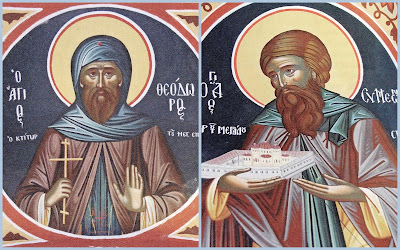
Saints Symeon and Theodore, Founders of the Monastery of Mega Spelaion

 
By Monk Moses the Athonite
 
They were born in Thessaloniki, and were brothers. When they came to Mount Athos, they were discipled under Venerable Euthymios the New. After being ordained priests they were seen as wise teachers of Mount Athos, distinguished for their asceticism.

Withdrawing from Mount Athos they went to venerate in the Holy Land and at God-trodden Mount Sinai. They returned to Mount Athos but left again for Thessaloniki and Thessaly, preaching against the heresy of the iconoclasts. They settled on the mountain near Thermopylae, continuing their inner struggles and after a vision they went to the Great Cave (Mega Spelaion) near Kalavryta in the Peloponnese. There they met with the shepherdess Saint Euphrosyne and after finding the miraculous icon of the Theotokos, they built a monastery.

Homilies on the Ecumenical Synods - The Seventh Ecumenical Synod (Metr. Hierotheos of Nafpaktos)


 Homilies on the Ecumenical Synods

The Seventh Ecumenical Synod (787 A.D.)

By Metropolitan Hierotheos of Nafpaktos and Agiou Vlasiou 

The Apostle Paul, beloved brethren, once speaking to the Presbyters of the Church of Ephesus, told them that he knew well that after his departure the wild wolves would invade among them, who will show no pity to the flock, and from among the members of the Church people will emerge who will speak perversions to distract the disciples and have them with them (cf. Acts 20:29-30).

This was seen throughout the history and life of the Church, as various heretics appeared, who ended up in non-orthodox teachings and created problems in the Church of Christ.

The devil always fights the Church, hates the person of Christ and wants to alter His teachings. From this perspective one must view heresies.

Leontius of Neapolis: A Seventh Century Defender of Holy Images


Below is a copy of a paper by Nicholas Gendle titled "Leontius of Neapolis: A Seventh Century Defender of Holy Images". Right click on each page to expand, or read the text here.
 

Iconoclasm and Saint Euphemia According to Theophanes the Chronicler


In the early 9th century historical text known as the Chronicle of Theophanes, under the year 766 A.D., the following is recorded about the iconoclast Emperor Constantine V Copronymos (741-775), who together with his iconoclastic policies also forbade the veneration of relics and prayers to the saints, and this is most notably reflected in his mistreatment of the relics of Saint Euphemia, which miraculously survived an attempt at their destruction and today rest at the Phanar in the Church of Saint George at the Ecumenical Patriarchate of Constantinople:

He who was ruling the Christians by the ineffable decision of God (just as the mad Ahab had ruled Israel) did far worse to the orthodox bishops, monks, laymen, rulers, and subjects under his control than did the madness of the Arabs. He totally renounced the intercession of the holy Virgin and Mother of God and that of all the saints, on the grounds that it gave no aid and was unscriptural. But all aid for us springs from this intercession.

The Holy Canons of Saint Nikephoros the Confessor


Prolegomena

Our Father among Saints Nikephoros the Confessor, having formerly been an private secretary, and later having become a monk, at length was made Patriarch of Constantinople during the reigns of Emperors Nikephoros, Staurakios, and Michael Rangave, thereby, in the year 815, according to Meletios of Athens (Eccl. Hist., vol. II, p. 259), becoming the immediate successor to the patriarchal throne after divine Tarasios, who had distinguished himself in the Seventh Ecumenical Synod. But he was deprived of the throne by Leo the Armenian, an opponent of images, or icons; accordingly, he is celebrated as a Saint on the 2nd day of the month of June.

Holy Martyr Peter the Kalyvite at Blachernae

St. Peter Kalyvites (Feast Day - May 16)

Verses

Peter's faith was unshaken as a rock,
Being brought to the sinew cords for his words.

Saint Peter the Kalyvite was the first victim of Iconoclasm on May 16, 762 under Emperor Constantine V Copronymos. His martyrdom was recorded by Theophanes (Chronicle 21), where he misnames him as Andrew, confusing him with Andrew the Stylite (whom Theophanes in Chronicle 27 misnamed as Peter) who was also killed by Copronymos. Theophanes writes:

Saint Sergios the Confessor, Father of Saint Photios the Great

St. Sergios the Confessor (Feast Day - May 13)

Verses

How did you come to the end of your life my Sergios?
My end was a common death, and I lived for you.*

Saint Sergios was born around 795 to a wealthy nobleman of Constantinople named Zacharias, who pursued a career as a state official and evidently reached the rank of consul. Sergios received an education suitable for a future civil servant, and soon attained the rank of spatharios, an uncommon honor for such a young man. He is described as a man of large physical stature who had a great soul to match. He was married to an aristocratic woman named Irene, who was pious and virtuous, and whose brother was the patrician Sergios, who married a woman also named Irene who was the sister of the iconophile Empress Theodora. The uncle of Saint Sergios was the Holy Patriarch Tarasios of Constantinople (Feb. 25, 786-806). Saint Sergios and Irene had five sons - Constantine, Sergios, Tarasios, Theodore and the renowned Holy Patriarch Photios the Great. Saint Sergios named his oldest son Tarasios after his uncle the Patriarch, while he named his second oldest son Photios after an eighth century iconophile martyr that may also have been related to him.

When the Soviets (Successfully) Blamed Orthodox Christian Icons for an Epidemic of Syphilis


By Daniel Peris

Icons played a uniquely important and personal role in the lives of the Russian Orthodox; they were present in the home of each believer and occupied a special corner of the peasant hut. Not surprisingly, they were the target of extensive antireligious propaganda. The specific charges made against icons varied over time. In 1924 Bezbozhnik claimed that an epidemic of syphilis in the countryside was being spread through the practice of kissing icons. Five years later, during collectivization, grain caches were claimed to have been found under icons. The resolution of the icon problem was straightforward: icons should be removed and destroyed. Early in the 1920s, the antireligious media reported that the population was turning away from icons. Bezbozhnik u stanka printed a pledge signed by thirty-eight workers at the Krasnaia Zvezda factory in Moscow, vowing that none had an icon and none practiced "icon worship." The consequences of disposing of icons were potentially miraculous. Bezbozhnik reported that after the Novyi Put' (New Path) commune in Nizhnyi Novgorod Province threw out its icons in 1925, the commune began to prosper: "Without God our affairs are much better. We obtained two tractors, a sophisticated thresher, and all the necessary equipment for working the land...." Later in the decade, more pointed activism was deemed necessary. In both Iaroslavl' and Pskov, the local League councils held campaigns to collect icons from apartments and workers' dormitories. The regime's success in removing icons from urban public places seems not to have been repeated in private apartments or in the countryside generally. The League's own propaganda provides indirect evidence of the continuing widespread presence of icons well into the 1930s.

Saint Eustratios the Wonderworker in the 21st Century: Revelations and Discoveries


In 2002, 88 year old Eustratios Lazaros saw Saint Eustratios the Wonderworker in his dreams twice, even though at the time he didn't know of his existence, during which time the Saint asked Eustratios to build a church in his name, in a specific place on property that belonged to the Church that bordered with his own property, in the village of Lada of Taygetos in Messinia (perhaps because this place looked similar to Olympus in Bithynia, where the Saint lived in asceticism).

His son Vasilios was a builder, and he undertook the complete task to construct the church in 2003, with the help of only two employees. By the grace of the Saint they overcame all obstacles very quickly, and on 9 January 2004 the first Divine Liturgy was celebrated. This was the only church dedicated to the Saint in Greece at the time.

Holy Newly-Appeared Martyrs Andrew, Stephen, Paul and Peter

Sts. Andrew, Stephen, Paul and Peter the Martyrs (Feast Day - October 21)

Verses

You had three crowned with you O Stephen,
Who contested with you by the same sword.

The Holy Newly-Appeared Martyrs Andrew, Stephen, Paul and Peter met their end by the sword.

Saint Naukratios the Studite (+ 847)

St. Naukratios the Studite (Feast Day - April 18 or June 8)

Verses

Naukratios is permitted to pass beyond the earth,
Having the Word as the steersman of the ship of his soul.

Venerable Naukratios lived in the ninth century, and was a disciple of Saint Theodore the Studite at the Stoudios Monastery in Constantinople. Like his spiritual father, he fervently upheld the veneration of sacred icons during the time of Iconoclasm, which is why he endured persecution and exile during the reign of Emperor Leo V (813-820). During this time, around 818, he endured flogging and imprisonment.

Synaxarion of our Venerable Father Thaddeus the Confessor (+ 818)

St. Thaddeus the Confessor (Feast Day - December 29)

Verses

Although Thaddeus was of a barbarian race,
He rebuked the impious with boldness.

Our Holy Father Thaddeus became the first slave to the most-venerable Theodore* who, by imperial decree, received the Monastery of Stoudios and converted it into a coenobium. Afterwards he was liberated from slavery, and the hairs of his head were tonsured in this Monastery of Stoudios, becoming a monk. Because he pursued conduct that was pleasing to God, he was beloved by all. He occupied himself with fasting and many vigils, had self-control over his tongue, payed attention to divine discourses, practiced sleeping on the ground, surpassed all in obedience, and was great in poverty, for the thrice-blessed one had nothing except the clothes he wore. Because at that time with the consent of God there ruled impious and iconoclast emperors, Michael the Stammerer (820-829) and his son Theophilos (829-842),** all the pious Bishops and Abbots of monasteries, as well as others, were imprisoned, while others were exiled. One of these was the great struggler Theodore, the master and abbot of Venerable Thaddeus. One time the Venerable One went with Saint Theodore to the imperial palace. Having become inflamed with divine zeal, he rebuked the impious emperor before the leader of the senate. The emperor ordered that the holy icon of the Savior be brought forth, and to be placed on the ground. The Venerable One was also forced to be held by strong brave men, and to be placed on top of the holy icon. There he stood without moving, standing on it against his will.

The Singing Emperor Who Was Murdered in Church on Christmas Day

Emperor Leo V leading the chanting at Christmas,
12th-century Madrid Skylitzis, Fol. 23r top.

By John Sanidopoulos

On Christmas morning in the year 820, while the iconoclast Emperor Leo V the Armenian was chanting in the palace chapel of Saint Stephen to celebrate the birth of the Lord, he was brutally murdered in the sanctuary. This took place because his friend Michael II the Stammerer became disgruntled with Leo V, when the Emperor divorced Michael's sister-in-law, and he began a plan to dethrone him. On Christmas Eve 820, Leo V accused him of conspiracy, jailed him, and sentenced him to death. Leo concocted a scheme where Michael was to be tied to an ape and cast into the bathhouse furnace of Zeuxippos, to be either maimed by the monkey or die from burning or dehydration under the heated bathhouse floor. It was the empress Theodosia, we are told, who fatefully interceded for Michael, imploring Leo not to taint his rule with such a savage act on the sacred feast of Christmas day. Leo too was troubled by the judgement he had passed upon his former friend and spent a sleepless night. He agreed to put off the execution until after the Christmas festivities. It would prove a fatal delay. During the night, Michael’s supporters put a conspiracy into action. Under the pretext of the prisoner wishing to confess his sins, a priest was sent for from the city. The servant sent to bring the priest summoned a number of conspirators who, disguised as monks, made their way into the Daphne palace complex and entered the Chapel of Saint Stephen, where the emperor would celebrate Christmas liturgy at dawn.

Synaxarion of our Venerable Father Euarestos

Venerable Euarestos (Feast Day - December 26)

Verses

Euarestos hastened in word and deed,
Until the end he pleased you O Word.

He lived during the reign of Emperor Leo the Armenian (813-820) who was an iconoclast, and was from the province of Galatia, the son of notable parents. After Leo was killed by the sword, Michael the Stammerer succeeded him in the year 820. Because he also was most-shameful and of the same habits as his predecessor Leo, for this reason he received a suitable punishment. When the Saint reached a prime age, he was given over to learn sacred letters. And having learned letters, he became all the beautiful things to everyone. That is to say, he became obedient to his parents, to his friends and neighbors he became graceful, and to foreigners and indigenous he became receptive. In short, he showed by true deeds his name, for he became pleasing to all.*

Saint Michael the Synkellos and Confessor (+ 846)

St. Michael the Synkellos (Feast Day - December 18)

Verses

Death was a stranger to you Michael,
But by death you live, even live worthily.

Michael was born at Jerusalem around 761 into an Arab family of pious Christians and at the age of three was dedicated to the service of God by his parents. Around 786 he became a monk at the Lavra of Saint Savvas. After the death of his father, he persuaded his mother and sisters to go to a monastery in Jerusalem.

Venerable Michael lived in the monastery for twelve years, subjecting himself for eighteen years to every form of hardship, eating a few vegetables two or three times a week, and allowing himself a little bread on the weekends. The abbot then chose Michael to be ordained a priest on account of his virtuous way of life. Following this, he received permission from the abbot to withdraw into a quiet cave.

Saint Stephen the Confessor, Archbishop of Sourozh

St. Stephen of Sourozh (Feast Day - December 15)

Saint Stephen the Confessor, Archbishop of Surrentium (Sourozh), was a native of Cappadocia and was educated at Constantinople in the eighth century. After receiving the monastic tonsure, he withdrew into the wilderness, where he lived for thirty years in ascetic deeds.

Patriarch Germanos of Constantinople (May 12) heard of Stephen’s humility and virtuous life, and wished to meet him. He was so impressed with Stephen that he consecrated him Bishop of the city of Surrentium (presently the city of Sudak in the Crimea). Within five years, Saint Stephen’s ministry was so fruitful that no heretics or unbaptized pagans remained in Surrentium or its environs.

Synaxarion of Saint Gregory the Confessor, Pope of Alexandria

St. Gregory the Confessor of Alexandria (Feast Day - November 5)

Verses

How unrewarded with discourses,
Is he who swiftly runs, as the eye of Orthodoxy?

Because this Saint loved Christ from a young age, he adorned himself with all the virtues. Therefore after the death of the holy Pope of Alexandria, he was ordained by divine Providence as Bishop of Alexandria, from among the Bishops of Alexandria, with the agreement of the pious people. In this way he became an exact teacher of Orthodoxy, as well as of virtuous conduct according to God. The renowned one taught virtue more by his deeds than with words. Hence he was meek, humble, merciful, wise, the father of orphans, the protector of widows, the guide of those in error, the physician of the sick and the consolation of those who grieve. Thus all the people rejoiced and were glad for this Saint.

Saint Anthony the Confessor, Archbishop of Thessaloniki (+ 844)

St. Anthony the Confessor of Thessaloniki (Feast Day - November 2)

In the Life of Theodora of Thessaloniki (812-892) written by a presbyter of Thessaloniki named Gregory, which is the longest female biography in the history of Byzantium, there is embedded a short biography of Archbishop Anthony of Thessaloniki, and an anti-iconoclastic discourse spoken by him which was addressed to Emperor Leo V the Armenian (chs. 10-19).

What connects the lives of Saint Theodora with Saint Anthony is that both were from the island of Aegina and due to Arabic raids Theodora came to Thessaloniki, though there is no indication they knew each other in Aegina but they were relatives. As to why Anthony and his sister Katherine came to Thessaloniki, and when, it is not known. While in Thessaloniki, the daughter of Theodora, Theopisti, entered the Convent of the Evangelist Luke, where the sister of Anthony, Katherine, was abbess.