Patriarch Daniel presented the agenda, which included the presentation of the liturgical texts that will accompany the proposal for the canonization of Venerables Dionisie Ignat and Petroniu Tănase.
September 30, 2022
Preparations Underway for the Canonization of Two Romanian Athonite Elders
Patriarch Daniel presented the agenda, which included the presentation of the liturgical texts that will accompany the proposal for the canonization of Venerables Dionisie Ignat and Petroniu Tănase.
September 27, 2022
Homilies on the Great Litany of the Divine Liturgy - Our Fellow Human Beings (Metr. Hierotheos of Nafpaktos)
Our Fellow Human Beings
By Metropolitan Hierotheos of Nafpaktos and Agiou Vlasiou
Thus, the Priest exhorts us: "For those who travel by land, sea, and air, for the sick, the suffering, the captives and for their salvation, let us pray to the Lord." Of course, one should not travel during the Sunday Divine Liturgy, but the Church, as a loving Mother, also prays for those who, due to various urgent needs, do not attend the holy church during the Divine Liturgy.
On Inexperienced Teachers in the Church
We all become teachers without having entered into the process of becoming students. Whoever does not take responsibility, whoever does not learn, whoever does not search like a hound to sniff out the teachings of the Saints of the Church, it is best that they shut their mouths.
And I say this first for us clergy who act as teachers, but I say it for you too because right outside the door of the church is someone making themselves a teacher to the other - or even worse one is making themselves an elder to the other, they want to guide, tell others what to do and how to do it.
The Psychotherapeutic Value of Byzantine Ecclesiastical Music
Emeritus Professor of Medicine at the University of Thessaloniki
In the human mind, which suffers from the constant interference of contemporary secular music and the aggression, restlessness, sadness, competition, dominance, demanding and inevitable impasses of contemporary society, Byzantine music is the ideal remedy for restoration of internal homeostasis and the harmonization of the higher mental processes with the spiritual aspirations and ascents of the soul.
September 26, 2022
Homily on the Feast of the Holy Apostle and Evangelist John the Theologian (St. Luke of Simferopol)
(Delivered in 1958)
Oh, how great, oh how glorious is the name of the beloved disciple of our Lord Jesus Christ - the Apostle and Evangelist John the Theologian.
I think that if our Lord Jesus Christ called His Forerunner and Baptist the greatest of all those born of women, then after this the greatest one would be the beloved disciple of the Lord Jesus, and after him the great Foremost Apostle Paul.
All the Apostles of Christ accomplished an immeasurably great deed: they entered into warfare, into mortal warfare with the darkness of this world. They dispersed this darkness - pagan darkness, terrible darkness - the darkness of innumerable sins.
Homily on the Repose of the Holy Apostle John the Theologian (St. Luke of Simferopol)
(Delivered on September 26/October 9, 1951)
Have you ever thought about how vast, how infinite, is the greatness of the apostles?
Have you thought about how immeasurable their power was?
Have you thought about what great strength of spirit, what courage these chosen ones of Christ, these brothers of Christ, these friends of Him possessed?
Have you thought about the fact that our God, who knows the hearts, chose as His disciples those whose hearts were the purest, the most ardent, the most capable of containing all the depth and all the greatness of the teaching of Christ?
September 25, 2022
Homily for the First Sunday of Luke - A Return to the Depths (Metr. Hierotheos of Nafpaktos)
A Return to the Depths
By Metropolitan Hierotheos of Nafpaktos and Agiou Vlasiou
"And when he had ceased speaking, He said to Simon, 'Return to the depths and let down your nets for a catch'" (Luke 5:4).
With today's Sunday begins a long period in the Church, during which passages from the Gospel of the Evangelist Luke will be read every Sunday and this will happen until the Sunday before the Nativity of Christ.
The Gospel written by the Evangelist Luke has some particularities that distinguish it from the other Gospels, because it shows more of Christ's love for the poor, the despised, women, children, sinners, and it has a universal character within it, since it shows the interest of Christ in both Jews and Gentiles. A medical terminology is also used, since it comes from the Evangelist Luke, who was a doctor by profession.
Reflection on the First Sunday of Luke (St. Theophan the Recluse)
September 24, 2022
Empirical Theology in the Orthodox Monasteries of Mount Athos According to Saint Silouan the Athonite
"What books do your monks read?"
"St. John Climacus, St. Abba Dorotheos, Theodore the Studite, St. John Cassian, Ephraim the Syrian, Barsanuphius and John, Makarios the Great, Isaac the Syrian, Simeon the New Theologian, Nicetas Stethatos, Gregory of Sinai, Gregory Palamas, Maximus the Confessor, Hesychius, Diadochus, Nilus and other Fathers from the Philokalia," replied Father V.
September 23, 2022
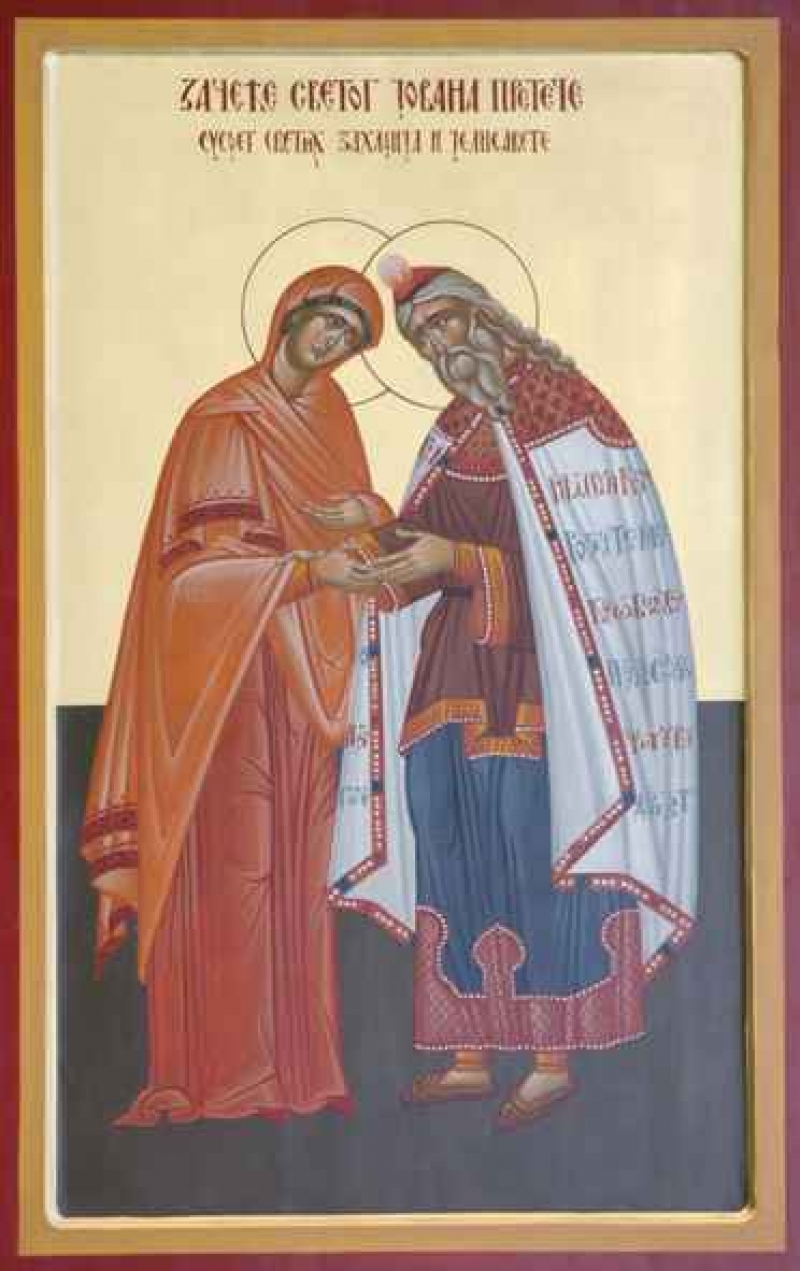
On the Conception of Saint John the Baptist (St. Justin Popovich)
September 23
By St. Justin Popovich
From The Lives of the Saints: September. Translated by John Sanidopoulos.
September 22, 2022
The Cave of Saint Kosmas of Zographou in Mount Athos
The Saint is considered the greatest ascetic to emerge from Zographou. His cavernous cell became the place of struggle with demons. There he was buried and from there he departed for the joy of his Lord. The admirable thing is that forty days after his burial the monks looked for his relic, but did not find it.
Gerasimos Smyrnakis (1903) mentions that the cave was also used as an observation post for forest rangers.
September 21, 2022
The Comparison of the Prophet Jonah and Hercules
Ἐκ ποντίου λέοντος ὁ τριέσπερος,
ξένως Προφήτης ἐγκάτοις φλοιδούμενος,
αὖθις προῆλθε, τῆς παλιγγενεσίας,
σωτηρίαν δράκοντος ἐκ βροτοκτόνου,
πᾶσι προφαίνων,
τῶν χρόνων ἐπ' ἐσχάτων.
The triple-night Prophet
strangely made the belly of the lion of the sea swell,
and came forth, making manifest beforehand to all
our regeneration in the last days
and our salvation from the dragon that slays mankind.
September 19, 2022
Homilies on the Great Litany of the Divine Liturgy - Prayer for the Environment (Metr. Hierotheos of Nafpaktos)
Prayer for the Environment
By Metropolitan Hierotheos of Nafpaktos and Agiou Vlasiou
This is the reason why in the Great Petitions we address to God, the so-called "Great Litany", at the beginning of the Divine Liturgy, we also pray for the world that surrounds us. "For favorable weather, for an abundance of the fruits of the earth, and for peaceful times, let us pray to the Lord." That is, let us pray to the Lord for good conditions - mildness in the air, for the fruitfulness of the earth and for peaceful times.
September 18, 2022
Homily for the Sunday After the Elevation of the Honorable Cross - Salvation and the Death of the Soul (Metr. Hierotheos of Nafpaktos)
Salvation and the Death of the Soul
Metropolitan Hierotheos of Nafpaktos and Agiou Vlasiou
"What will it profit a man if he gains the whole world and loses his own soul?" (Mark 8:36)
In Holy Scripture, there are two meanings of the word "soul". Sometimes with the word "soul" it is characterized as "the spiritual element of our existence" and sometimes it is used with the biblical meaning of "life". This double meaning of the soul is seen in the following text: "Whoever would save his soul will lose it; and whoever loses his soul for my sake and the gospel's will save it. What will it profit a man if he gains the whole world and loses his own soul?" (Mark 8:35-36). This double meaning of the word "soul" indicates an inner connection between soul and life.
According to the Holy Fathers, the image of God in man refers to the soul, which is "rational and intelligent" or it also refers to the powers of the soul, especially the mind and speech, which are more related to the image of God in man. However, the soul is closely connected with the body. As God is omnipresent in all creation, so the soul with its energies is present in the whole body. And just as God through His energy sustains and animates the world, so the soul of man sustains and animates the attached body. Saint Gregory Palamas teaches that the image of God in man is stronger than the image of God in angels, because it animates the attached body.
Reflection on the Sunday After the Exaltation of the Holy Cross (St. Theophan the Recluse)
Mark 8:34-38; 9:1
By St. Theophan the Recluse
It is impossible to follow the Crucified Lord without a cross; and all who follow Him certainly follow with the cross.
What is this cross? All sorts of inconveniences, hardships and sorrows, both from the outside and from within, on the path of conscientious fulfillment of the commandments of the Lord in life in the spirit of His precepts and requirements. Such a cross is so fused with a Christian that where there is a Christian, there is this cross, and where there is no such cross, there is no Christian.
September 17, 2022
Wisdom, Faith, Hope and Love ...
The name of these virtues is shared by four martyrs (the mother and her three young daughters) of our Church, whose memory is honored on September 17.
And in fact the widowed mother, Sophia, did not prevent, but pushed her three young daughters, twelve-year-old Faith, ten-year-old Hope and nine-year-old Agapi, to martyrdom.
Her speech to her daughters was shocking and touching, after the judge's call for her and her children to deny Christ, otherwise terrible torture and death awaited them.
September 16, 2022
Homily Three on the Exaltation of the Cross of the Lord (St. Luke of Simferopol)
(Delivered on September 14/27, 1954)
September 15, 2022
Homily One for the Exaltation of the Honorable Cross (Archim. George Kapsanis)
You will remember, when the Lord was walking towards the crucifixion Passion, He said the words: "Now the Son of man is glorified" (Jn. 13:31). From a human point of view, death on the cross was a disgrace, it was the ultimate humiliation and contempt of man.
Homily Two on the Exaltation of the Cross of the Lord (St. Luke of Simferopol)
(Delivered on September 14/27, 1953)
You came last night in great numbers to this holy temple. What attracted you? Why were your hearts filled with such deep reverence when you saw how I carried out and lifted up before you the cross of Christ? Why do we love the cross of Christ so much? Why do we bow down to it so much?
Of course, we do not only venerate the tree, although the tree of the cross of Christ became the greatest relic after it was drenched in the Blood of Christ. We venerate the crucifixion of Christ, we worship Christ God crucified on the cross, for the greatest mystery took place on the cross. What is this mystery? Why did our Lord Jesus Christ make such an amazing sacrifice for the salvation of the world?
September 14, 2022
Homily One on the Exaltation of the Cross of the Lord (St. Luke of Simferopol)
(Delivered on September 14/27, 1952)
God bless you for this reverence, but is it enough? Is it enough to see the carrying out of the cross only three times a year, arousing your awe? Oh no, not at all! Much more is needed. It is necessary that the cross of Christ be imprinted on your hearts, and not just hung on your chest.
In the Middle Ages, there was a Teutonic Order of knights. A large cross was sewn on their cloaks, but with this sign of Christ they shed the blood of dark Lithuanian and Estonian pagans in streams, forcing them to be baptized with fire and sword.
Reflection on the Exaltation of the Holy Cross (St. Theophan the Recluse)
This is why: in September the harvest is taken from the field, at least with us. And so that some of the Christians might not feel too satisfied and say: “Soul, thou hast much goods laid up for many years; take thine ease, eat, drink, and be merry!” and so that others might not fall in spirit because of scarcity, the elevated cross is brought before all. It reminds the former that the support of well being is not possessions, but their bearing of the cross in a Christian, inner way, should God’s goodness bring external plenitude; it inspires the latter to acquire patience in their souls, through the certainty that they will go from the cross directly to paradise. Therefore, may some endure, knowing, that they are travelling a smooth path to the heavenly kingdom; and may the others enjoy external comforts with fear, not sealing the entrance to paradise against themselves.
Venerable Mary of Tarsus, Who Was Once a Harlot
![]() |
| Venerable Mary of Tarsus (Feast Day - September 14) |
Homily Two for the Feast of the Exaltation of the Cross of the Lord (Archpriest Rodion Putyatin)
"God so loved the world..." (John 3:16).
On September 14 it is solemnly erected, especially in our cathedral during Vespers, in memory of the well-known ancient event, when the Cross of the Lord was found in the ground, taken out and elevated, to be shown to the crowds.
This happens once a year, or even every day after prayers and church services, an exaltation happens. So what is it for? The priest raises, elevates, lifts up the Cross of the Lord, so that you see it, venerate it, then he overshadows you with the Cross, so that you adore it and accept the blessing of the Crucified One on the Cross.
Homily One for the Feast of the Exaltation of the Cross of the Lord (Archpriest Rodion Putyatin)
"We venerate Your Cross, Lord!"
Once, the Equal-to-the-Apostles Emperor Constantine the Great, going to battle against Maxentius, saw in the daytime in the air a cross made up of stars, and at the bottom of the cross were the words: “In this sign thou shalt conquer.” Encouraged by such a wonderful appearance, Constantine the Great boldly entered the battle and happily defeated his enemy. The mother of Constantine, the holy Equal-to-the-Apostles Empress Helen, attributing this victory to Jesus Christ, from this incident took the intention to find the Cross on which Jesus Christ was crucified. And so she goes to Jerusalem, searches, visits, asks the inhabitants of Jerusalem about the Cross of the Lord, but no one knew anything about it. Finally, from some elderly Jew named Judas, she learns where the Cross of the Lord is: it was buried in the ground, under a pagan temple. Saint Helen immediately ordered the building to be demolished; and the building was demolished, they began to dig and found three crosses in the ground.
September 13, 2022
On the Consecration of the Temple of the Resurrection of Christ in Jerusalem (St. Justin Popovich)
September 13
By St. Justin Popovich
September 12, 2022
Saints Demetrios, Evanthia and Demetrian as Models for our Lives
Saints Demetrios and Evanthia were husband and wife and Demetrian was their son. Their life is recorded in a concise way in the Synaxarion of Saint Cornelius the Centurion, because it is connected with two miracles that were performed in this family through Saint Cornelius. The first miracle is the resurrection of Evanthia and Demetrian, and the second and greatest miracle is the complete change of Demetrios.
Demetrios was a philosopher and ruler in the city of Skipsi in Asia Minor, but also a fanatical idolater, who furiously persecuted all those who believed in Christ. His wife and son became Christians without him knowing it.
September 11, 2022
Homily for the Sunday Before the Elevation of the Honorable Cross - The Thrice-Blessed Cross (Metr. Hierotheos of Nafpaktos)
The Thrice-Blessed Cross
By Metropolitan Hierotheos of Nafpaktos and Agiou Vlasiou
"And as Moses lifted up the serpent in the wilderness, even so must the Son of Man be lifted up..." (Jn. 3:14)
The story of the bronze serpent is well known, to which today's Gospel reading refers. Because of the indignation of the ungrateful Jewish people, God sent snakes that spread death. However, God again took pity on the people and ordered Moses to make a bronze serpent, which when the Jews saw it, they were cured of the snake bites (Num. 8-9). This historical event is adapted in two ways to the case of Christ, according to two ecclesiastical interpretations.
According to the first established interpretation, the bronze serpent is a type of the Crucified Christ. Just as the bronze serpent had the form of a snake but had no poison, so Christ had a human body but had no sin. The Jews saw the brazen serpent and were afflicted by the bites of real snakes. Christians see the Crucified Christ, receive His Grace and are healed from the bites of invisible snakes, evil spirits. The Crucified One gives us spiritual health, purification of the soul, eternal life, unspeakable peace.
Homily for the Sunday Before the Elevation of the Honorable Cross (St. Luke of Simferopol)
(Delivered in 1949)
I want these words to amaze you and shock you, so that you imprint them forever in your hearts:
“For it pleased the Father that in Him all the fullness should dwell, and by Him to reconcile all things to Himself, by Him, whether things on earth or things in heaven, having made peace through the blood of His cross” (Col. 1:19-20).
September 9, 2022
Homily Two on the Nativity of the Theotokos (St. Luke of Simferopol)
(Delivered in 1957)
Will not these opening words of the troparion of this great feast seem like an exaggeration to some of you? Would you say that not only Jews, Muslims and Buddhists, but even Lutherans who have departed from the One, Holy, Catholic and Apostolic Church, Protestants, and all sectarians do not feel any joy on the birthday of the Most Holy Theotokos, whom they consider only a simple pious woman, of which are very many?
If you think so, then I will in no way agree with you, because the troparion of the feast speaks precisely of the joy of the entire universe, and not just our little land. And the universe is immensely large, and in the night sky we see countless star worlds.
September 8, 2022
Homily One on the Nativity of the Theotokos (St. Luke of Simferopol)
(Delivered in 1952)
In silence, without any widespread glory, the life and preaching of Her Divine Son began.
September 7, 2022
A Letter of Saint Daniel of Katounakia to a Student of Theology on How to be a True Theologian
Blessings from my soul.
Having perused with lively interest and abundant spiritual revelry the general contents of your last letter, which is in my hands, and having ascertained your good thoughts and meditations, full of prudence and reverence, I greatly approve your prudence, by thoroughly wetting your letter with paternal tears.
I praise, as it deserves, your Christian and evangelical zeal and the vigilance you have for your future life, for which I hope and will always hope, even if unworthy, that it turns out fruitful and salvific.
Saint Daniel of Katounakia in the Life of Saint Joseph the Hescyhast
![]() |
| Elders Daniel, Arsenios and Joseph |
His first stop was Katounakia, at the blessed community of the Danielaioi. The founder of that community, the ever-memorable Elder Daniel, was living there at that time. He was a man of great piety, learned, wise, well experienced in ascetic life, and very gentle and comforting to those who came to him. Our Elder’s favorable impressions of that community and particularly of the holy elder remained fresh in his mind throughout his life, as he often told us. But he had set out with an ardent desire to live a life of the utmost strictness and in a more peaceful spot, and this was why he did not stay long with the Elder Daniel. Instead, he left to find the stillness that he longed for.
Homily Two for the Twelfth Sunday of Matthew - Eternal Life (Metr. Hierotheos of Nafpaktos)
Eternal Life
By Metropolitan Hierotheos of Nafpaktos and Agiou Vlasiou
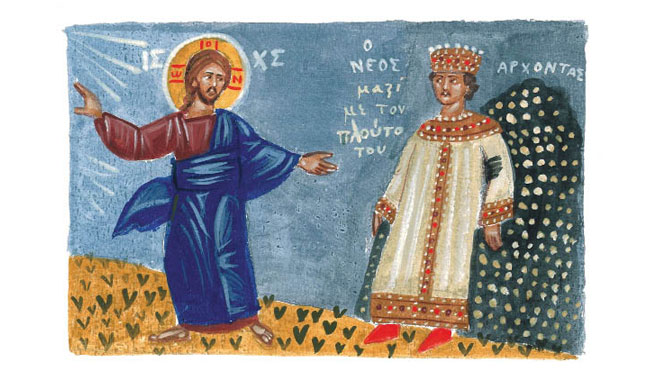
A young man, as today's Gospel reading told us, approached Christ and asked him what he must do to obtain eternal life. Christ initially pointed out to him the observance of the commandments, which He Himself gave to Moses, and then urged him to sell his existing possessions and give the money he will collect to the poor and thus acquire treasures in heaven. This is because, as He said, it is very difficult for the rich to enter the Kingdom of God.
September 6, 2022
Homily One for the Twelfth Sunday of Matthew - Three Shocking Questions (Metr. Hierotheos of Nafpaktos)
Three Shocking Questions
By Metropolitan Hierotheos of Nafpaktos and Agiou Vlasiou
"What good thing shall I do that I may have eternal life? ...
A young man, as today's Gospel reading told us, approached Christ and talked with Him. People's dialogues with Christ are always revelatory, because His energy penetrates into their existence, reveals the depths of their inner world, creates great surprise. In reality, Christ with love and tenderness enters the heart of man and creates surprises and questions.
September 5, 2022
Homily on the Twelfth Sunday of Matthew (Archpriest Rodion Putyatin)
One rich young man asked Jesus Christ: “Good teacher! What good must I do to receive eternal life?" Jesus Christ told him what he should do, and in conclusion he added that he should seel his property and distribute it to the poor.
Hearing this, the young man departed with sadness, because he had a large estate. And he wanted to inherit eternal life, and it was a pity for him to part with the estate.
On this occasion, Jesus Christ said to His disciples: "Truly, I say to you, it is difficult for a rich man to enter the Kingdom of Heaven."
Reflection on the Twelfth Sunday of Matthew (St. Theophan the Recluse)
Matthew 19:16-26
By St. Theophan the Recluse
September 3, 2022
Synaxarion of the Translation of the Relics of Saint Nektarios the Wonderworker
By Monk Gerasimos Mikragiannanitis
On the 3rd of this month [September], we celebrate the translation of the honorable relics of our Holy Father Nektarios the Bishop of Pentapolis and Wonderworker, which took place in the year of our salvation 1953.
Verses
Your relics appeared from the earth Father,
Showing its hidden grace to all.
On the third the bones of Nektarios appeared out of the earth.
September 2, 2022
Homily on the Holy Martyr Mamas (St. Luke of Simferopol)
(Delivered on September 2/15, 1957)
Reflection on the Ecclesiastical New Year (St. Theophan the Recluse)
For more than fifteen years, the Mystagogy Resource Center has been a labor of love dedicated to making the riches of the Orthodox Christian tradition freely available to people throughout the world.
Thousands of articles, translations, lives of saints, theological reflections, historical resources, and daily materials have been published across this ministry’s websites, all offered free of charge for anyone seeking a deeper understanding of the Orthodox faith.
This is a one-man ministry that requires countless hours of research, translation, writing, editing, and maintenance each day.
If this work has spiritually benefited, educated, encouraged, or inspired you in any way, I humbly ask you to consider supporting this ministry financially.
Generous annual and monthly benefactors make possible the continuation and expansion of this work for the future, for without such support this ministry cannot exist.
Every contribution, whether large or small, truly makes a difference and is deeply appreciated. May God bless you abundantly for your generosity and prayers.


.jpg)