Showing posts with label Orthodoxy in Russia. Show all posts

December 22, 2022

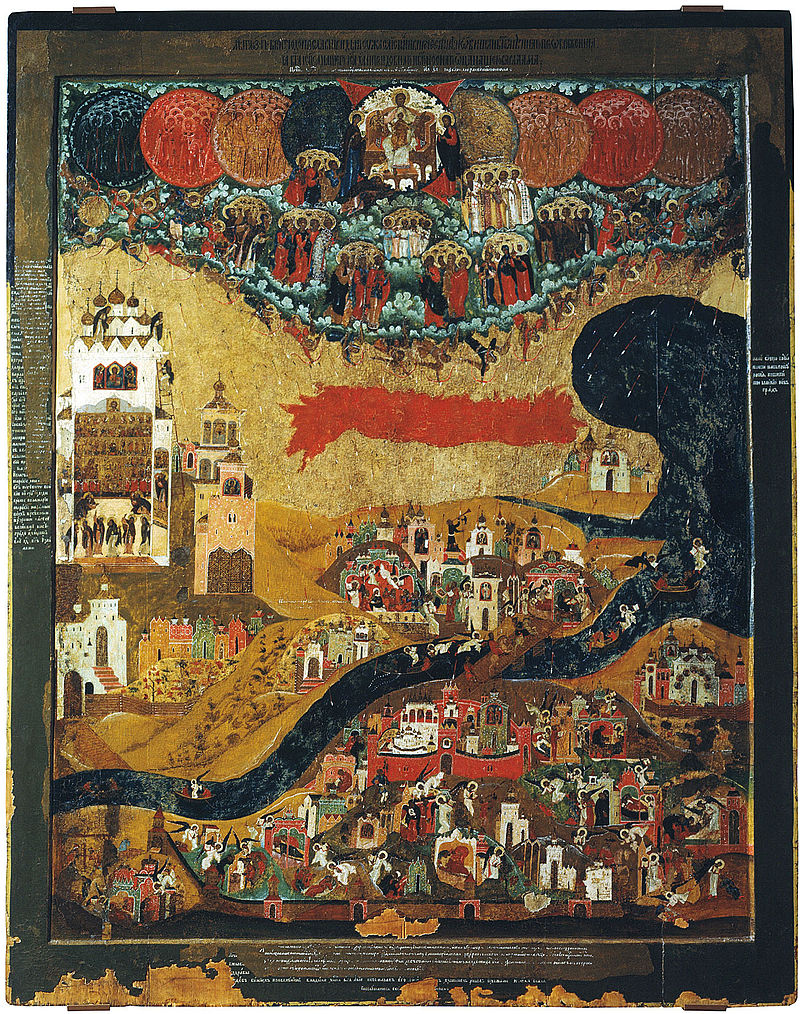
Church of the Holy Martyr Anastasia in Novgorod, Built in One Day To Protect the People From the Deadly Plague of 1417


A.D. 1417. A.M. 6925. The same summer and winter there was a fearful plague among the people in Novgorod, and in Ladoga, in Russa, Porkhov, Pskov, Tver, Dmitrov, and in Torzhok, and throughout their districts and villages. And how can I relate the fearful and terrible misery that there was during the whole plague? What grief the living had for the dead, for the deaths increased so in towns and villages that the living had barely time to make the dead tidy for burial; so many died every day, that they had not time to bury them; and many houses were closed unoccupied. First of all it would hit one as if with a lance, choking, and then a swelling would appear, or spitting of blood with shivering, and fire would burn one in all the joints of the body; and then the illness would overwhelm one; and many after lying in that illness died. But to many Christians God was merciful: they left this life entering the angelic order after receiving holy unction from the Vladyka. And two Posadniks died in the same order: Ivan Olexandrovich and Boris Vasilievich.

October 19, 2022

The Church Where Saint John of Kronstadt Served for 53 Years


The Cathedral of Saint Andrew the First-Called was the main Russian Orthodox cathedral of Kronstadt.

The church was built in 1805–1817 to Andreyan Zakharov's designs to replace a wooden church dating from 1717 whose foundation stone was laid by Peter the Great.

In 1718, the original cathedral was ready for construction and on July 13 it was solemnly consecrated in the presence of the Emperor and his numerous retinue, as well as foreign ambassadors and envoys. It was dedicated to the Apostle Andrew, the patron saint of the Russian Navy.

December 6, 2021

The Veneration of Saint Nicholas in Russia Today


In Russia, the veneration of Saint Nicholas the Wonderworker is very widespread, and the number of churches dedicated to him and painted icons is the largest after the Mother of God. Until the beginning of the 20th century, his name was one of the most popular in Russia when naming babies. Saint Nicholas is the most revered saint in modern Russia as well. As of 2021, there are about 5,400 churches and chapels in Russia, not counting the monasteries, consecrated in honor of Saint Nicholas, which is about 12% of their total number (in second place are churches and chapels in honor of the Protection of the Most Holy Theotokos - about 1800).

October 30, 2021

The Russian Churches on Blood


In the Russian Orthodox tradition, Church on Blood (храм на крови) is a church commemorating the spot of the murder of a member of the royal family. There are four such churches:

1. Church of Saint Demetrios on Blood in Uglich (17th century) - commemorates the murder of Tsarevich Demetrius

2. Church of the Saviour on Blood in St. Petersburg (19th century) - commemorates the murder of Alexander II of Russia

3. Church of All Saints, Yekaterinburg (21st century) - commemorates the murder of Nicholas II of Russia and his family

4. Church of the New Martyrs and Confessors of the Russian Orthodox Church a.k.a. Lubyanka Church on Blood (21st century) - commemorates the Gulag victims. It stands next to the infamous Lubyanka Building on the grounds of the Sretensky Monastery.


August 25, 2021

The Remarkable and Recently Restored Wooden Russian Church With Its 22 Domes


The Church of the Transfiguration, a visionary wooden wonder with an octagonal frame and 22 domes built in 1714 — legend has it without a single nail — has reopened to tourists for the first time in 40 years after an extensive, and at times contentious, restoration.

Located on an island in Lake Onega about 60km north-east of the city of Petrozavodsk, the capital of the Karelian republic, the Russian Orthodox church is part of an ensemble of storied wooden buildings known as Kizhi Pogost. A Unesco World Heritage Site since 1990, the complex also features the nine-domed Church of the Intercession and a bell tower.

The 37m-tall Church of the Transfiguration was built by craftsmen drawing on ancient and somewhat mysterious traditions of wooden construction. It was in dire condition for decades, and specialists and bureaucrats sometimes warred over restoration plans because of its unique architecture. The conservation process involved numerous commissions and consultations with international experts.

May 6, 2021

Bell-Ringing and Resurrection Joy in Russia


In Russia there is a unique custom that takes place the week after Easter (known as Bright Week or Renewal Week), which explains why some call it Ringing Week. It is the only time of year when every believer is allowed to ring the church bells. All you have to do is ask for the blessing of the priest of the church and you can access the bell tower. As a rule, priests do not deny anyone.

All week, after the services, you can hear the inconsistent ringing of bells. They are the parishioners who organize this peculiar "concert", of happy and melodic sounds. It is mainly children who ring the bells, carrying the joyful message of the Resurrection of the Lord with the sounds of joyful children.

April 8, 2021

Theophany During the Cholera Epidemic of 1909 in St. Petersburg


The Holy Hieromartyr Cyril (Smirnov) of Kazan was the Metropolitan of the Eparchy of Kazan in Russia from 1918 to 1922. Designated by Patriarch Tikhon as first locum tenens of the see of the Patriarchate, Metropolitan Cyril fought against Bolshevik control of the Church of Russia during the 1920s and 1930s. On July 7, 1937, Metropolitan Cyril was arrested in Yany-Kurgan and imprisoned in Chimkent on a charge of “participating in a counter-revolutionary underground organization of churchmen” together with Metropolitan Joseph of Petrograd. The two hierarchs were condemned by a troika of the South Kazakhstan region on November 19, and were shot together on November 20, 1937 in Lisiy ovrag, near Chimkent. They were buried in Lisiy ovrag. His feast day is November 20th.

March 8, 2021

When Socialist Revolutionaries Tried to Blow Up the Wonderworking Kursk-Root Icon of the Mother of God of “the Sign” in 1898


On March 8, 1898, three young men who were atheist Socialist revolutionaries, forerunners of Bolshevism, led by the future inventor and scientist Anatoly Georgievich Ufimtsev (1880-1936), hoped to shake the people’s faith in the Kursk-Root Icon’s wonderworking power, so they decided to destroy it. In the Cathedral of the Sign in the city of Kursk, during a vigil in honor of the Honorable Cross, as the Cross was being processed around the church, they placed a time bomb that was made in Finland next to the Icon as an "offering", but the bomb did not explode at the intended time during the service, instead a devastating explosion at 2 o’clock in the morning shook the Monastery's walls while the church was empty.

November 2, 2020

Synaxis of the Shuiu-Smolensk Icon of the Mother of God


In the summer of 1654, one of the worst plague epidemics in history spread from Moscow to almost the entire central part of Russia. In this deadly time, a parishioner expressed a proposal before the entire congregation of the Resurrection Church in Shuiu to commission an icon of the Mother of God to deliver them from this deadly plague. Trusting in the mercy of God and the intercession of the Mother of God, the parishioners of the Resurrection Church commissioned a certain pious monk, Gerasim Tikhonovich Ikonnikov, to paint the icon of the Smolensk Mother of God, an icon long attributed with being a rescuer of the Russian people from enemies and misfortune. The icon painter told them: “I promise with joy to fulfill your commission, if only the Most Holy Lady Theotokos would help me.” And without delaying the time, he began to paint the icon.

October 22, 2020

Synaxis of the Andronikos Icon of the Mother of God

 
Synaxis of the Andronikos Icon of the Mother of God (Feast Day - October 22)

The Andronikos Icon of the Mother of God, also known as the Monemvasia Icon or the Greek Icon, was a family icon of the Roman Emperor Andronikos III Palaiologos. In 1347 he gave the icon to a monastery in Monemvasia of Peloponnesos. After an attack in 1821 by Turkish troops, the abbot of the monastery, Bishop Agapios, trying to save the miraculous Andronikos Icon, hid it in Patras. Before his death, Agapios bequeathed this icon to his relative, the Russian Consul General N.I. Vlassopoulos, whose son, A.N. Vlassopoulos, in 1839 sent the icon from Athens to Odessa with a letter for its transmission to Emperor Nicholas I Pavlovich in St. Petersburg. From 1839 to May 12, 1868, the Andronikos Icon was in the Winter Palace, and from May 12, 1868 to April 16, 1877 it was in the Trinity Cathedral, which is on the Petersburg side. In 1877, the miraculous icon was transferred to the Kazan women's monastery near the city of Vyshny Volochek of the Tver diocese. In 1984 the icon was stolen and its current whereabouts are unknown. Other feast days of this icon are May 1 and July 8.
 

October 17, 2020

Synaxis of the Deliverer Icon of the Mother of God

 
Synaxis of the Deliverer Icon of the Mother of God (Feast Day - October 17)

The Deliverer Icon of the Mother of God, before being brought to the New Athos Simono-Kananitsk Monastery in the Caucasus, was on Mount Athos with a brother of the Russian Saint Panteleimon Monastery, Schemamonk Martinian (+ 1884). The pious schemamonk had received this icon from the ascetic Theodoulos. 
 
The holy icon was glorified by miracles for many centuries. After praying before this icon the inhabitants of Sparta, Greece were delivered from a plague of locusts in 1841.
 

Synaxis of the Icon of the Mother of God “In Giving Birth, You Preserved Your Virginity”

 
Synaxis of the Icon of the Mother of God “In Giving Birth, You Preserved Your Virginity” (Feast Day - October 17)
 
The Icon of the Mother of God “In Giving Birth, You Preserved Your Virginity” (“A Virgin Before Birth and After Birth”) was transferred to the Nikolaev Peshkov Monastery of the Moscow diocese by the Moscow merchant Alexis Grigorievich Mokeev. Around the year 1780 Alexis joined the brethren of the monastery. He had given all of his wealth to the abbot of the monastery, Archimandrite Macarius, and the holy icon remained in his cell.
 
After Alexis’s death, the icon was brought to the archimandrite, who observed that the icon was painted in oil on canvas and not according to the prescribed rules of iconography (using egg tempera on wood), and he installed it over the exit door of the Chapel of Saint Methodius, which was on a street not far from the monastery.

October 14, 2020

Synaxis of the Icon of the Mother of God of Yakhrom

 
Synaxis of the Yakhrom Icon of the Mother of God (Feast Day - October 14)

Saint Kosmas of Yakhrom (Feb.18) was the son of a boyar who lived within the limits of Vladimir. Apparently, due to a lack of money, he was given to be raised by a neighbor-landowner, from the Sekerin boyars, and served him by traveling to cities and villages with the boyar seeking healing for his illness. 
 
The Yakhrom Icon of the Mother of God appeared to the holy youth Kosmas in the year 1482, while he was accompanying his master, the sick landowner. Kosmas had stopped at the bank of the Yakhrom River, not far from Vladimir, and the sick man fell asleep. Kosmas suddenly saw a bright light coming from a nearby tree, and heard a voice, “Attend and understand the words of life. Live a God-pleasing life and seek the joy of the righteous, and then you will delight in eternal blessings.” The light had come from an icon of the Most Holy Theotokos.
 

October 12, 2020

Synaxis of the Rudens Icon of the Mother of God

Synaxis of the Rudens Icon of the Mother of God (Feast Day - October 12)

The miraculous Rudens Icon of the Mother of God was revealed in 1687 in the town of Rudnya in the Mogilev diocese. In 1689, the local priest, Father Vasily, transferred it to the female Kiev Pechersk Monastery. Since 1712, the icon of the Most Holy Theotokos resided in the Kiev Florovsky Monastery in Podil after its merger with the Kiev Pechersk Monastery. In the 1920s, the miraculous icon, placed in a beautiful robe adorned with diamonds, disappeared; it appears to have been stolen from the temple. But now in the Ascension Cathedral you can venerate the copy of the miraculous icon.

There are quite a few revered copies of the miraculous Rudens Icon of the Mother of God. Among them is an icon painted on canvas that was in the Church of the Protection of the Most Holy Theotokos in the town of Aleshki of the Kharkiv region. Legend says that it was brought to the Kharkov borders around 1612 by a certain priest Peter Andreev, who came from the Podolsk region, fleeing the persecution of the Uniates.

September 24, 2020

The Birthplace of Saint Silouan the Athonite


Simeon Ivanovich Antonov was born on January 17, 1866 in the village of Sovskin in the Tambov province of Russia. There he lived as one of seven children in a rural family, working from a young age in the fields, and receiving little formal schooling - two winter terms at the village primary school - which is why his spiritual child Saint Sophrony referred to him as being "illiterate" or "semi-literate". Despite this, he was still very smart and quick to grasp ideas and information.
 
At four years of age the word of a peddler - "Where is this God of yours, then?" - had troubled his previously undoubting faith in God. Though his father insisted the peddler was speaking as a fool, it took fifteen years before again he felt wholeheartedly that God exists and is alive. When he was nineteen and a carpenter, a pilgrim was telling the estate workers about Saint John Sezenov, whose tomb she had venerated. Hearing about the Saint's miracles and wonderworking relics made Simeon reflect: "If he was a holy man, then it means that God is here with us, so there is no point in me going off to search for him." This indicates that Simeon all those years was wondering where he could find God. With his new found reassurance, prayer was ignited in him and he began to feel drawn towards monasticism.

August 8, 2020

Synaxis of the Tolga Icon of the Mother of God

Synaxis of the Tolga Icon of the Mother of God (Feast Day - August 8)

The Tolga Icon of the Most Holy Theotokos appeared on August 8, 1314 to Bishop Prochorus of Rostov (Tryphon in schema). Going about his diocese, the Saint visited the environs of White Lake and from there traveled along the banks of the Rivers Sheksna and Volga, to Yaroslavl. He stopped with the approach of night seven versts distant from Yaroslavl, at the right bank of the Volga River where there flows opposite into it the River Tolga.

July 10, 2020

Synaxis of the Konevits Icon of the Mother of God

Konevits Icon of the Mother of God (Feast Day - July 10)

It was with this icon of Greek origin that John, abbot of one of the Athonite monasteries, blessed Saint Arsenius, founder of the Konevits Monastery (June 12). Saint Arsenius brought the icon from Mount Athos to Russia and placed it in the Cathedral of the Nativity of the Theotokos at the Konevits Monastery. The holy icon was glorified by many miracles.

In the year 1610, during an invasion of the Swedes into the Novgorod territory, the icon was transferred from the Konevits Monastery to the Novgorod Derevianits Monastery with the blessing of Archbishop Isidore of Novgorod. Each year on July 10 a festal celebration of the Most Holy Theotokos took place at this monastery in honor of the holy icon.

The Placing of the Honorable Robe of the Lord at Moscow (1625)


According to the Gospel of John, the soldiers who crucified Jesus did not divide his tunic after crucifying him, but cast lots to determine who would keep it because it was woven in one piece, without seam. A distinction is made in the New Testament Greek between the Savior's robe ta himatia (literally “over-garments”) and the seamless tunic, which is the chiton, (literally "under-garb tunic").

Then the soldiers, when they had crucified Jesus, took his garments (ta himatia) and divided them into four parts, to every soldier a part, and the tunic (kai ton chitona). Now the tunic was without seam, woven whole from the top down. Therefore, they said among themselves, let us not tear it, but cast lots for it, whose it will become. Thus the saying in Scripture was fulfilled: They divided My garments (ta imatia) among them, and for My clothing (epi ton himatismon) did they cast lots. ( John 19:23–24; quoting the Septuagint version of Psalm 21 [22]:18–19)

July 8, 2020

Synaxis of the Tenderness Icon of the Mother of God in Novgorod

Synaxis of the Tenderness Icon of the Mother of God in Novgorod
(Feast Day - July 8)

On July 8, 1337 a caretaker in Holy Trinity Church in Novgorod heard a noise inside the church and went to investigate. He was astonished to see that the icon of the Mother of God from the second tier of icons above the northern door of the iconostasis had left its place and was floating in the air, and tears were flowing from the eyes of the Virgin.

Support the Mystagogy Resource Center

For more than fifteen years, the Mystagogy Resource Center has been a labor of love dedicated to making the riches of the Orthodox Christian tradition freely available to people throughout the world.

Thousands of articles, translations, lives of saints, theological reflections, historical resources, and daily materials have been published across this ministry’s websites, all offered free of charge for anyone seeking a deeper understanding of the Orthodox faith.

This is a one-man ministry that requires countless hours of research, translation, writing, editing, and maintenance each day.

If this work has spiritually benefited, educated, encouraged, or inspired you in any way, I humbly ask you to consider supporting this ministry financially.

Generous annual and monthly benefactors make possible the continuation and expansion of this work for the future, for without such support this ministry cannot exist.

Every contribution, whether large or small, truly makes a difference and is deeply appreciated. May God bless you abundantly for your generosity and prayers.

❖ ❖ ❖
PayPal • Credit Card • Debit Card • Venmo
Become a Patron on Patreon