
The oldest datable kontakia are those of St. Romanos, and the present one is his best known work and in fact is the composition that seems to have first brought him to the notice of the public of Constantinople. For many years, it was sung at the royal banquet on Christmas Day. The prelude, one of the best-loved hymns among Orthodox Christians, and the first stanza are still used for the feast of the Nativity in the Orthodox Church.
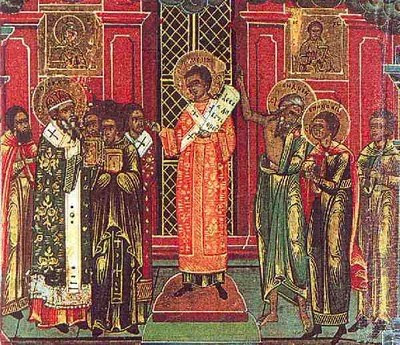
Little is known about St. Romanos himself. He was born in the late 5th century, probably in Emesa, Syria, of Jewish descent. He served as deacon in the church of the Resurrection in Beirut before coming to Constantinople during the reign of Anastasios I (491-518). According to his Life, he was miraculously endowed with the gift of writing kontakia. The Virgin appeared to him in a dream on Christmas eve, and gave him a scroll which he swallowed. The poet rose from sleep, gave praise to God, went straight to church and, mounting the pulpit, chanted the kontakion which appears below. We know that he lived beyond the middle of the 6th century, and that he was buried in the church of the Virgin in the Kyrou Quarter of Constantinople. He is commemorated in the Orthodox Church on October 1st, along with his disciple Ananias.
Read all the Christmas Kontakia of St. Romanos here.
Little is known about St. Romanos himself. He was born in the late 5th century, probably in Emesa, Syria, of Jewish descent. He served as deacon in the church of the Resurrection in Beirut before coming to Constantinople during the reign of Anastasios I (491-518). According to his Life, he was miraculously endowed with the gift of writing kontakia. The Virgin appeared to him in a dream on Christmas eve, and gave him a scroll which he swallowed. The poet rose from sleep, gave praise to God, went straight to church and, mounting the pulpit, chanted the kontakion which appears below. We know that he lived beyond the middle of the 6th century, and that he was buried in the church of the Virgin in the Kyrou Quarter of Constantinople. He is commemorated in the Orthodox Church on October 1st, along with his disciple Ananias.
Read all the Christmas Kontakia of St. Romanos here.

