Showing posts sorted by date for query plague. Sort by relevance Show all posts

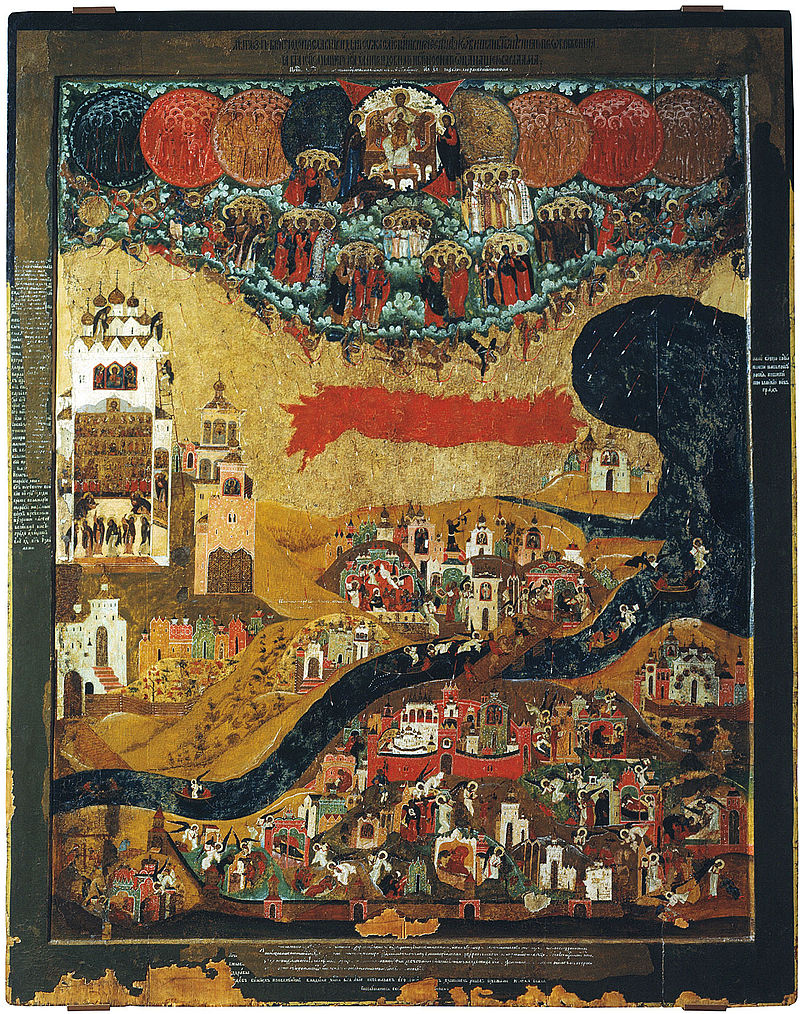
Church of the Holy Martyr Anastasia in Novgorod, Built in One Day To Protect the People From the Deadly Plague of 1417


A.D. 1417. A.M. 6925. The same summer and winter there was a fearful plague among the people in Novgorod, and in Ladoga, in Russa, Porkhov, Pskov, Tver, Dmitrov, and in Torzhok, and throughout their districts and villages. And how can I relate the fearful and terrible misery that there was during the whole plague? What grief the living had for the dead, for the deaths increased so in towns and villages that the living had barely time to make the dead tidy for burial; so many died every day, that they had not time to bury them; and many houses were closed unoccupied. First of all it would hit one as if with a lance, choking, and then a swelling would appear, or spitting of blood with shivering, and fire would burn one in all the joints of the body; and then the illness would overwhelm one; and many after lying in that illness died. But to many Christians God was merciful: they left this life entering the angelic order after receiving holy unction from the Vladyka. And two Posadniks died in the same order: Ivan Olexandrovich and Boris Vasilievich.

Saint Savvas the Sanctified, a Man of the People in Time of Famine and Plague


During the reign of Emperor Anastasios (491-518), a great famine visited the villages of Jerusalem, and there ensued much loss of life. With the passage of time, it spread into others areas of the Eastern Roman Empire and Constantinople. From this scourge, numerous homes were deserted and left uninhabited.

The various bureaus of the state and the emperor himself, in order to avoid a great loss of revenue, enacted a decree, whereby the unpaid taxes of the deceased were to be paid by their survivors. When the merciful Savvas heard of this unjust and absurd law, he journeyed “once more to Constantinople” to see the emperor, expressing his disapproval of it, demonstrating that the needy would be totally annihilated and that it was not in the best interests of the realm, but to its detriment and destruction. For it was utter injustice for those that were spared by two evils - the famine and the deadly plague - to be further tormented at the hands of the state by having to shoulder an unjust tax burden. Oppressed by the state and driven by necessity, they might attempt something that would be injurious to the realm.

Greek Customs and the Feast of Saint Andrew

Well of Saint Andrew in Patras, 1819

Saint Andrew the First-Called Apostle was martyred in the Greek city of Patras, where the largest cathedral in Greece honors his name over the place he was martyred. He is celebrated annually on November 30, which coincides with the last day of autumn. For this reason, his celebration includes beliefs, fears, hopes and perceptions, customs and habits, with a magical, superstitious character. Saint Andrew is considered the patron saint of Nafplio as well, since the liberation of the city of Nafplio from the Turks took place on November 30, 1822.

The villagers of the mountains and plains fear the month of November, which is why they give it the name of Saint Andrew. The people in the Peloponnese and Epirus called the month of November "Aindria". In Kozani, Thessaly, Thrace and Sinope in Pontus, November is called "Andrias". In traditional Greek culture, it is customary for months to be named after a saint, as for example October is also called "Aidemitriatis".

Homily for the Epistle Reading on the Twenty-Fourth Sunday After Pentecost (St. Luke of Simferopol)


 By St. Luke, Archbishop of Simferopol and All Crimea

(Delivered on November 23, 1952)

Today you heard in the apostolic reading part of the epistle to the Ephesians of the holy Apostle Paul. This is extremely important, you need to understand this. You didn’t quite understand the reading in Slavonic, so I’ll read it first in Russian, but don’t blame me if I read and preach while sitting, because I don’t feel very well.

Addressing the pagans who were inhabitants of Ephesus and now believe in Christ, Saint Paul says to them thus:

“Therefore remember that you, once Gentiles in the flesh — who are called Uncircumcision by what is called the Circumcision made in the flesh by hands — that at that time you were without Christ, being aliens from the commonwealth of Israel and strangers from the covenants of promise, having no hope and without God in the world. But now in Christ Jesus you who once were far off have been brought near by the blood of Christ. For He Himself is our peace, who has made both one, and has broken down the middle wall of separation, having abolished in His flesh the enmity, that is, the law of commandments contained in ordinances, so as to create in Himself one new man from the two, thus making peace, and that He might reconcile them both to God in one body through the cross, thereby putting to death the enmity. And He came and preached peace to you who were afar off and to those who were near. For through Him we both have access by one Spirit to the Father” (Eph. 2:11-18).

Oration on Saint Gregory the Wonderworker (St. Gregory of Nyssa)


Oration on Saint Gregory the Wonderworker

By St. Gregory of Nyssa

(Delivered on November 17, 380)

Both our essay and the congregation assembled here have one aspiration, namely, to reflect upon the great Gregory. For my part, it seems best to consider the fortitude of his virtue and wonderful achievements and by invoking his help, such an outstanding example may assist us in how we should conduct our lives. Indeed, this is a gift from the Spirit who provides a living example and testimony, thereby affirming each person with unflagging dedication. Since the Spirit's power is the foundation which enables such a radiant and admired life to flourish, prayer upholds us when we must speak of it. We should not scorn this praise because this man's memory demonstrates in the present his witness which had been manifested through his deeds.

Homily for the Fifth Sunday of Luke - Inequality and Prophecy (Metr. Hierotheos of Nafpaktos)


 Homily for the Fifth Sunday of Luke

Inequality and Prophecy

By Metropolitan Hierotheos of Nafpaktos and Agiou Vlasiou


"
There was a rich man ... a poor man named Lazarus" (Luke 16:19-20).
 
Beloved brethren,

In the Parable of the Rich Man and Lazarus that we heard today, Christ expressively presented the abysmal difference between two people. The rich man had daily gluttony, while the poor man lived on the crumbs that fell from the rich man's table. The rich man was physically healthy, while the poor man had "sores". The rich man lived in a mansion and had fun there with his friends, while the poor man begged at the door of the rich man's house, keeping company with the dogs. The rich man wore "purple and fine linen" every day, while the poor man was raggedy and naked. Christ depicted in the best way the great disparity between wealth and poverty.

Homily Two for the Third Sunday of Luke (St. Luke of Simferopol)


By St. Luke, Archbishop of Simferopol and All Crimea

(Delivered on October 26, 1952)

Let us transport our thoughts to distant ancient Palestine, let us approach the city of Nain and see there an ineffable, indescribable spectacle: we will see a huge crowd of people, along with the apostles, accompanying the Lord Jesus Christ, for crowds of people always followed Him, attracted by His Divine teaching, His glorious miracles.

A sad procession comes out of the gates of the city: they carry the only son of the unfortunate widow to the burial, and her heart breaks, and she cries and sobs inconsolably. Her Jewish acquaintances follow the coffin and weep with her.

Homily for the Ninth Sunday of Matthew - The Internal Problem of Mankind (Metr. Hierotheos of Nafpaktos)


Homily for the Ninth Sunday of Matthew

The Internal Problem of Mankind

By Metropolitan Hierotheos of Nafpaktos and Agiou Vlasiou

"Take courage, it is I; be not afraid" (Matt. 14:27)

Sacred Chrysostom, interpreting the event according to which the Apostle Peter, while walking on the waves, then sank, says that Christ at that moment did not stop the wind, but stretched out His hand and caught him, saying "O you of little faith, why did you hesitate?" (Matt. 14:31). In this way, Christ showed that the change in Peter was not caused by the force of the wind, but by his lack of faith. If his faith did not weaken, then he could easily face the wind. That is why Christ took him by the hand and let the wind blow, showing that the wind cannot do any harm when the faith is firm.

Holy New Martyrs Ambrosios, Neophytos and Makarios of Vatopaidi (+ 1821)

Sts. Ambrosios, Neophytos and Makarios of Vatopaidi (Feast Day - June 22)

In 1820 the Hieromonks Neophytos and Ambrosios, the Hierodeacon Parthenios and the monks Dionysios and Dorotheos and later Makarios were sent to Crete, by invitation, with sacred relics, in order to expel the terrible disease of the plague, which infected the locals there. These relics were a portion of the Holy Zoni of the Panagia which was a gift to the monastery of the emperor John Kantakouzinos, a piece of Holy Wood from the True Cross, and the skull of Saint Andrew of Crete.

The Best of February 2022 by the Mystagogy Resource Center (MRC)


Below is the monthly review for the month of February 2022 of the ten most popular articles on johnsanidopoulos.com, then all the posts made on the other websites of the Mystagogy Resource Center in order of popularity.

The Custom of the Distribution of a Piece of Watermelon in Kerkyra Every February 11th


Although watermelon today is known to Greeks as the king of the summer fruits, it is traditionally known as a winter fruit (heimoniko), due to the fact that it has a thick rind and can be preserved until Christmas, or even until Great Lent. On the island of Kerkyra, it is a custom to distribute a piece of watermelon on the feast of Saint Blaise, which is February 11th, at the Metropolitan Church of the island after the Divine Liturgy.

On February 11th in Kerkyra, the Empress Theodora is primarily celebrated, whose relic came to Kerkyra from Constantinople, shortly after the fall of Constantinople, together with the relic of Saint Spyridon. The litany of the relic of Saint Theodora, who ratified the decisions of the Seventh Ecumenical Synod in 787 and restored the Holy Icons in 843, is kept in the Metropolitan Church of Kerkyra which is dedicated to the Most Holy Theotokos Spilaiotissa and Saint Theodora.

Saint Haralambos and the Twelve Year Plague of Crete in the 19th Century


In Crete the plague is likened to an ugly old woman. The folklorist Nikolaos Politis describes her as follows: "She is a blind woman, running through the cities from house to house and killing those she touches, but because as a blind woman she touches the walls of the houses, she is unable to touch those in the middle of the rooms."

In 1817 an endemic took place in Crete that lasted for 12 years. It is believed the plague was brought by 22 Egyptian soldiers. Many families took refuge in the countryside (caves and elsewhere) to avoid being infected. Other times the sick resorted to the caves to prevent the transmission of the disease.

Saint Sebastian and the Arrows of the Plague


The Elements of Foolishness for Christ in the Sinaite Monk Fr. Ioannis Aleiferis


 By John Fourtounas,
Professor of the University of Cairo

On November 29th, 40 days have passed since the death of Fr. Ioannis Aleiferis, a monk of the Sacred Monastery of Saint Katherine of Mount Sinai.

Originally from Vatika of Laconia, Fr. Ioannis Aleiferis became a monk in the Monastery of Sinai and served the brotherhood there as an ecclesiarch for many years.

The most important gift he acquired was foolishness for Christ, which he preserved as the apple of his eye appearing to people as insane.

The Contemporary Problems of the Church According to Father John Romanides


 By Metropolitan Hierotheos of Nafpaktos and Agiou Vlasiou

The late Father John Romanides lived in the 20th century, then he died in 2001, at the beginning of the 21st century, and dealt with all the problems of his time through the empirical theology of the Church.

Precisely because he relied on the theology of the Saints, who did not talk about that which pertains to God, but about God, that is why he had acquired a spiritual sense to foresee the problems that exist in every age that need to be confronted by the shepherds of the Church.

In fact, he claimed that a theologian is also a spiritual father and a spiritual father is also a theologian. He said this because real theology, which is the essence of the pastoral ministry, distinguishes the created from the uncreated, the energies of God from the energies of the devil, which is characterized as discernment. Both the theologian and the spiritual father must have the patristic discernment to help their spiritual children.

Saint Dositheos the Recluse (+ 1776)

St. Dositheos the Recluse (Feast Day - September 25)

This is the story of how a young girl named Daria, became a serf named Dositheos, who lived for decades as a recluse, and gave the blessing to Saint Seraphim to go to Sarov.

Daria was born in 1721 to the noble Tiapkin family in the province of Riazan. Before she was born, her grandmother entered the Monastery of the Ascension at the Moscow Kremlin and took the name Porphyria. When Daria was two years old she visited her grandmother with her parents, and when her grandmother saw her she insisted Daria remain in the monastery with her to be dedicated to God and the patroness of the monastery, Saint Euphrosyne. The parents reluctantly allowed their child to remain with her grandmother in the monastery. With her grandmother, Daria was educated and learned to love the monastic way of life of asceticism and prayer.

Life and Passion of Saint Cyprian of Carthage (Pontius of Carthage)

 
By Pontius of Carthage,
Deacon and Biographer of Saint Cyprian of Carthage

1. Although Cyprian, the devout priest and glorious witness of God, composed many writings whereby the memory of his worthy name survives; and although the profuse fertility of his eloquence and of God's grace so expands itself in the exuberance and richness of his discourse, that he will probably never cease to speak even to the end of the world; yet, since to his works and deserts it is justly due that his example should be recorded in writing, I have thought it wall to prepare this brief and compendious narrative. Not that the life of so great a man can be unknown to any even of the heathen nations, but that to our posterity also this incomparable and lofty pattern may be prolonged into immortal remembrance. It would assuredly be hard that, when our fathers have given such honour even to lay-people and catechumens who have obtained martyrdom, for reverence of their very martyrdom, as to record many, or I had nearly said, well near all, of the circumstances of their sufferings, so that they might be brought to our knowledge also who as yet were not born, the passion of such a priest and such a martyr as Cyprian should be passed over, who, independently of his martyrdom, had much to teach, and that what he did while he lived should be hidden from the world. And, indeed, these doings of his were such, and so great, and so admirable, that I am deterred by the contemplation of their greatness, and confess myself incompetent to discourse in a way that shall be worthy of the honour of his deserts, and unable to relate such noble deeds in such a way that they may appear as great as in fact they are, except that the multitude of his glories is itself sufficient for itself, and needs no other heraldry. It enhances my difficulty, that you also are anxious to hear very much, or if it be possible every thing, about him, longing with eager warmth at least to become acquainted with his deeds, although now his living words are silent. And in this behalf, if I should say that the powers of eloquence fail me, I should say too little. For eloquence itself fails of suitable powers fully to satisfy your desire. And thus I am sorely pressed on both sides, since he burdens me with his virtues, and you press me hard with your entreaties.

Metropolitan Chrysostomos and the Tragedy of Smyrna in 1922


 By Panagiotis Melikidis

On August 27, 1922, the Kemalist troops, after breaking through the defensive line of the Greek troops in the area of Eskişehir-Afyonkarahisar-Kütahya, invaded the city of Smyrna, where the Greek element was in the majority.

Among the victims of the Turkish atrocity is the Metropolitan of Smyrna and Exarch of all Asia, Chrysostomos Kalaphatis. The martyrdom of the Hierarch is considered the culmination of the atrocities committed by the Turks against the Christian population.

The Chapel of the Holy Skull in Samos

Relics from left to right: 1) Gifts of the Magi, 2) St. Febronia, 3) St. Michael of Synnada

The village of Ano Vathi is situated in the northeast of the island of Samos. Ano Vathi was created in the 17th century when the inhabitants moved away from the coast due to pirate raids. The streets are narrow and steep and some of the traditional, old houses have hanging bay windows in a Venetian style.

One of the hidden jewels of this village is the Chapel of the Holy Skull, or Agia Kara. Agia Kara is a small single aisle, tiled-roof church, built around the end of 17th century. The two main features of interest in this chapel is the wood carved iconostasis and the large fresco of the Great Judgment built at the chapel's exit.

The Cholera Epidemic That Struck Athens in 1854


In 1854 cholera struck Athens, brought by English and French soldiers during the Crimean War. Panic gripped the citizens, and those who were wealthy enough fled, but more so the politicians left the city. Most of the members of the Civil Protection Committee swiftly fled and there were only two left. Everything was paralyzed as many police, doctors, nurses, judges and even the prefect left the city to save their own lives, leaving the poor citizens, 1/3 of the population, at the mercy of the deadly cholera epidemic.

Metropolitan Neophytos of Athens prohibited the public from going to church, to prevent the spread of the disease, and one priest even published his weekly sermons and had them distributed so the people would not go to church while at the same time receive spiritual benefit. It was announced that it was not a sin at this time to avoid attending church.