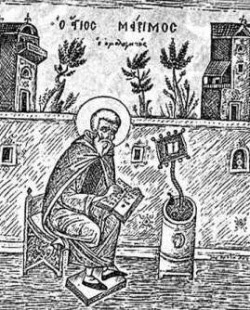
Showing posts with label St. Maximus the Confessor. Show all posts

January 21, 2022

Introduction to the Writings of Saint Maximos the Confessor in the 'Philokalia' (St. Nikodemos the Hagiorite)


 Introduction to Saint Maximos the Confessor 
 
By St. Nikodemos the Hagiorite

(The Philokalia, vol. 2)

Our Holy Father Maximos the Confessor lived during the reign of Constantine Pogonatos, around the year 670, and was, of all, the chief destroyer of the ill-famed Monothelite heresy.

At first he distinguished himself in the royal palaces and was honored with the office of Chief Secretary, then, leaving worldly endeavors behind, he engaged himself in ascetic combat. His mouth approached the fount of wisdom, and drinking incessantly from the fountains of the divine Scriptures which flow with life, he made to gush forth from his belly rivers of divine doctrines and writings which flooded the ends of the universe.  

Maximos Confessor on the Infinity Of Man (Panagiotis Chrestou)


 By Panagiotis Chrestou

I have chosen my subject for this conference, stimulated by my studies on the writings of Gregory Рalamas, which I have edited with the help of a group of my students in Thessaloniki.

Palamas in his attempt to emphasize the difference between knowledge of a thing and participation in it, pretended in one of his treatises that those who praise God through knowledge of his uncreated energies are merely pious, while those who participated in them become without beginning and without end by grace άναρχοι and ατελεύτητοι. He bases his optimistic perspective mainly on Maximos the Confessor, whose thought rules on a high level over his argumentation during the middle period of his literary activity. Gregory Akindynos, against whom that treatise was addressed, of course rejects this aspect and ironically questions how Palamas succeeded in becoming a man without beginning, since all men have a physical beginning. In the sequel he refers to that heresiarch, who was expelled from the Church on the grounds that he merely had said that the human body of Jesus Christ was without beginning and heavenly. He obviously meant Apollinarius.

Anna Comnena on Reading the Works of Saint Maximus the Confessor


In Book 5 of The Alexiad, Princess Anna Comnena (1083-1153) writes about her mother's love of reading the dogmatic texts of Saint Maximus the Confessor, and her desire to understand his writings. She writes:

And here I will tell a little tale, for the laws of oratory allow that. I remember the Empress, my mother, when breakfast was already on the table, carrying a book in her hands and poring over the writings of the didactic Fathers, especially those of the philosopher and martyr Maximus. For she was not so much interested in the physical disputations as in those about the dogmas, because she wished to gain true wisdom. And I was often seized with wonder at her and one day in my wonder I said to her, "How can you spontaneously rise to such sublime heights? for I tremble and dare not listen to such things even with the tips of my ears? For the purely abstract and intellectual character of the man makes one's head swim, as the saying goes." She smiled and said "I know that kind of quite laudable dread; and I myself do not touch these books without a tremor and yet I cannot tear myself away from them. But you wait a little and after you have dipped into other books, you will taste the sweetness of these." The remembrance of these words pricks my heart and I have plunged into an ocean, so to speak, of other tales. 


September 10, 2021

The Patristic Basis of Theology (Metr. Hierotheos of Nafpaktos)

 
By Metropolitan Hierotheos of Nafpaktos and Agiou Vlasiou

It is very significant that Saint Maximus the Confessor at the beginning of his theological struggle spoke about hesychast and neptic issues. He began, that is, with the texts that speak about love and more generally the texts that speak about the healing of man. The second phase of his struggle he was concerned with transmitting the terminology of the Cappadocian Fathers regarding the Trinitarian God in the Person of Christ. And the third phase of his theological struggle he was concerned with the topic about how every nature has its own will, that is, it was against monothelitism in Christ.

January 21, 2021

The Timeliness of Saint Maximus the Confessor


By Metropolitan Hierotheos of Nafpaktos and Agiou Vlasiou

(Sermon Delivered in the Metropolitan Church of Ioannina 
on 21 January 2020)

First of all, I would like to warmly thank His Eminence the Metropolitan of Ioannina and beloved brother in Christ, Maximos, for the ministry of the word that he has entrusted to me, and especially today, when the great teacher of our Church celebrates, Saint Maximus the Confessor, whose name the Metropolitan and my beloved brother in Christ bears.

Your Eminence Metropolitan of Ioannina and beloved brother Maximos, revered chorus of Hierarchs, Priests of God the Most High, ministry of Christ, most honorable leaders and chosen Christians:

It is known to all of you that from the time your Metropolitan, who bears the name of Saint Maximus, came here to Ioannina, various speeches have been made about this great teacher of the Church. Saint Maximus lived in the seventh century, in a very difficult century in many ways, and he became a foremost teacher of our Church and a great theologian, a soaring eagle of theology.

Life, Writings and Theology of Saint Maximus the Confessor (Fr. George Florovsky)

 
By Fr. George Florovsky
 
 The Life of St. Maximus

We know little about St. Maximus’ worldly life. He came from an old, distinguished family and was, it seems, favored by Emperor Heraclius — possibly even related to him. He was born about 580 in Constantinople. He received an excellent education. His biographer writes that St. Maximus received the εγκύκλιος παίδευσις: Sherwood is correct in writing that "this would mean that his training lasted from about his sixth or seventh year till his twenty-first, and contained grammar, classical literature, rhetoric and philosophy (including arithmetic, music, geometry, astronomy, logic, ethics, dogmatics and metaphysics), and also that it must have included his first contact with Aristotle and the Neo-Platonists (through the commentaries of Proclus and lamblichus)." St. Maximus studied philosophy with a special love. Later on, St. Maximus’ great gift for dialectic and logic, and his formal culture with its great erudition, left their mark on his disputes with the Monothelites. His erudition was not merely restricted to ecclesiastical topics but included a wide range of secular knowl edge.

January 21, 2020

Our Venerable Father Maximus the Confessor (+ 662)

St. Maximus the Confessor (Feast Day - January 21)

By Hieromonk Makarios of Simonopetra

Saint Maximus* was born into one of the great families of Constantinople in 580.** Endowed with exceptional intelligence and an uncommon ability for high philosophical speculation, he completed his studies with great distinction and embarked on a political career. The Emperor Heraclius, on coming to the throne in 610, appointed him as his chief secretary; but honors, power and riches could not quench the secret longing of Maximus since his youth to lead a life in keeping with the true philosophy. He resigned his post after only three years and became a monk at the Monastery of the Mother of God at Chrysopolis (Scutari, modern Uskudar). Well prepared for spiritual combat through meditation on Holy Scripture and study of the holy Fathers, he climbed steadily up the ladder of virtues leading to blessed impassibility. He overcame the impulses of lust through well-regulated ascesis, and of anger through meekness. Freeing his mind thereby from the tyranny of the passions, he nourished his intellect through prayer, raising it peaceably to the heights of contemplation. In the silence of his cell, gazing into the abyss of his heart, he considered within himself the great Mystery of our Salvation — whereby the Word of God, moved by His infinite love for mankind, has condescended to unite Himself to our nature, which is separated from God and divided against itself by self-centred love (philautia); He has thus restored the unity of our nature, brought in the reign of brotherly love and concord among men, and opened to us the way of union with God, for "God is Love" (1 John 4:16).

December 27, 2019

The Divine Economy According to Saint Maximos the Confessor


By St. Maximos the Confessor

1. The Good that is beyond being and beyond the unoriginate is one, the holy unity of three persons, Father, Son and Holy Spirit. It is an infinite union of three infinites. Its principle of being, together with the mode, the nature and the quality of its being, is altogether inaccessible to creatures. For it eludes every intellection of intellective beings, in no way issuing from its natural hidden inwardness, and infinitely transcending the summit of all spiritual knowledge.

2. The substantive and essential Good is that which has no origin, no consummation, no cause of being and no motion whatsoever, so far as its being is concerned, towards any final cause. The goodness to which such terms apply is not substantive since it has an origin, a consummation, a cause of being, and motion, so far as its being is concerned, towards some final cause. Even if what is not being in the substantive sense is said to be, it exists and is said to be by participation, through the will of substantive being.

April 22, 2019

The Meaning of the Withered Fig Tree of the Gospel (St. Maximus the Confessor)


On Difficulties in Sacred Scripture:
The Responses to Thalassios

Question 20

What is the meaning in the Gospel of the fig tree that to all appearances withered contrary to reason? And what is the inordinate hunger of Christ that sought for figs out of season? And what is the meaning of a curse placed upon something that is devoid of sense?

Response

The Divine Word, who governs everything with wisdom for the sake of human salvation, first trained human nature with a law requiring a more corporeal observance, because humanity's ignorance of, and estrangement from, the archtype of divine realities was preventing it from receiving the truth free of figurative veils. Afterwards, manifestly becoming man by taking on flesh possessing an intellective and rational soul, He redirected the course of human nature - insofar as He is the Word - toward immaterial and cognitive worship in the Spirit. Once the truth was made manifest to human life, the Word did not want a shadow to hold sway over that life, a shadow whose very type and figure is the fig tree. This is why Scripture says that He encountered the fig tree "while returning from Bethany to Jerusalem." In other words, after His figurative, shadowy, and hidden presence in the law, He becomes present anew to human nature through the flesh (for this is how one must understand "returning"), for it was then that "He saw a fig tree on the way of having nothing but leaves." It is evident that the tree is the corporeal observance of the law, existing in shadows and figures, having an unstable and transient tradition, which is why it is found "on the way," being a sign of passing figures and precepts. Seeing that, like a fig tree, it was ostentatiously and extravagantly adorned by the outward leaves of the corporeal observances of the law, but finding no fruit on it - clearly no fruit of righteousness - He cursed it, since it did not provide nourishment for the Word. Or rather He commanded that the figures of the law should no longer hold sway over and conceal the truth. And this was subsequently proven to be the case through actual deeds, when the beauty of the law, which exists merely in external forms, was completely withered, and the pride that the Jews took in it was extinguished. For insofar as the truth of the fruits of righteousness was now visibly displayed, it was neither reasonable nor seasonable, that the appetites of those who travel on the road of life should be beguiled and deceived by mere "leaves," and in the process neglect the edible fruitfulness of the Word. This is why it says: "It was not the season for figs." In other words, the time when the law prevailed over human nature was not the time for the fruits of righteousness, but was rather a prefiguration of those fruits and in some way indicative of the future divine and ineffable grace that is able to save all. Since the ancient people did not arrive at this grace, they were lost through unbelief. For the divine Apostle says that: "Israel, which pursued righteousness based on the law" - referring, of course, to the law in shadows and figures - "did not arrive at the righteousness of the law," that is, the law fulfilled in the Spirit through Christ.

July 20, 2018

Overcoming Slavery to the Passions as Typified in the Prophet Elijah (St. Maximus the Confessor)


By St. Maximus the Confessor

(On the Lord's Prayer)

It is our aim to make the nous stand alone, stripped through the virtues of its affection for the body; for this affection, even when totally dispassionate, is still natural. The spirit, completely triumphing over nature, has to persuade the nous to desist from moral philosophy in order to commune with the supra-essential Logos through direct and undivided contemplation, in spite of the fact that moral philosophy helps the nous to cut itself off from, and to go beyond, things pertaining to the flux of time. For when the nous has become free from its attachment to sensible objects, it should not be burdened any longer with preoccupations about morality as with a shaggy cloak.

May 20, 2018

Saint Thalassios of Libya (+ 648)

St. Thalassios of Libya (Feast Day - May 20)

Verses

Thalassios dwelling in the grave,
Gushes forth a sea of grace from the grave.

Our holy Father Thalassios was from Libya in Africa, and both a priest and an abbot, who lived during the reign of Constantine Pogonatos (668-685). He was an ascetic author, whose four centuries titled On Love, Self-control and Life in accordance with the Nous appears in the Philokalia. This is his only known writing.

He was a personal friend of Saint Maximus the Confessor, whose largest work, To Thalassios: On Various Questions Relating to Holy Scripture, consists of answers to difficulties raised by Saint Thalassios. The Two Hundred Texts on Theology by Saint Maximus are also dedicated to Saint Thalassios, and in addition five of Saint Maximus’ letters are addressed to him. Twice Saint Maximus describes himself as a disciple of Saint Thalassios. Perhaps this is no more than an expression of courtesy towards someone older than himself, and it may have been Saint Thalassios who was in reality the disciple: but it is not impossible that Saint Maximus was indeed decisively influenced by him.

Saint Thalassios, like Saint Maximus, sees self-love as the source of all the vices, and the two agree in emphasizing the supreme importance of love. He reposed in peace in the year 648.

January 21, 2018

Synaxarion of Saint Maximus the Confessor

St. Maximus the Confessor (Feast Day - January 21)

On the twenty-first of this month, we commemorate our Venerable Father Maximus the Confessor.

Verses

Handless and tongueless you brought forth a hand and tongue,
And delivered your soul Maximus into the hands of God.
On the twenty-first it was the lot of Maximus to be buried.

This Saint lived during the reign of Constans (641-668), the father of Constantine the Pogonatos, nephew of Heraclius. He was honored by the emperors with great honors, and appeared competent in political administration, as much in his wisdom and words as in his manner and good principles, as well as in his prudence, which he had due to his many years of giving good counsel to what one must do. For this reason he was elevated to the office of Protasekretis, and became a participant in the councils of the emperor. Because the wicked and heretical belief in the one will of Christ was mindlessly and impiously minded and held at that time, a heresy which abolished the two natures of Christ, imperial edicts and decrees were issued in the marketplaces and the churches, which accepted and upheld this heresy. At that time the majestically named Maximus (for Maximus in Latin means majestic) could not suffer to associate with irreverence and impiety, so he abandoned his imperial honors and worldly authority, preferring it better to be rejected in the house of God than to dwell in the tents of sinners, as David says. And going to the monastery which was in Chrysopolis, which today is called Skoutari, he cut the hairs on his head and became a monk. Later he became abbot of the same monastery.

September 20, 2017

Synaxarion of the Holy Confessors Pope Martin of Rome, Maximus the Most-Wise, Theodore, Euprepios and Two Named Anastasios

Holy Pope Martin, Maximus, Theodore, Euprepios, and the two Anastasioi (Feast Day - September 20)

Verses

To Martin of Rome and Maximus the Confessor.

Maximus and Martin suffered much,
Both were made worthy of much praise.

To the Two Confessors Named Anastasios.

The two Anastasioi of the teacher,
Rejoiced standing firm as pious-minded.

To Theodore and Euprepios the Confessors.

Euprepios together with the great Theodore,
Seized the reward of the grace of orthodoxy.

March 11, 2017

The Marvelous Life of Patriarch Sophronius I: His Company of Saints, and the Fall of Byzantine Jerusalem


By Mother Nectaria McLees

Saint Sophronius of Jerusalem (c. 560-638, feast-day March 11) stands among the most intriguing and attractive of Byzantine hierarchs, his eight decades encompassing a wealth of life experience as a highly-trained sophist, traveling ascetic pilgrim, esteemed church writer, and eventually patriarch. The monastic spiritual son and friend of two of the 6th-century’s great Christian luminaries, John Moschus (author of The Spiritual Meadow) and St. John the Almsgiver, Patriarch of Alexandria, St. Sophronius’ own spiritual son, St. Maximus the Confessor, would continue his life-long combat with heresy. An author of church services and hagiography, St. Sophronius is best-known as the author of the Life of St. Mary of Egypt, the only saint’s life read aloud as part of an official service in the yearly liturgical cycle of the Orthodox Church. This great hierarch ended his days as Patriarch of the Holy City of Jerusalem, which, in the absence of higher political or military authority, he surrendered to Muslim conquerors in 638 to avert the destruction of the city and its population after a six-month siege.

February 25, 2016

Saint Maximus the Confessor on Heretics


By St. Maximus the Confessor

Heretics, therefore, we should in no way help, as heretics, even if we all are allowed without fear to do anything, both for the aforementioned reasons, nor to impinge on God without realizing it; and because it is not good to give them the freedom to festively process in their falsehood and protest against piety, so as to prevent them from shaking the secure foundation of the Faith of certain ones who are naive, with the bite of treachery, like snakes, appearing within us, and we also are found, without wanting, to participate in the punishment which hangs over them for this. [...]

January 21, 2016

Saint Maximus the Confessor Resource Page

St. Maximus the Confessor (Feast Day - January 21 and August 13)
 
About 


Relics

Homily for the Translation of the Relics of Saint Maximus the Confessor (Metr. Hierotheos of Nafpaktos)

The Severed Right Hand of St. Maximus the Confessor

Grave of St. Maximus the Confessor Discovered in Tsageri, Georgia

The Grave of Saint Maximus in Georgia (video)

The Relics of St. Maximus the Confessor in Georgia Authenticated


Teachings

The Divine Economy According to Saint Maximos the Confessor

Why Jesus Had To Be Virgin Born - St. Maximus the Confessor Explains

Meaningfully and Personally Sharing in the Passion, Cross and Resurrection of Christ

Maximus the Confessor: "God Divided the Ages Wisely"

Maximus the Confessor on the Church and Gospel

Perfect Love According to St. Maximus the Confessor

Teachings On Purification of the Nous (St. Maximus the Confessor)

The Five Reasons Demons Attack Us

Saint Maximus the Confessor on Heretics

A Spiritual Interpretation of Jacob's Well by St. Maximus the Confessor

Elijah, the “Still Small Voice”, and Scripture

Overcoming Slavery to the Passions as Typified in the Prophet Elijah (St. Maximus the Confessor)

St. Maximus the Confessor: 18 Spiritual Interpretations of the Transfiguration (1)

St. Maximus the Confessor: 18 Spiritual Interpretations of the Transfiguration (2)

St. Maximus the Confessor: 18 Spiritual Interpretations of the Transfiguration (3)

St. Maximus the Confessor: 18 Spiritual Interpretations of the Transfiguration (4)

St. Maximus the Confessor: 18 Spiritual Interpretations of the Transfiguration (5)

St. Maximus the Confessor: 18 Spiritual Interpretations of the Transfiguration (6)

The Meaning of the Withered Fig Tree of the Gospel (St. Maximus the Confessor)

What Do the 153 Fish Caught by the Apostle Peter Signify?


The Severed Right Hand of St. Maximus the Confessor


During the reign of the monothelite Emperor Constans II (630-668), Saint Maximus the Confessor was exiled three times, but before the third time an incident took place that earned him the title of "Confessor". To put an end to his teaching and writing about the Orthodox faith against Monothelitism, the Emperor ordered that his tongue be cut out and his right hand severed. Then as he was carried off to his third exile from Constantinople to the Caucasus, it was ordered that his severed members be hung around his neck as he was paraded through the City. Saint Maximus reposed in exile in 662.

October 29, 2015

The Relics of St. Maximus the Confessor in Georgia Authenticated

The excavation pit with the Saint's relics, 2010.

Tamara Manelashvili
October 27, 2015
Pravoslavie.ru

With the blessing of His Holiness Catholicos-Patriarch Ilia II of Georgia the Fifth International Theological Conference was held in Tbilisi. This year scientists, researchers, and Church figures from Serbia, Greece, Russia, the UK and Australia took part in the conference which was dedicated to the life and activity of St. Maximus the Confessor (c. 580-c. 662; feast: August 13/26).

At the conference the results were announced of the investigations lasting several years that were dedicated to the authenticity of the saint’s relics uncovered in Georgia in 2010.

May 10, 2015

A Spiritual Interpretation of Jacob's Well by St. Maximus the Confessor


By St. Maximus the Confessor

Jacob's well is Scripture.

The water is the spiritual knowledge found in Scripture.

The depth of the well is the meaning, only to be attained with great difficulty, of the obscure sayings in Scripture.

April 18, 2015

What Do the 153 Fish Caught by the Apostle Peter Signify?


By St. Maximus the Confessor

"Simon Peter went up and drew the net to the land, full of large fish, a hundred and fifty-three; and though there were so many, the net was not torn" [Jn. 21:11].

What does the number of the one hundred and fifty-three fish in the Gospel signify?

BECOME A PATREON OR PAYPAL SUBSCRIBER