Churches, chapels and holy springs are scattered throughout the length and breadth of Constantinople and its suburbs. Many of them with a great historical background, some in full connection with the rise and fall of Roman civilization and other modest ones that await the pilgrim to visit them.
Nichori (or Neochori, known today as Yeniköy) is located on the European shores of the Bosphorus strait, between the neighborhoods of İstinye and Tarabya. Nichori was until the 1955 Istanbul pogrom a neighborhood with a considerable Greek (Roman) population as well as Armenian and Jewish communities. It was here behind the yali of Ahmed Afif Pasha, where Agatha Christie stayed as a guest in 1933 while writing Murder on the Orient Express. There are several Christian churches in the neighborhood. The Greek Orthodox Church of Dormition of the Theotokos (Panayia Kumariotisa Rum Ortodoks Kilisesi) was built in 1837 at the request of Sultan Mahmud II′s personal physician Stephanos Karatheodoris.
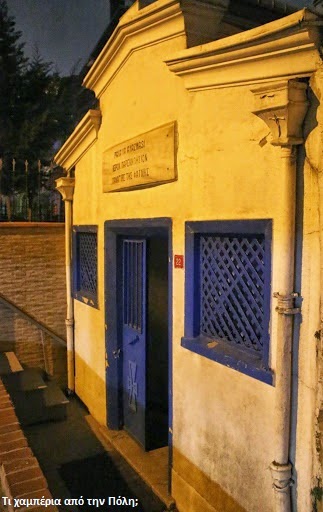
In Nichori is also a Holy Spring known as Panagia of the Stable (Panagia tis Fatni). It was once a stable of a Turkish owner. Inside was found an old Icon of the Virgin Mary and believers came for pilgrimage to the place while at the same time the domestic animals remained inside it. The inhabitants of Nichori gave the name: Panagia Achouriotissa, since the word "achouri" is of Turkish origin from the word "ahir", which means "stable".
Entering its interior, you descend a few steps to the interior of the chapel. A humble, modest and heartfelt space.
The spring has no water, and although it is placed in the category of the Holy Springs of the City, it is essentially a chapel. Over the years, the site was granted to the Roman community, maintaining its original name but also its humility. The most important renovation of the site was carried out in 1950 during the Patriarchate of Athenagoras at the expense of the locals. Patriarch Athenagoras was the one who proposed the more ornate and elegant name change to Panagia of the Stable instead of "Achouriotissa".
Nichori (or Neochori, known today as Yeniköy) is located on the European shores of the Bosphorus strait, between the neighborhoods of İstinye and Tarabya. Nichori was until the 1955 Istanbul pogrom a neighborhood with a considerable Greek (Roman) population as well as Armenian and Jewish communities. It was here behind the yali of Ahmed Afif Pasha, where Agatha Christie stayed as a guest in 1933 while writing Murder on the Orient Express. There are several Christian churches in the neighborhood. The Greek Orthodox Church of Dormition of the Theotokos (Panayia Kumariotisa Rum Ortodoks Kilisesi) was built in 1837 at the request of Sultan Mahmud II′s personal physician Stephanos Karatheodoris.
In Nichori is also a Holy Spring known as Panagia of the Stable (Panagia tis Fatni). It was once a stable of a Turkish owner. Inside was found an old Icon of the Virgin Mary and believers came for pilgrimage to the place while at the same time the domestic animals remained inside it. The inhabitants of Nichori gave the name: Panagia Achouriotissa, since the word "achouri" is of Turkish origin from the word "ahir", which means "stable".
Entering its interior, you descend a few steps to the interior of the chapel. A humble, modest and heartfelt space.
The spring has no water, and although it is placed in the category of the Holy Springs of the City, it is essentially a chapel. Over the years, the site was granted to the Roman community, maintaining its original name but also its humility. The most important renovation of the site was carried out in 1950 during the Patriarchate of Athenagoras at the expense of the locals. Patriarch Athenagoras was the one who proposed the more ornate and elegant name change to Panagia of the Stable instead of "Achouriotissa".